Keble Chatterton on the early development of racing yachts, part II

[ad name=”intheboatshed-post”]

J Russell Scott

Naval architect J Scott Russell advocated a wave approach to the problem of resistance to hulls moving through water

Here’s another scrap from Keble Chatterton’s history Fore and Aft Craft. See the previous extract here.

‘Between the years 1823 and 1844 the Royal Thames, Royal Northern, Royal Western, Royal Eastern, Royal St George’s, Royal Southern, Royal Harwich, Royal Mersey, and Royal Victoria Yacht Clubs had been established, additional, of course, to the Royal Yacht Squadron. Thus, in all parts of the country the builders and designers of the fore-and-aft craft received every incentive to create the best which materials and existing knowledge could bring about. Presently these clubs were to be added to by the instituting of many more similar organisations in almost every suitable harbour or estuary in the United Kingdom. Royal patronage had also helped, and the first royal cup was given by William IV to the Royal Yacht Squadron in the year 1834.

‘All sorts of theories had for the previous hundred years been advanced in connection with the resistance of water in the progress of a vessel, and many an attempt had been made to design such a hull as would offer the least possible resistance compatible with seaworthiness. Of these theories many were of Gallic origin. But in the ‘forties Scott Russell made very valuable contributions to this science, suggested certain theories for dealing with resistance, and advocated a wave-like system. Others have since increased this body of information by further experiments. It was during the ‘forties that designers began to realise thoroughly that the old ‘cod’s head and mackerel’s tail’ was a long way from the ideal design. So in the year 1848 there was built on the Thames a cutter named the Mosquito, which was entirely original in that she posessed a long hollow bow, and a short after body of great beam, and generally was in conformity with the lines advocated by Scott Russell. She was of 70 tons displacement, and built not of wood but of iron. However, so great was the existing blind prejudice that she was not popularly received.

‘But in the meantime the Americans had developed the schooner and improved on the pilots and fishermen until they were able to produce a schooner yacht. During the early ‘forties the yachtsmen of the United States had been engaged in racing both in sloop and schooner. In 1844 a memorable race took place between two American yachts, of which one was the 178 ton centreboard sloop Maria, which had a clipper bow, and the other was the schooner-rigged Coquette of 74 tons. The result was that the schooner won, for, thanks to the influence of the Gloucester fishermen and pilots, this type of vessel had beenĀ  brought very close to perfection considering the amount of knowledge then extant.

‘There was a man in New York of the name of George Steers, who had obtained a first-class reputation for the building of crack pilot schooners, and to him now came the commission to build a racing schooner yacht that was to cross the Atlantic on her own bottom and see what she could do in English waters against English craft… when we say that she was the famous America, after which the historic races for the America Cup have been named, the reader will not feel himself disinterested.’

More information about the history of the America’s Cup can be found in this discounted book from Amazon: The Story of The America’s Cup: 1851-2007.
Keble Chatterton on the early development of racing yachts, part I

[ad name=”intheboatshed-post”]

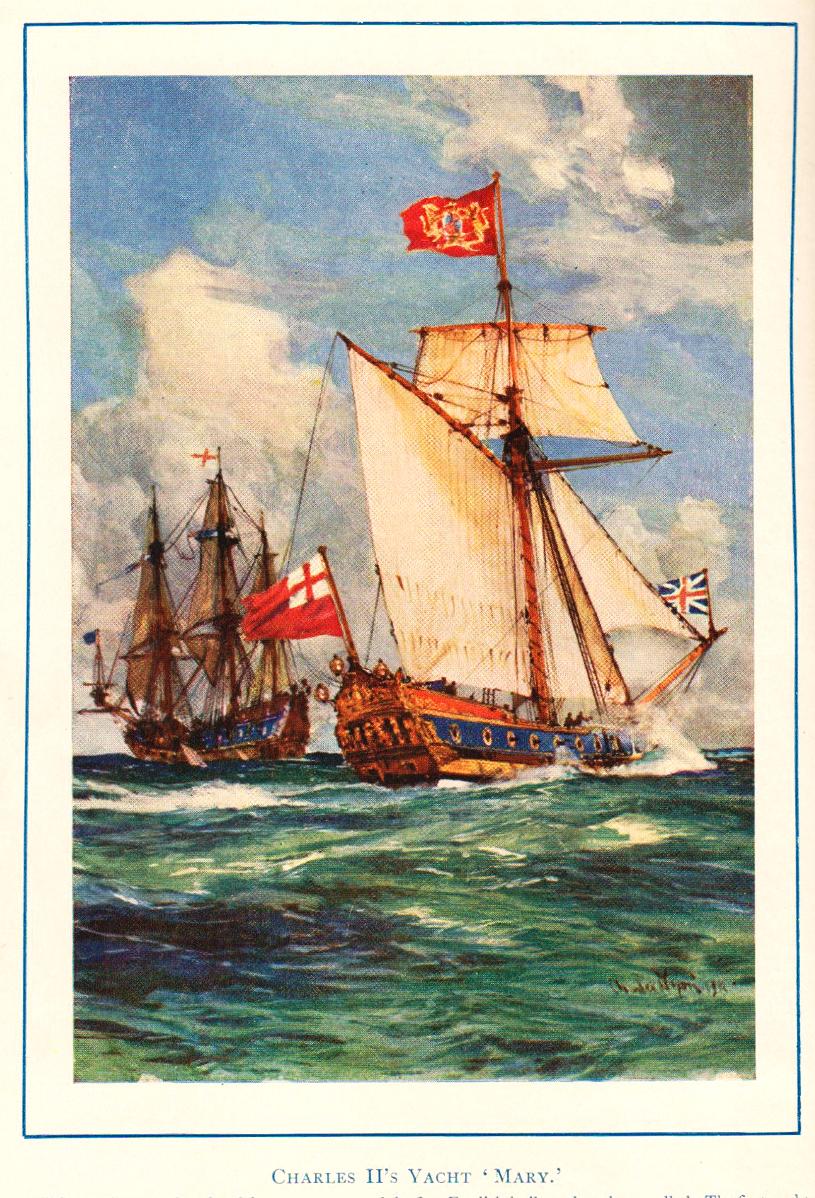
King Charles II's yacht Mary

King Charles II’s yacht Mary. Progress in the developments of yachts remained slow until after Waterloo

‘I’m still reading Keble Chatterton’s entertaining if possibly dodgy history Fore and Aft Craft, and I thought intheboatshed.net readers might be entertained by his account of yacht racing’s development during the 19th century. It comes, of course, from an early 20th century perspective.

‘Among the famous yachts of the ‘twenties must be mentioned the Pearl, the Arrow and the Alarm. These were all built as cutters. The Pearl was launched in 1820 at Wyvenhoe and was of 95 tonnes. The Arrow was 84 tonnes. She was altered and rebuilt many times since she first appeared in 1822. The Alarm, which came out in 1830, was only seven tons short of two hundred, and was one of the very largest cutters ever built. What a gybe must have been like round a mark-boat in a smart breeze we can well wonder. Her origin is not without interest, for she was designed from the lines of a celebrated smuggler that was captured off the Isle of Wight.

‘It was owing to the fact that no time allowance was granted that the development of size in yachts had gone on unchecked: otherwise such a monstrosity as the Alarm would not have appeared. Right away as far back as Charles II the English yachts had been ballasted with shot. It was suggested to Christopher Pett that stones should be used for this purpose, but he wisely declined to entertain such an idea on the ground that it took up too much room. In this respect, Pett was more ahead of his time than might appear, for the ocean-going ships had for centuries had a considerable amount of their valuable internal space taken up by gravel ballast, which left but little room for the ship’s stores.

‘In some of the early nineteenth century yachts gravel or stone blocks were still used, just as one still finds to this day in the case of some of the open fishing craft which go out from the shore to their lobster pots. After that, iron blocks were introduced, and finally a reversion to the idea of lead. Bags of shot were employed in the last century so that they could easily be moved up to windward at each tack. In 1846 lead pigs were used, and finally, ten years later, in spite of the frownings of pessimists, the lead, instead of being used as inside ballast was transferred to the keel outside.’

‘After the battle of Waterloo the sport of yachting and so the development of yacht architecture and everything connected with the yacht from ballast to running gear, received the advantage of an enthusiasm which had never previously been granted: and both immediately before and after the Crimean War this enthusiasm and interest had been increased tenfold. It was because there had been so little personal interest on the part of the owner, such scant encouragement given to the builder, such universal ignorance in regard to problems of naval design, such infrequent races for testing certain types of hull and rigs, that the progress since the introduction of the first Mary into our country had been slow.’

And then:

‘But now all this was changed. The Victorian sovreignty had brought about peace and contentment, and the effects of the great industrial revival of the previous century had already caused so much increased wealth to our countrymen that there was an unprecedented army of rich sportsmen from whose ranks to draw a large band of yachtsmen. Here then was the needful force of encouragement to builders. This was intensified by the formation of powerful yach clubs having for their object, as the preamble to almost every yacht and sailing club reads, “the improvement of yacht building and the encouragement of yacht sailing”, “giving the greatest latitude in the construction, rigging and sailing of vessels, consistent with their aptitude to yachting.’

To be continued…

Amazon has original hardback copies of an earlier edition of Keble Chatterton’s book, Fore And Aft, The Story Of The Fore & Aft Rig From The Earliest Times To The Present Day, and also scanned copies of Fore & Aft Craft and Their Story; another relevant book that looks particularly interesting in this connection is Lennarth Petersson’s book Rigging: Period Fore-And-Aft Craft, which describes the rigging of three 18th century vessels in detail – an American schooner, an English cutter and a three-masted French lugger, and includes some 200 diagrams.

The Medway by paddlesteamer

VIC 56 Medway

VIC 56, just outside Chatham Dockyard. Click on the images in this post (and most others!) for much larger photos

The weather forecast predicted strong winds and thunderstorms – so I decided against going sailing. But what to do instead? Julie and I decided to take a river trip down the Medway on the wonderful paddlesteamer Kingswear Castle, startingĀ  from Rochester Pier, just by the city’s impressive Norman castle, and these are a selection of photos from the outing.

I hope you’re seated comfortable, for there are lots of shots here – and quite a few questions. If you know the answers, please fill me in using either the Comment button below, or by emailing me at gmatkin@gmail.com.

TID 164 steam tug Medway redundant lightships houseboats medway

TID 164, VIC 56, redundant lightships on the Medway

unusual schooner - who designed and built her? Pretty motorsailer Medway paddlesteamer

The river had a lot to show us that was intriguing, to say the least. What’s the story, we wondered, behind this neat little schooner? Or the pretty and comfortable-looking motorsailer?

Sweet cutter - is she a conversion? Pretty little clinker yacht outside Medway cruising club's premises Elegant wooden yacht, apparently on the brink of going somewhere

There was this beautiful old cutter – is she a conversion? And this pretty little clinker built pocket cruiser. And what about this elegant cruiser apparently on the brink of going somewhere?

Old fashioned yacht A smack moored opposite the dockyard

Two photos of the same old-fashioned yacht, and a smack yacht moored near Upnor Castle

Sinking building in the Chatham Dockyard grounds

This old fashioned chine-hulled dayboat, very like one I’ve seen many times moored at Queenborough – I wonder whether they were made by a local builder? I’m sure generations of visitors have been intrigued by this sinking building in the grounds of Chatham Dockyard

Smacks moored and ready for a race Harvest Queen looks like a converted wooden motor fishing vessel

Old smacks stand ready for a race; Harvest Queen looks like a converted wooden motor fishing vessel

Dutch tjalk Small Thames barge Whippet

There was this pocket cruiser – I haven’t figured out to which design she was built, but will be looking her up – and this smart Dutch tjalk, and the small Thames barge Whippet

Hope of Porthleven

Hope of Porthleven, and cormorants guarding their buoys

Paddle steamer tug Mystery yacht

Steam tug John H Amos – I gather there’s hope she will be restored; a mystery yacht I’d like to know more about; one of the forts known as Palmerston’s follies

A squib returns from racing Double ended motor fishing vessel Double-ended motor fishing vessel

A Squib returns from Sunday racing; a motor fishing vessel that looks a lot like Jay Cresswell’s model of a ring-netter

Another double-ended MFV Edith May is still looking very smart following her restoration at Lower Halstow

Another very well looked-after MFV conversion, Thames barge Edith May is also looking great following her restoration

Russian submarine in the Medway conning tower Russian submaring Black Widow on the Medway

The Medway’s Cold War-era Russian sub, however, is very down-at-heel

No vessel to anchor opposite Powder magazine

You can’t moor here; and here’s why

Bella something of Dover

Finally, what’s this craft? I’ve never heard of the Bella-something of Dover, and the Internet seems to be unaware of her also. What is her future to be, I wonder?


The Medway Pilots webpage has a useful history of the River Medway.