The incomplete tale of a Norfolk racing launch

[ad name=”intheboatshed-post”]

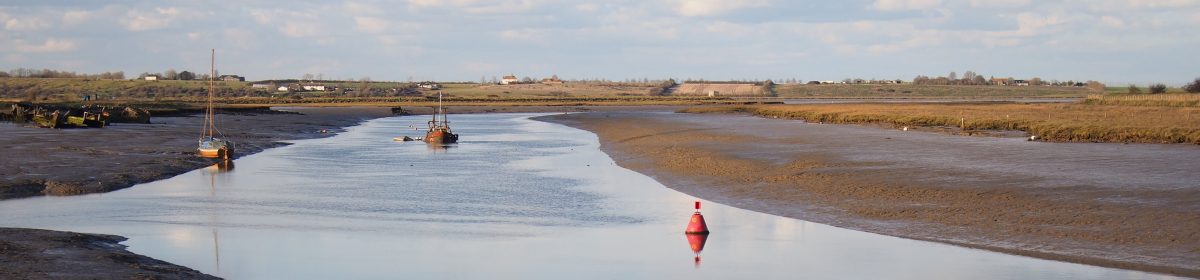
Rocinante at Reedham

Keith Johnston has kindly written in with some photos and the story of a boat that’s often moored at Reedham on the Norfolk Broads. It’s an intriguing boat that looks like a Thames slipper launch, but which nevertheless has a completely different background. I’ll let Keith tell the story:

We were approaching Reedham on the Norfolk Broads when I noticed a boat which looked rather like a slipper launch and, as I had just finished building one, I decided to make enquiries because this appeared to be a boat out of its normal habitat.

There are two boat yards at Reedham so it didn’t take a lot of searching to find the background to this good looking vessel. I found Steve Sanderson at Hall’s Old Boatyard and he was kind enough to tell me the story of this particular boat.

Rocinante as her reincarnation is called, is not a slipper launch at all but a 23ft Norfolk racing launch, the original of which Steve found on a Yarmouth demolition site in an extreme state of dereliction – and about to be burnt.

However, being a proper wooden boat enthusiast he decided that the boat should be restored or at least saved. He brought the remains to his boatyard in Reedham and he began talking to his friends and neighbours about the boat in general.

On the way back to Wroxham I found the other hull, now fully fitted and moored in Horning. From the river and with a cover on she looks virtually identical to Rocinante – however, I am told that she has been fitted with an American marine diesel engine of 4.8 litres, which should put this launch very definitely back in the racing category!

I did some research and found that launch racing started on Thursday 23rd August 1903; the inaugural race was during Oulton Broad Sailing Regatta Week that year organised by the Royal Norfolk and Suffolk Yacht Club under the auspices of the Norfolk Automobile and Launch Club. Six boats competed in a single heat, and the race was won by a steam launch named Monarch – but by 1910 there were big changes. There’s an interesting club history on the website http://www.lobmbc.co.uk.

For more on this no much more complete story, click here.

Will Stirling draws boatbuilding plans for a gentleman’s cutter of 1880

[ad name=”intheboatshed-post”]

Gentleman’s cutter Integrity in the style of an 1880 cruiser-racer, beautifully drawn by Will Stirling. Click on the thumbnails for a bigger image

Here’s a lovely piece of work: a set of drawings by Will Stirling for a forthcoming project to be built by Stirling & Son.  She’s a 43ft gentleman’s cutter of the period around 1880 drawn with careful reference to craft of that era including Nicholson’s Marigold, Beavor-Webb’s Partridge, GLWatson’s Vanduara, Dixon Kemp’s Zoraida and Fife’s Bloodhound. A cruising-racer, she can set 2,000 square feet of canvas in fine weather, yet Will says she will snug down to trysail and storm jib in poor conditions.

Click on the thumbnails above to see the lines and boatbuilding details more clearly. As you do, it’s worth reflecting that thay have been created without the aid of computer-aided drafting software – Will completed the whole drafting job the traditional and laborious way using ships curves and calculations. I have no doubt that her carvel-built wooden hull will be equally historically accurate from stem to stern.

Many thanks for this Will! I think Integrity is bound to attract some serious attention over the coming months, and I’m delighted to be able to give the boating world this preview.

Contact Will at http://www.stirlingandson.co.uk, tel 01822 614 259.

More on the last Portuguese fishing schooners

[ad name=”intheboatshed-post”]

Brites, built in 1936 crossing the Atlantic in the 1960s – her wooden dories clearly visible on deck

(Above, left )Adelia Maria, (above, right) Coimbra, both of which were built in 1948

Novos Mares

Following his tip-off about the stunning Lonely Men of the Dories Youtube videos Jay Cresswell has sent through some old photos of the last of the sailing Grand Bankers of Portugal from his personal collection.

The Lonely Men of the Dories footage shows the crews of the Portuguese Grand Banker schooners using the small wooden boats called dories for long-lining cod.

Luisa Ribau was the last sailing Grand Banker to be built, and was launched in 1953 and destroyed on the Grand Banks by fire in 1973.

A number of large Grands Banks schooners were built by the Portuguese after World War II, notably the four-masters Adelia Maria and Coimbra in 1948.

Collectively known as the White Fleet, the last departure of the schooners from St John’s in Newfoundland was the wood-built lugre named Novos Mares in July 1974. So ended the last significant chapter of trans-Atlantic commercial sail, an aspect that Jay remarks seems to be barely known about here in the UK, and which seems to have been missed by famous maritime historian Basil Greenhill when he was writing wrote his 1980 book Schooners, which was published by Batsford – although he did include the Canadian Bankers at the very end of the dory-schooner fishery on the Banks, and enjoyed rowing a dory on near his home towards the end of his life.

Perhaps he hadn’t heard about the Portuguese – the world was a bigger place in those days, and I suppose it’s a reminder that historians, like journalists and everyone else, can miss important points from time to time. What I find striking is the discovery that these large sailing fishing craft were working so late into the 20th century. When I grew up I remember everyone said that the days of large sailing craft were long over outside of sail training ships – but everyone was clearly wrong.