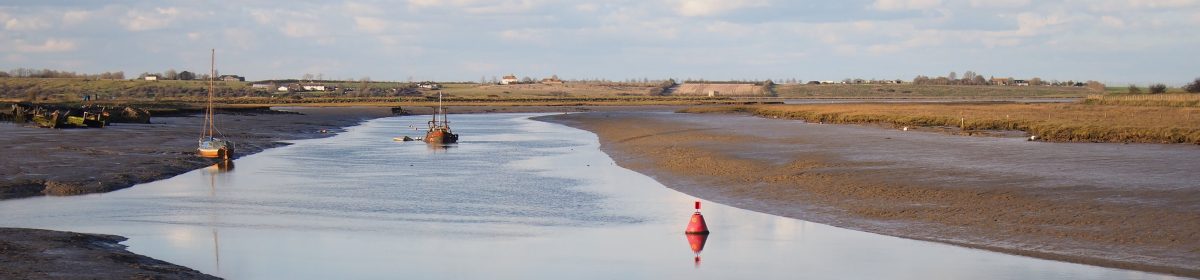
Faversham Creek consultation – have your say by the 24th June

Standard Quay

Faversham Creek urgently needs our help once again.

Readers will remember that a little while ago I appealed to readers to sign a petition calling for action to save Standard Quay as a working boatyard and to retain the business and skills already in place.

Many of those businesses will have moved out by the end of this month, but efforts to protect and improve the Creek are continuing.

This time the threat is a consultant’s report to Swale Borough Council that proposes abandoning important measures that would help maintain the creek as a navigable waterway and would open the door to developers to build more lucrative housing, restaurants and so on.

Known as the Fullwood Report, these proposals are now open for consultation – which means those of us who disagree with its proposals for the area have until the 24th June to tell planners what we think.

Everyone who reads the report will have different views on what’s wrong with it – for example, you might take a moment to check out the Faversham Creek Consortium view, and those of the traditional craftsmen and women that have now been forced to leave Standard Quay.

While no-one wants the Creek to become a sad unusable ditch, Fullwood seems to have taken the view that developers should be allowed to do their worst because local authorities cannot afford to get involved with expensive projects.

Not everyone agrees with this approach, not least because the Creek has much to offer in terms of both tourism and  maritime industry. There are other reasons for optimism also: the Faversham Creek Trust’s campaigners say that ‘just because the Council do not have the funds, does not mean that it cannot be done. This is where not-for-profit organisations such as the Trust, volunteers and the wider society take over’.

Let’s be specific about some of the key points.

Fullwood is weak on the important area at the top of the creek, including the crucially important swing bridge that could allow vessels to use the upper part of the creek, and the sluice, which should be reinstated for its purpose of washing silt down the channel to keep it navigable.

It fails to deal properly with the issue of access to the creek – in some areas in Faversham itself, developers have been allowed to re-route established footpaths away from the creek and to eliminate wharf areas where vessels can moor. This kind of thing must be prevented in future, and where possible footways and mooring facilities must be reinstated.

The report also proposes re-designating areas subject to flooding so that housing can be built upon them if certain criteria are met – for example flats might be built above ground floor business premises. There seems to be some debate about whether Faversham is in need of more housing, but if it is this probably isn’t the right way to provide it. If anyone would like to know how unpopular a council can become when housing projects are allowed and are then affected by suffer flooding, I suggest they ask the people of Lewes.

Yet another problem is that the banks of the creek include some important old buildings – the Hasarde building dating back to the 15th century was used for trading and is now the home of a corps of Sea Cadets, while at Standard Quay there is a magnificent 17th century granary that is currently subdivided for the use of a variety of businesses offering antiques, bric-a-brac, a small garden centre and teas.

The Fullwood Report is available online; please send your comments to Natalie Earl at ldf@swale.gov.uk by the 24th.

Also on the subject of Faversham Creek, I’d like to add that a one-hour version of independent film-maker Richard Fleury’s beautifully shot film The Quay is now available online.

Songs: Maggie May and The Smacksman

It’s about time for a song, I think – so here are two for good measure. The first, Maggie May, is often thought of as terribly bawdy, but really it’s just a warning song, like so many songs that were popular in the past.

The second is sometimes called The Smacksman and sometimes the Trawler Song. Either way, it’s a great chorus number that I have very much in mind if I get into ‘the good singing room’ at this year’s English Country Music Weekend at the historic Essex fishing port of Brightlingsea (do take a look at the programme – ‘country’ here generally means old fashioned English rural music, not something manufactured in Nashville) and for the Nordhorn canal festival being organised by regular contributor Hans-Christian Rieck and colleagues.

Hans-Christian Rieck
Hi Gavin, what about this chap and his accordion he bought or not bought in G…
1:07 PM (6 hours ago)

Students at the Boat Building Academy race to complete boat building projects

1 james higson paul gartside clinker dinghy boat building academy 1503113 2 Hannah Jenkins Polynesian canoe 3 fiona molloy tammie norrie boat building academy 1503112

Paul Gartside dinghy, Polynesian canoe, Tammie Norrie

4 uli killer spitzl boat building academy 130511 5 martin nott half rater sibbick boat building academy 1503112 6 Ollie Rees Barnacle 10ft clinker dinghy

Spitzl rowing boat, half-rater, 10ft dinghy

7 tom sargison cayman catboat boat building academy 1305113 8 sean quail - yachting world dayboat boat building academy 1503112 9 Chris Smith selway fisher canoe 7

Caymans catboat, Yachting World Dayboat, Selway Fisher canoe

10 wee rob canoe Matt Cowlbeck 11 gary thompson haven joel white boat building academy 1503113

Wee Rob canoe, Haven 12 1/2

Students and tutors at the Boat Building Academy are to launch a record twelve boat building projects by the September 2010 group on June 7th.

The event details are available here and the BBA folks would like to invite everyone to join us in the celebrations.

With 18 days to go, principal Yvonne Green says the workshops have never been busier – every spare inch of space seems to be occupied by a boat or a bit of a boat. On main instructor Justin Adkin’s weekly boat round on Friday morning Justin was quietly confident that every boat could be completed on time – but he did mention midnight oil on a couple of occasions…

Yvonne adds that while the students (and staff) will probably be shattered by launch day, the boats will be glorious.

‘The boats will be lined up outside the Academy before being walked down to the harbour on the morning of 7th,’ explains Yvonne. ‘Anyone who wants to join us walking them down is very welcome.

‘We’re then off to Beale on Thursday 9th and Art in Action on 23rd July. It’s going to be a busy summer.’

Here’s a quick preview of what will be going into the water, the links lead to each boat’s build diary:

They include:

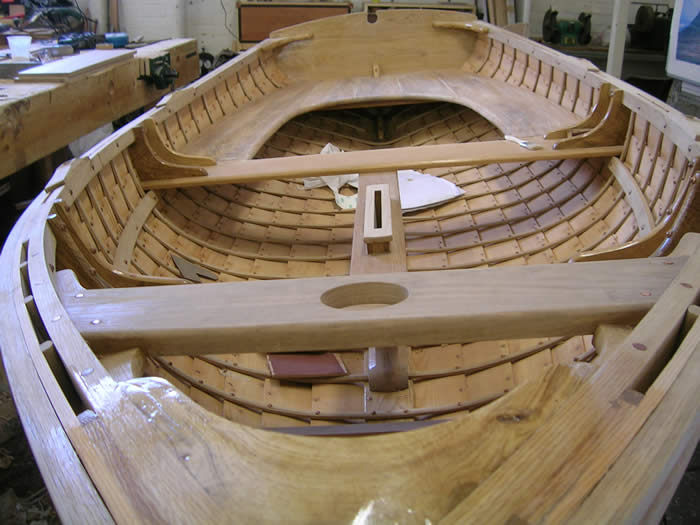
  • Paul Gartside-designed 12ft traditional clinker dinghy, built in larch and oak with a grown stem and knees. This boat will also be at the Art in Action exhibition, where it has been entered into the Best of the Best category
  • Polynesian outrigger sailing canoe, 16ft long with a cold moulded hull and glass and foam outrigger
  • Spitzl classic German 4.4m lake rowing boat, built traditionally in clinker mahogany on oak. Her main builder, Uli Killer was still up at 7am one morning, and even then just kept oiling until by the end of the day she had 30 coats.
  • Iain Oughtred Tammie Norrie, glued ply and epoxy, with fifteen coats of oil.
  • Diamond Half Rater originally designed by Charles Sibbick in 1897 6.5m long, it is a replica created on the lofting room floor from photographs, a couple of similar lines plans and the only other existing replica Half Rater from another (American) designer that is owned by Rees Martin, a great friend of the Academy. Her hull has a cedar core with laminated outer and inner skins – the the inner skin was resin-infused
  • Yachting World Dayboat with spruce planking, mahogany backbone and oak timbers. She’s identical to a boat built by Lachlan MacKenzie and the class of September 2009
  • Traditional clinker dinghy built from lines taken from a boat restored at the school by short courses, planked in mahogany
  • 14ft Cayman islands catboat of carvel construction, planked in cedar Mexicana. She has a typical Caribbean hull shape used for fishing and racing. She will be going to the Caymans after the launch. All frames laminated in epoxy were baked i.e. post-cured to ensure maximum strength from the glue which then won’t be affected by the Caribbean hea.
  • Strip planked sailing canoe designed by Selway Fisher, 14ft, with a cedar core with laminated outer and inner skin, of which the inner skin was resin-infused
  • Iain Oughtred Wee Rob canoe in glued clinker ply, with simple fit-out with the paddler sitting on the floor boards
  • Joel White Haven 12½ made in epoxy glass and foam with traditional fit-out, oak-laid deck and rig
  • Fit-out of GRP rowing boat, CSM lay-up designed by instructor Justin Adkin from the sliced bread mould admired by David Johnson of Wessex resins some time ago – click here

It sounds like a great day in the making. I can’t be there for boring work reasons. So if anyone could send me some shots at gmatkin@gmail.com, I’d be most grateful!