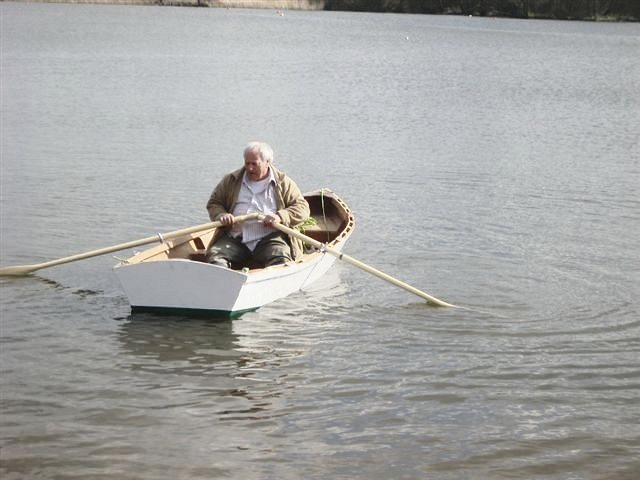
Norman Fuller launches his Ella plywood skiff built to free plans – and it’s a success!


free boat plans, boat plans, plywood boat, plans, skiff plans, ella skiff, gavin atkin, stitch and glue, tack and tape, wroxham broad, norman fuller

free boat plans, boat plans, plywood boat, plans, skiff plans, ella skiff, gavin atkin, stitch and glue, tack and tape, wroxham broad, norman fuller free boat plans, boat plans, plywood boat, plans, skiff plans, ella skiff, gavin atkin, stitch and glue, tack and tape, wroxham broad, norman fuller

Norman Fuller has launched his Ella skiff built using free boat plans from this website – and has pronounced it a success.

He launched the boat on Wroxham Broad, not far from his home in Norwich. Here’s what he had to say about the project when he emailed me late last evening:

‘Hi Gavin, after a slow start I finally got under way, having not been on the water for many many years.

‘Once I sorted the collars on the oars, worked out where they needed to fit and then nailed them in place, the Ella skiff performed very well. As you see I left the forward hatch open because thats where I kept the nails and hammer.

‘The boat’s very easy to handle and I think the skeg was doing it’s job, as I found I could row in a straight line, which could be some sort of indication the bottom is not skidding.

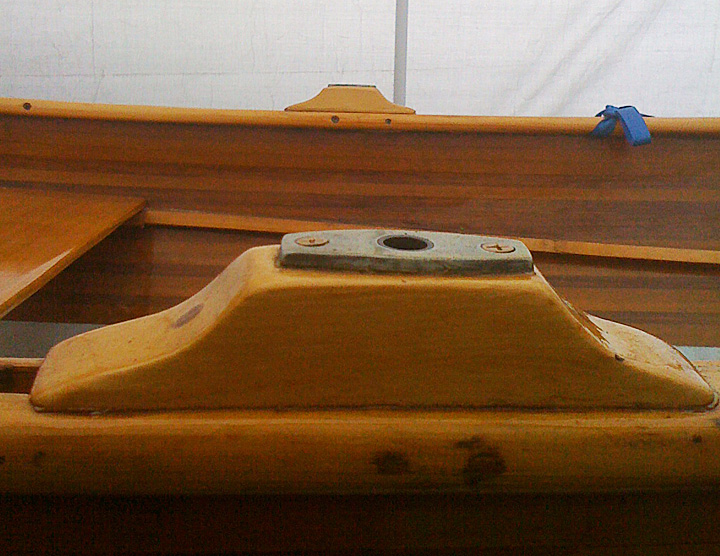
‘Only one was a little bit awkward, and that is the angle of the rowlock’s. I set them in the gapped inwale following the line of the side of the boat, but they need to be more upright, so I think I will change them. My friend Jenny was so proud of what I had done she took me for a carvery, not bad eh?

‘Till next time!

‘Norman’

From the pictures, I think the problem you had with the rowlocks is that they could be higher – the choice is between lowering the thwart and raising the rowlocks, or both.

I’d start by screwing a 4-6in by 1 1/2in by 1 1/2in block with chamfered ends onto the gunwale for the rowlock to fit into. It’s easy to do, you see it done very often, and when the block wears you can replace it. Small people and kids won’t need them, but I should add these blocks to the plans. Here’s an example of how it would work; and here’s another from intheboatshed.net reader David Luckhardt.

The Ella skiff is a lightweight general purpose stitch and glue flattie skiff for use in sheltered waters. She’s 12ft long overall by 4ft beam, by 400lbs displacement, and is designed for stitch and glue construction using 1/4in or 3/8in 4ft by 8ft plywood. It is meant to be a simple and quick stitch and glue building job of a size that is convenient for building in domestic garages made to take a small to medium-sized car – which probably describes the building area available to most people. For more on this boat and the plans, click here.

Is it a Humber yawl? A Thames canoe yawl? Restoration begins with detective work

[ad name=”intheboatshed-post”]

canoe yawl, humber yawl, restoration, wood boat, clinker, yawl, Turk's

canoe yawl, humber yawl, restoration, wood boat, clinker, yawl, Turk's canoe yawl, humber yawl, restoration, wood boat, clinker, yawl, Turk's canoe yawl, humber yawl, restoration, wood boat, clinker, yawl, Turk's

The mystery canoe yawl. Does anyone have any clues as to what this
particular boat would have looked like when launched? And what’s the
meaning of the enamel plate showing a paddle?

One of the interesting items that turned up at the Turk’s Boatyard sale wasn’t actually in the on-line auction – an old canoe yawl spotted by our good friend Steve Taylor.

The Turk’s yard folks quickly accepted his offer, and so last week he trailered the old boat home to begin the first stage of any restoration: trying to work out what the boat must have been like before age and botched modifications and repairs brought it to its current condition. This boat has certainly had it’s share of odd, badly executed changes, though the original workmanship seems to be quite fine and the materials certainly seem to have been expensive.

The boat’s 18ft in length, and came with some stories attached to it. These had it that the boat was originally made by Turk’s, that it was made for William Baden Powell, that it was depicted in Dixon Kemp and that it had been brought to the yard many years ago by a pair of elderly ladies who intended that it should be restored by the yard, though the project never went ahead.

Having looked at my copy of the book, I don’t think we’re convinced by the Dixon Kemp link, but I suppose she could have been built by Turk’s to a set of plans that might have been associated with the Humber. Does anyone have any information that would help Steve towards working out the details of his restoration please? If you do, please email me at gmatkin@gmail.com and I’ll pass it on.

Stand by for the May/June issue of Water Craft magazine due in a few days

[ad name=”intheboatshed-post”]

water craft, magazine, pete greenfield, boatbuilding, methods, techniques, wooden boats, plywood boats, boat plans, articles, photos

The May/June issue of Water Craft magazine is about to come out, and editor Peter Greenfield has sent us his customary preview. Here’s what he says:

‘April, moaned Mr Eliot, is the cruellest month. Obviously, he also had suffered the seemingly interminable wait for the weather to warm up enough for varnishing the gunwale. What to do while you’re waiting? Well, the new Water Craft is out on the 22nd, with…

Two French connections: last year, Tim O’Connor loaded his elegant Oughtred Acorn on the car roofrack, hitched up the caravan and went sailing the lakes of Limousin. And much more recently, in March in fact, Kathy Mansfield caught the Eurostar for a long-planned visit to the amateur boatbuilders of Nautique Sevres, near Paris.

Back in Dorset, professional wooden boatbuilder Gail McGarva builds Cornish pilot gigs and in the first of a two-part series, she explains not only how but why. However, If a 32ft (9.8m) clinker rowing skiff is a tad too ambitious for you, see Paul Gartside’s complete plans for a 12’ (3.7m) outboard skiff. Clinker too challenging? Build the hard-chine flat-bottom pocket cruiser called the Stevenson Weekender, like Jeremy White. Or you could go to boatbuilding college, like Lars Herfeldt from Berlin who learned to build a Petersson Runabout at Lyme Regis.

Still too wintry? Time to read designer Andrew Wolstenholme’s report from Dusseldorf on the latest in electric propulsion… And designer Paul Fisher’s description of his new Felix electric launch… And designer Matt Newland’s introduction to the Bayraider 17, which he hopes to exhibit at the Beale Park Boat Show, 4-6 June. Where you’ll also find Water Craft, together with a St Ayles Skiff – see W79 – and one of Gail’s gigs.

Finally, it must be warm enough now! Time for a varnishing workshop with master boatbuilder Colin Henwood…

It’s particularly good to see the Home Built Boat Rally group’s Tim O’Connor getting a mention, and also Lars Herfeldt – see photos of the the launch of his handsome gentleman’s runabout here.

You will be able to find the May/June 2010 issue in good UK newsagents from the 22nd April – this website will find you a newsagent stocking the magazine. Alternatively, buy a subscription here and support both Water Craft and intheboatshed.net at the same time.