Ben Wales’ clinker launch restoration

Ben Wales working on 18ft clinker launch Mary

Ben Wales working on 18ft clinker launch Mary

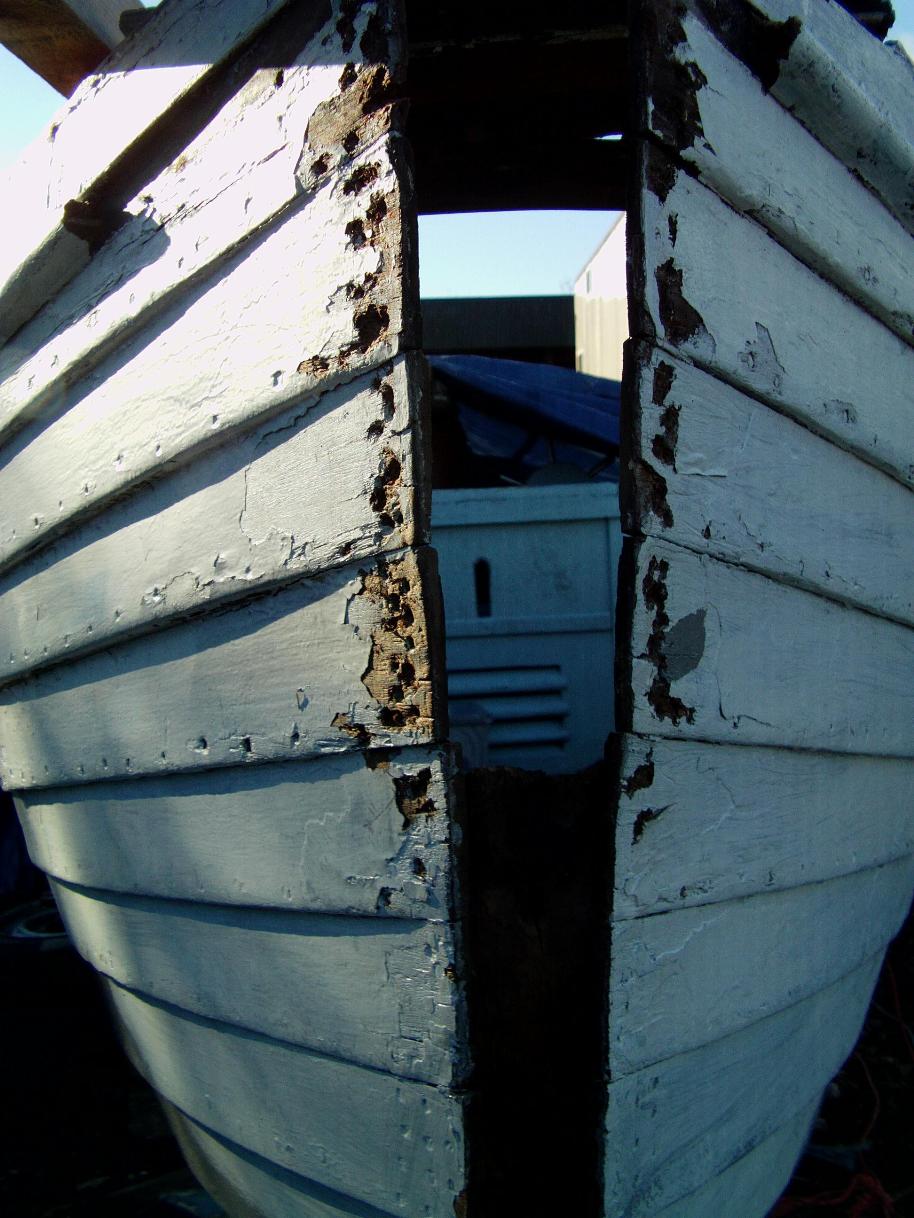
The new stem, and the old stem piece and apron removed

Some time when you’re sitting in the warm, spare a thought for dedicated Ben Wales working when he can in the open air during this winter restoring his 18ft clinker-built motor launch Mary. While you’re at it, wish him luck and good weather.

Here’s what he wrote a few days ago:

‘Here is the latest update on my restoration on Mary. The work has been slow – the weather held us up for over a month as it was just too cold, and before that it was wet whenever we wanted to work on her outside.

‘The stem has now been replaced in English grown oak as the old one was badly worn and soft. Without a doubt this is the most complex and time consuming job we have done on the launch, and all without  power tools or power.

‘First, a template had to be cut out for the bottom and top stem piece and then drawn out on a new in 4in thick oak plank where the two were cut out.

‘The lower part of the stem, which joins with the kee, was first shaped to fit and then holes were drilled out for stainless steel bolts made the job. It had to be scarphed on each end, and a mixture of paint and putty was applied for packing.

‘The top part of the apron was also replaced and that was cut and shaped before the top stem piece was fitted.

‘While the upper part of the stem was fitted we had a quite a task to shape it, as we tried to follow the original patten precisely – but found that had been cut wrong. So after more shaping it fitted far better than the original it replaced.

‘The next task is to fit the gunwales and knees, and to reframe the topsides. When the Weather gets warmer and I have saved up some money, I will purchase the timber to plank her topsides.

‘Ben’

Thanks Ben – I’ll be thinking of you at least!

For an earlier post about this project, click here.

Steel-hulled schooner for sale, lying at Standard Quay, Faversham

Schooner for sale

Schooner for sale

A pal and I dropped by Standard Quay at Faversham to see if we could spot a little lugger that we’d heard a friend is considering buying, so I took the opportunity to bag some photos of how things are there now. I’m sorry if you feel they’re not up to my usual standard – on arrival I discovered the battery of my usual camera was flat and so had to use my mobile phone, which seems to produce quite blue-grey images. I must get a spare.

Anyway, if you’re in the market for a steel-hulled schooner liveaboard, the one currently for sale at Standard Quay may be just what you’re looking for. It looked in pretty good shape to us, though neither of us has ever seen it sailing. The schooner’s pictured above.

Lady of the Lea Thames sailing barge Lady of the Lea Thames sailing barge Cambria being renovated

Roxane at Faversham Thames sailing barge Cambria being renovated

On a more cheerful note, the first two shots above are of the lovely small Thames sailing barge Lady of the Lea, two shots of Bob Roberts’ old sailing barge Cambria in restoration and a nice little Roxane that lives on the creek here.

And below is the bow of another Thames sailing barge Lady Daphne, here in a dry dock being repaired after a racing accident (I believe) and the yuppie flats that have already encroached the area opposite Standard Quay. The blue banner reads ‘Save Standard Quay’. For more on the Standard Quay campaign, click here.

Lady Daphne, Save Standard Quay banner

Lady Daphne, Save Standard Quay banner

Great finds discovered and restored: two Macgregor canoes and a Salter’s rowing gig

Macgregor canoe

Salter's skiff before restoration by Adrian Morgan Salter's skiff restored by Adrian Morgan

Adrian Morgan wrote a couple of weeks ago to remind me of some treasures that I might have missed. He’s right, I need to make amends – though in my defence nobody mentioned them to me at the time!

(Note to traditional boat builders: please tell me what you’re doing, as this website gets seen by a lot of people!)

One important find was two rare and very beautiful MacGregor canoe found in the Marquess of Aberdeen’s sawmill loft a year or so ago – Macgregors are very rare and Adrian says the canoes came with full documentation. Adrian says the canoes were like Bugattis found in a barn: complete with chicken poo and swadust, they had been untouched for nearly 100 years.

Naturally, the Royal Canoe Club were over the moon and the canoes have since been restored by Colin Henwood.

There’s more about Macgregor here and here.

Another discovery at the same site was a half-rigged rowing gig made by Salter’s, which Adrian went on to restore – there’s more about this boat at Adrian’s website, but he says the colour of the Brazilian mahogany that appeared after weeks of stripping the gig was amazing. After treating the splits, liberal doses of Varnol brought the timber back from dry lifelessness to rich, deep colour.

Traditional boat builder Adrian Morgan is based at Ullapool and has a website at www.viking-boats.com and a weblog at www.thetroublewitholdboats.blogspot.com. The weblog is certainly interesting: recent posts argue for working with your hands rather than a mouse; praise the Jumbo, the Solent and the work of  Fair Isle boat builder Ian Best; and appeal for plans for longish gun punts.

PS – I’m reminded that informative notes on the Rob Roy canoe are included in Macgregor’s book The Rob Roy on the Baltic, which is available from Dixon-Price Publishing. There’s also some material in the book Practical Boat Building For Amateurs.