Does anyone know the story of the racing yacht Mayhi?

Mayhi lines - note that this is foreshortened due to the angle from which it was shot
Mayhi lines – note that this is foreshortened due to the angle from which it was shot

Shipwright Simon Grillet is appealing for  for information about the history of the sliding gunter-rigged centreboard sloop Mayhi, the racing yacht to be used as the template for building a new vessel by apprentices on the Faversham Creek Trust’s new scheme starting in August this year.

She is believed to have been built at Ramsgate in 1908, but I gather that it is the period before the Great War that is least known. I’m curious myself about how her form was arrived at and what the references might  have been. If you can help at all, please write to gmatkin@gmail.com, and I’ll pass the information on the Simon.

Mayhi is 27ft by 8ft with a draft of 5ft 3in with her keel down and 2ft 3in  with her keel up. Her saucer shape (seen in the foreshortened photos above) is said to make her very stable, and her sail balance when close-hauled is reported to be excellent, with only slight weather helm.

The Dutch open Veenvaart – a canal route for pleasure boats and leisure activities

Veenvaart 2 Veenvaart 1

Jantje on the Veenvaart canal system

Last weekend see the opening of the Veenvaart, a new canal complex in Holland for use by pleasure boats that includes an important new section built for the purpose.

I think it’s an important example of what can be achieved when vision, imagination and enthusiasm are brought to bear, and frequent Intheboatshed contributor Hans-Christian Riecke has written to tell us about it.

The revitalised canal system is situated between the villages of Ter Apel and Erica in the Dutch province of Drenthe – you can read about the new canal at http://veenvaart.nl if you can manage the Dutch language – but many of us will find the English language brochure helpful.

It took just five years to plan an dig the waterway. Originally the plan was to reactivate the old Scholtenskanaal, but this was not possible because of a new motorway – so project manager Wim Paas and colleagues decided instead to reopen parts of the Osterdiep Canal, dig a new canal to connect it with the Scholtenskanaal, reopen parts of this as well and call the whole thing Veenvaart. The name means ‘bog way’, and the canal route is so named because it cuts through old swamps and bogs in north west Europe.

The idea of the canal is to provide a recreational experience that extends beyond boating: there are foothpaths and cycleways, campsites and pubs, and one stretch of the canal passes through the Veenpark open air museum.

Intheboatshed contributor Hans-Christian Riecke described it this way: ‘It is a fantastic experience. The Graf Ship Association’s sailing barge Jantje was one of the stars of the opening, as it was the second boat passing through the canal and the new locks.’

‘We had a lot of guests on board and meet a lot of great people. There was brilliant sunshine and the inhabitants of the area were celebrating wholeheartedly.’

Graf Ship campaigns to open the canals in North-Western Germany for leisure and other purposes.

The latest issue of the wonderful The Marine Quarterly and two books: Mike Smylie’s Traditional Fishing Boats of Europe and an account of cruising in canoes in the 19th Century

flyer-big

Novelist Sam Llewellyn’s other project, the unfailingly beautifully edited The Marine Quarterly,  continues to impress, and I’m enjoying the new edition as much as I have each of the previous nine editions. I say it’s essential reading, and that a full set – if one could keep them together – would be an asset when waiting for the tide.

This issue includes an illuminating history of pilots and piloting by Tom Cunliffe, Ken Duxbury’s account of visiting his first Greek island aboard his Drascombe Lugger Lugworm,   and an introduction to the story of pier-head painting by artist and illustrator Claudia Myatt.

In fact, if anything it gives me even greater pleasure because it includes a piece from Ben Crawshaw. Ben, as regular readers may remember, built one of my small boat designs, the Light Trow, and his book Catalan Castaway recounts his remarkable adventures. (See the ad at the top right of this weblog.)
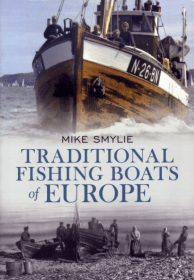
Mike Smylie Traditional Fishing Boats of Europe

I’m also just beginning to read Mike Smylie’s latest book, Traditional Fishing Boats of Europe, which aims to tell the story of how the various types of fishing boats evolved over hundreds of years in line with the catches they were built to chase, the seas and climates in which they must work, and of course the cultural influences involved.

It’s a complicated story and clearly an important project, and I’ll be fascinated to find out just how he can cram all of that information between two covers! No doubt he can, though, because he’s done this kind of thing before and knows what he’s doing…

Those Magnificent Men in Their Roy-Roy Canoes

Jim Parnell’s Those Magnificent Men in Their Roy-Roy Canoes is clearly a must for  anyone interested in the remarkable story of sailing in these little boats.

It’s really a historical record of the adventures of the three New Zealand canoeing Park brothers, George, William  and James, who were active in the late 19th and early 20th Century, and includes material from their logs and from newspaper cuttings, and is written very much in the quite formal, slightly detached style of that era.

Still, the adventures they describe are quite something, and include crossing South Island (including a long portage, naturally) and crossing Cook Strait on a night with no moon. I needn’t mention how dangerous the Southern Ocean can be – but the Parks, particularly George Park, seem to have been indomitable.
