[ad name=”intheboatshed-post”]

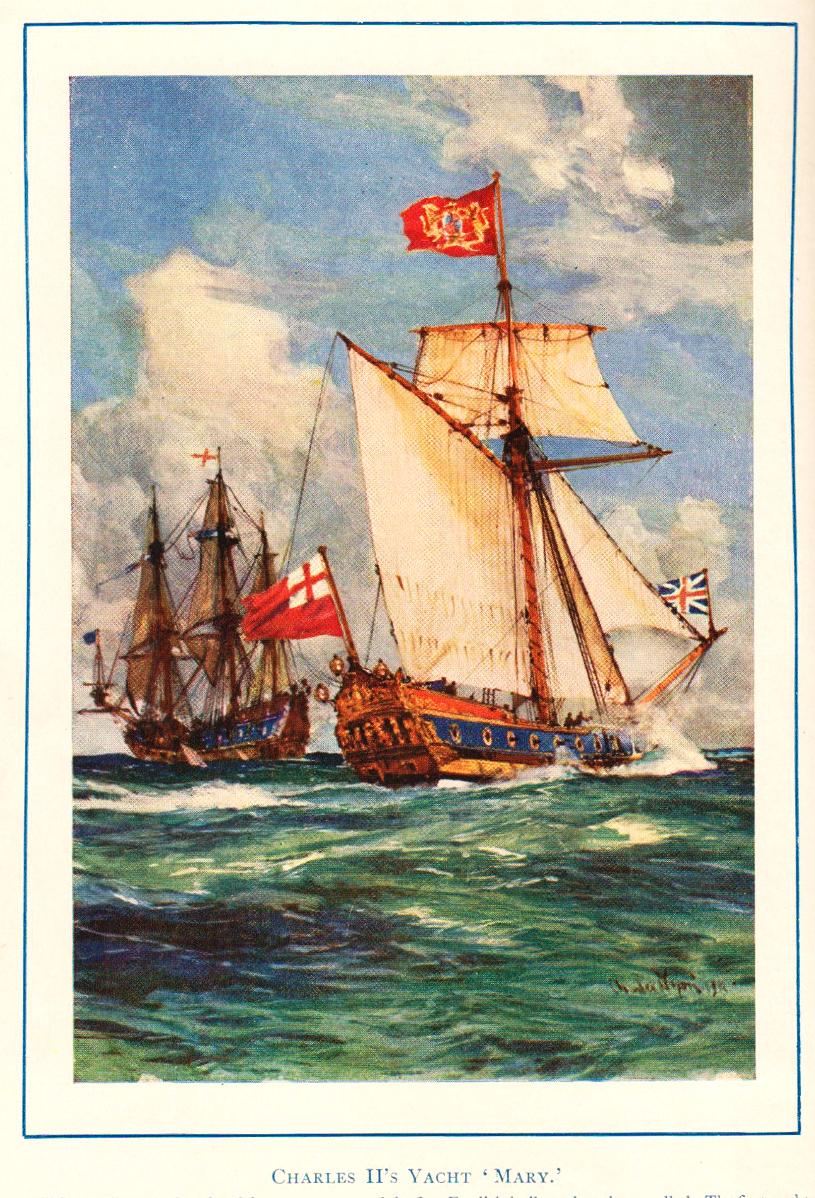
King Charles II’s yacht Mary. Progress in the developments of yachts remained slow until after Waterloo
‘I’m still reading Keble Chatterton’s entertaining if possibly dodgy history Fore and Aft Craft, and I thought intheboatshed.net readers might be entertained by his account of yacht racing’s development during the 19th century. It comes, of course, from an early 20th century perspective.
‘Among the famous yachts of the ‘twenties must be mentioned the Pearl, the Arrow and the Alarm. These were all built as cutters. The Pearl was launched in 1820 at Wyvenhoe and was of 95 tonnes. The Arrow was 84 tonnes. She was altered and rebuilt many times since she first appeared in 1822. The Alarm, which came out in 1830, was only seven tons short of two hundred, and was one of the very largest cutters ever built. What a gybe must have been like round a mark-boat in a smart breeze we can well wonder. Her origin is not without interest, for she was designed from the lines of a celebrated smuggler that was captured off the Isle of Wight.
‘It was owing to the fact that no time allowance was granted that the development of size in yachts had gone on unchecked: otherwise such a monstrosity as the Alarm would not have appeared. Right away as far back as Charles II the English yachts had been ballasted with shot. It was suggested to Christopher Pett that stones should be used for this purpose, but he wisely declined to entertain such an idea on the ground that it took up too much room. In this respect, Pett was more ahead of his time than might appear, for the ocean-going ships had for centuries had a considerable amount of their valuable internal space taken up by gravel ballast, which left but little room for the ship’s stores.
‘In some of the early nineteenth century yachts gravel or stone blocks were still used, just as one still finds to this day in the case of some of the open fishing craft which go out from the shore to their lobster pots. After that, iron blocks were introduced, and finally a reversion to the idea of lead. Bags of shot were employed in the last century so that they could easily be moved up to windward at each tack. In 1846 lead pigs were used, and finally, ten years later, in spite of the frownings of pessimists, the lead, instead of being used as inside ballast was transferred to the keel outside.’
‘After the battle of Waterloo the sport of yachting and so the development of yacht architecture and everything connected with the yacht from ballast to running gear, received the advantage of an enthusiasm which had never previously been granted: and both immediately before and after the Crimean War this enthusiasm and interest had been increased tenfold. It was because there had been so little personal interest on the part of the owner, such scant encouragement given to the builder, such universal ignorance in regard to problems of naval design, such infrequent races for testing certain types of hull and rigs, that the progress since the introduction of the first Mary into our country had been slow.’
And then:
‘But now all this was changed. The Victorian sovreignty had brought about peace and contentment, and the effects of the great industrial revival of the previous century had already caused so much increased wealth to our countrymen that there was an unprecedented army of rich sportsmen from whose ranks to draw a large band of yachtsmen. Here then was the needful force of encouragement to builders. This was intensified by the formation of powerful yach clubs having for their object, as the preamble to almost every yacht and sailing club reads, “the improvement of yacht building and the encouragement of yacht sailing”, “giving the greatest latitude in the construction, rigging and sailing of vessels, consistent with their aptitude to yachting.’
To be continued…
Amazon has original hardback copies of an earlier edition of Keble Chatterton’s book, Fore And Aft, The Story Of The Fore & Aft Rig From The Earliest Times To The Present Day, and also scanned copies of Fore & Aft Craft and Their Story; another relevant book that looks particularly interesting in this connection is Lennarth Petersson’s book Rigging: Period Fore-And-Aft Craft, which describes the rigging of three 18th century vessels in detail – an American schooner, an English cutter and a three-masted French lugger, and includes some 200 diagrams.