The greatest RNLI rescues and tragedies described in a new book

[ad name=”intheboatshed-post”]

fraserburgh-1909

mounts-bay-1888 union-star-penlee-1981

Scenes of lifeboat operations clockwise from the
top: Fraserburgh; Penlee and Mount’s Bay

Lifeboat Heroes by Edward Wake-Walker is a new book that tells the stories of 16 of the Royal National Lifeboat Institution’s most dramatic rescues from its distinguished 185-year history.

Anyone sitting safe from a storm by their fireside when their local crew races to the station is bound to wonder how it must be on board their local lifeboat; this book should give them a clear picture.

The stories of triumph and disaster at sea are packed with personal recollections of crewmen, other emergency services, survivors, and local families who waited at home for their loved ones to return.

Newspaper articles from the time also report the devastating scenes. This is a quotation from the Daily Telegraph, 6th January 1881:

‘As the last man came I held my breath; he was alive when taken from the wreck, but had died in the boat. Four men bore him on their shoulders, and a flag flung over the face mercifully concealed what was most shocking of the dreadful sight; but they had removed his boots and socks to chafe his feet before he died, and had slipped a pair of mittens over the toes which left the ankles naked. This was the body of Howard Primrose Fraser, the second mate of the lost ship and her drowned captain’s brother.’

The earliest story is that of Sir William Hillary, founder of the RNLI, who rescued all 17 crew and passengers from the Fortroendet, which went aground in 1827. A more recent account concerns the valiant attempt at rescue in 1981, when brave Trevelyan Richards, coxswain of Penlee lifeboat was lost with his seven-man crew and all those he was attempting to save from the coaster Union Star.

Many of the incidents of outstanding bravery recounted here proved to be turning points in the history of the RNLI and the business of sea rescue in general. The wreck of the Mexico in the Ribble Estuary in 1886, when 27 crewmen from two lifeboats lost their lives, hastened the quest for powered lifeboats and gave rise to flag days and street collections. The loss of the Penlee lifeboat and her crew accelerated the development of today’s powerful lifeboats and reminded the public of the ultimate invincibility of the sea.

Edward Wake-Walker worked for 28 years with the RNLI, the final 16 as public relations director. His other books on the RNLI and its history are Gold Medal Rescues (1992), Lost Photographs of the RNLI (2004) and The Lifeboats Story (2007), and he is an honorary adviser to the RNLI Heritage Trust. He lives in Dorset.

The RNLI is the charity that saves lives at sea. It provides, on call, a 24-hour lifeboat search and rescue service to 100 nautical miles out from the coast of the United Kingdom and Republic of Ireland. It is is largely a volunteer organisation – its volunteers include 4,500 crew members, 2,900 shore helpers and station mangers, and 35,000 fundraisers. The charity is independent from government and relies on voluntary contributions and legacies for its income. The lifeboat crews and lifeguards of the RNLI have saved over 137,000 lives at sea since 1824. For every copy of this book sold, the publishers Haynes will donate £1 to RNLI funds.

‘I had a beautiful yacht… ‘

[ad name=”intheboatshed-post”]

aerial1

mailgooglecom

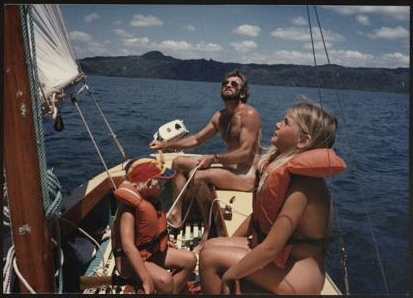
Photos of Aerial by Phil Smith

Phil Smith has written to show us these photos, and to tell us about his airborne lifeboat Aerial, which he had in the 1980s in New Zealand.

‘In the early eighties I had a beautiful yacht called Aerial. She was 23 feet long, around six foot of beam, floated in ankle deep water, and went like the wind.

‘Her name derived from the fact that she was an airborne lifeboat designed for use in rescuing downed aircrew from the North Sea during World War II.

‘Built of double-diagonal mahogany on dozens of thin oak ribs with epoxy dynel sheathing, she was a strong but slippery boat and surprisingly seaworthy. Stability was provided by a heavy steel quadrant shaped centreplate and on either side of the centrecase were the tangs from which the parachute harness was attached.

‘The airborne lifeboats were designed by British naval architect and maritime legend Uffa Fox to fit under the hull of a medium bomber.Within the hull were numerous watertight lockers which, as well as providing buoyancy, contained food, water, first aid things and sailing equipment.

‘The boat was dropped by parachute to survivors in the sea who would rig the mast and rudder and sail to safety.

‘On my first day out I was apprehensive about going alone. It was 10 knots, gusting to15, and Aerial looked like she could be a bit of a handful.

‘A very experienced yachting friend, just returned from a solo voyage from Tahiti, came and officiated. To my horror and delight he sheeted her hard in and, with four bums on the gunwale and my friend grinning wickedly at the tiller, we took off up the harbour in a cloud of spray.

‘She tacked perfectly, sat nice and straight downwind, didn’t slam into chop and never looked like putting a spreader in the water though we tried hard!

‘Because of the strong tides and sometimes fluky winds in the area I fitted a 4hp Evinrude to a light transom bracket and she became unstoppable under power.

‘A relative of Uffa Fox’s Flying 15, Aerial was rigged like a small trailer-sailer, and while simple to launch she was a swine to retrieve due to her length and lack of any keel.’

Thanks Phil – that’s a super story. I wonder whether any of these conversions are sailing now?

Follow the link for more on airborne lifeboats at intheboatshed.net.

PS I’ve been sent these photos of an airborne lifeboat looking very like Phil’s being carried by a US Coastguard plane. My informant, a kind chap called Eric, has no idea where he found them, so if anyone feels I have infringed their copyright in putting these small images us, please contact me and I will take them down immediately. However I would be grateful to be able to leave them in place – the airborne lifeboat story is an important one and should be remembered. Thanks Eric!

pb1g_1

pb1g_8


Uffa Fox’s airborne lifeboat – at last a nice clear photograph!

[ad name=”intheboatshed-post”]

Uffa Fox's airborne lifeboat at the Classic Boat Museum, Isle of Wight

Uffa Fox’s airborne lifeboat at the Classic Boat Museum, Newport

I’ve posted about the airborne lifeboat before – see Uffa Fox’s airborne lifeboat at the Museum of the Broads and Uffa Fox’s great and lasting memorial – the Airborne Lifeboat – but I’m delighted that Julie’s photo of the example at the Classic Boat Museum at Newport on the Isle of Wight is the best I’ve seen.

Thanks again Julie!

Search for Uffa Fox’s books at ABE Books

[ad name=”link-unit-post-bottom”]