Restored 1943 type K Montagu whaler, good condition, for sale in London

[ad name=”intheboatshed-post”]

vancouver

Montagu whaler Vancouver is now sold

Dick Wynne is selling his 27ft 6in type K Montagu whaler. I’m sure it has been a painful decision and it’s a damn shame for all those who have enjoyed crewing her, but no doubt two traditional boats like this is too much for one man!

This could be the offer of a lifetime for someone. Here’s what he says about the boat:

Vancouver is an ex-Royal Navy ship’s boat built in 1943 and lovingly restored and maintained over many years regardless of expense.

Construction is mahogany and larch on oak, with gunwales, thwarts etc in solid teak. She is probably the finest example of the type in existence. Her equipment includes:

– five matching 15ft spruce Admiralty oars plus many spares

– full sailing rig – lug main, jib and mizzen

– 6hp Mariner outboard on a lifting quarter bracket, with lock, and separate fuel tank mounted in sternsheets

– two bilge pumps

– ample buoyancy

– 12 x 150N automatic XM lifejackets with recharging kits

– two paddles for tight spots

Admiralty pattern anchor

– mooring lines, fenders, full-length tent/cover

– nearly new four-wheel braked trailer with sealed hubs and brake flushing system

All her external paintwork was renewed in 2008, and all her exposed timber stripped of varnish and oiled (with Deks Olje #1 and #2) for ease of maintenance. Although of traditional timber construction, she is in superb condition and is easily maintained so. A faultless recent professional survey report is available to serious enquirers.

She is a robust, stable and versatile workhorse fully equipped for pulling, sailing and motoring in a variety of applications including raids, races, expeditions, pleasure trips under power, race/committee boat use, etc. She would make an excellent school or club boat.

Vancouver has plied the tidal Thames in London under oar and sail for the past few years, and is a regular in the annual Great River Race. She has been trailed farther afield to locations including the East Coast, Western Highlands, and Milford Haven, and attracts much attention wherever she goes. She is only reluctantly for sale as, rather improbably, she is my second boat and I can no longer find the time to do justice to two traditional wooden boats. She is currently lying afloat in London.’

For a pdf including more photos from last year click here, and for more on the boat and what he’s been doing with it, click here.

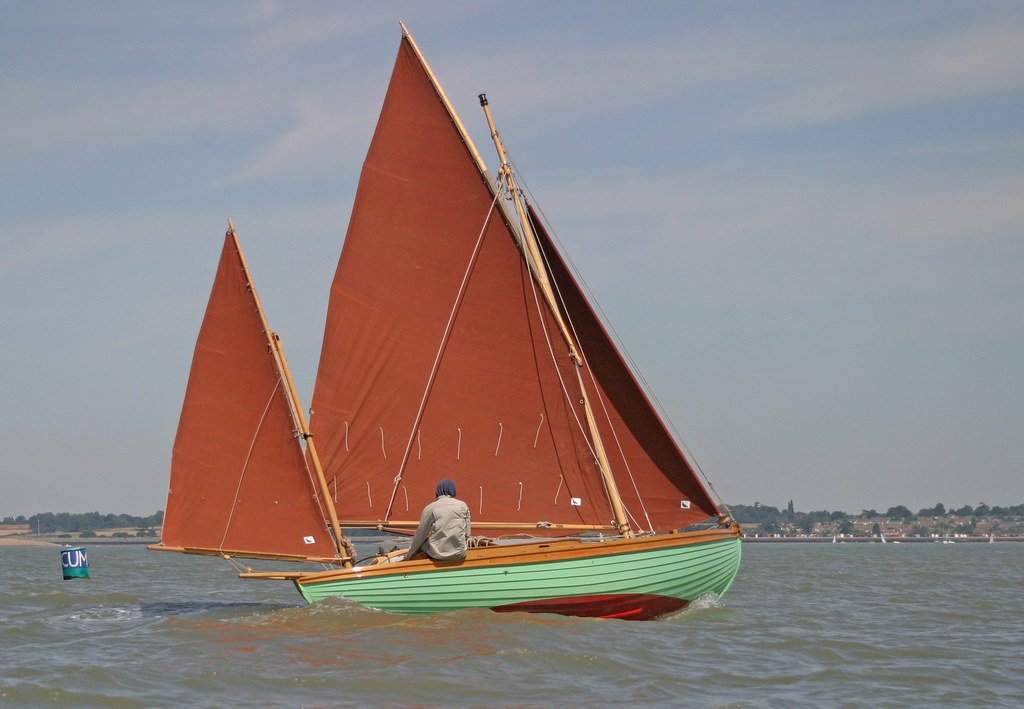
Also, if you’re curious about what his other boat might be, this photo and the knowledge that he’s a leading member of the Albert Strange Association will probably tell you all you need to know.

Complete with a full inventory including trailer, Dick is asking for £9,500 or offers. Call him on 07990 573160.

We don’t often see whalers, but for some photos of one I spotted in the Fal Estuary some time ago, click here.


Heckstall-Smith and du Boulay on the origin of 19th century racing yachts


Wood engraving The Yacht Race – A Sketch from the Deck of a
Competing Yacht
, was published in Harper’s Weekly in  1872.
Taken from the Wikimedia Commons

Although Charles II was almost as enthusiastic about yachting as he was about his many mistresses, his collection of 16 yachts do not seem to have had much of an influence on later racers.

From their researches including studying Clark’s History of Yachting up to the year 1815, Heckstall-Smith and Du Boulay say later racing yachts derived their form largely from revenue cutters.

They write: ‘the fashionable type of cutter was about three and a quarter beams to her length, her midship section was so round it might have been drawn with a pair of compasses. She had a nearly vertical stem, and a  short counter high above the water. The greatest breadth was just abaft or close abreast of the mast. The bow was therefore bluff, and the run long and often not ungraceful.’

The type was known as ‘cod’s head and mackerel tail’ and had evolved  in competition with the craft used by smugglers. This seems to me to be a case of a rather imperfect form of evolution, if faster boats could have been achieved by moving the greatest beam aft, but there are some good stories about how the same boat builders worked for both smugglers and  the revenue men.

Living in Kent as I do, this one from Heckstall-Smith and du Boulay appeals to me particularly: ‘it has been recorded that Mr White of Broadstairs, whose descendants afterwards moved to Cowes, used to lay down two cutters side by side, very much as 19-metres and 15-metres are laid down today, and the Government officials used to puzzle their brains to puzzle out which would turn out the faster, knowing that whichever boat they bought, the other would be sold for smuggling.’

For more on revenue cutters at intheboatshed.net, click here.

Don’t miss something good – subscribe to intheboatshed.net

More photos from the Tall Ships start at Falmouth

[ad name=”intheboatshed-post”]

The water boiled with motor boats and yachts as the competitors left harbour,
and the local press quoted the police as saying there were 130,000 watching
the send-off. It was quite a sight! As usual, click on the thumbnails for much
bigger images

Astrid

Capitan Miranda

Cuauhtemoc’s lively Mexican crew fires a cannon salute off Pendennis Point

Mir approaches Pendennis Point

Mir catches the late afternoon light

Pogoria

The Russian sail training ship Sedov approached from over the horizon. There’s
something special, I think, about a sailing ship that approaches alone in this way,
without the modern distraction of hundreds of little plastic boats

Shabab Oman

Alexander von Humboldt and Tecla

We’ll return to the usual menu of smaller craft for the rest of the week!

[ad name=”link-unit-post-bottom”]