Nigel Royall’s Broads gun punt

[ad name=”intheboatshed-post”]

broads, punt, gun punt, sailing boat, rowing boat, plywood, royall, boatyard, broadland, gun, gun punt, nigel royall

broads, punt, gun punt, sailing boat, rowing boat, plywood, royall, boatyard, broadland, gun, gun punt, nigel royall broads, punt, gun punt, sailing boat, rowing boat, plywood, royall, boatyard, broadland, gun, gun punt, nigel royall broads, punt, gun punt, sailing boat, rowing boat, plywood, royall, boatyard, broadland, gun, gun punt, nigel royall

broads, punt, gun punt, sailing boat, rowing boat, plywood, royall, boatyard, broadland, gun, gun punt, nigel royall

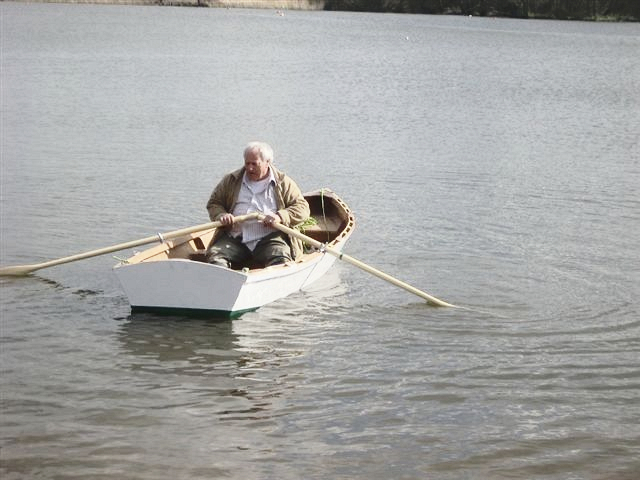
These shots are of a 18ft by 53in gun Norfolk punt named Shoveler made by Nigel Royall, of Royall’s Boatyard at Hoveton on the Norfolk Broads, and fitted with a rig from a Coypu. My thanks go to Nigel for his permission to use them.

As a boatyard operator hiring boats to holiday-makers, Nigel’s had a few dealings with gun punts over the years and finally decided to make his own; he’s put a long post about the project on the Royall’s Boatyard weblog.

As he points out, in the old days most Broadsmen could only afford one boat, so a gun punt was not just used for wild fowling in winter. For example, they it might be used for eel picking or transporting a marshman to or from the dykes where he was employed in dredging and clearing dykes – which is called dydling and fying in Norfolk.

Nigel also explains that gun punts were open until 1824 when a Colonel Hawker introduced his new half-decked design and that the punt has hardly changed since then. Slightly different types developed at Hickling and on the River Ant and Breydon Water, but they all tended to be around 18ft with a beam of between 3ft up to 4ft, with the larger beams on the tidal water of Breydon.

They all had a long foredeck, a short aft deck and narrow side decks with low combings and 9in high sides, and they drew about 1½in of water. Where they varied was in the details of the big punt guns, such as their bore, whether they were muzzle or breach loading, and how they were restrained.

Nigel tells me that he has recently recreated eel picking, and sculling and firing a punt gun from another gun punt for a local amateur film maker, and says he was intrigued to see how it handled with an eleven foot sculling oar and a large gun on board.

My hearfelt thanks go to HBBR member Ian Ruston for tipping me off about this story, and Nigel’s entertaining and interesting weblog.

PS Check out the Nigel’s post about  the Broads pleasure wherry Solace.

If you’d like to receive a weekly intheboatshed.net newsletter sign up here.


The Dinghy Cruising Association at the Beale Park Thames Boat Show

[ad name=”intheboatshed-post”]

dca, dinghy cruising, association, beale park, thames, boat show, suppliers, wooden boat, boat plans, boatbuilding, sailing

The Dinghy Cruising Association at last year’s Beale Park Thames Boat Show

Dinghy Cruising Association member Nick Watt has written to say that his organisation will be at the Beale Park Thames Boat Show.

The DCA is usually in residence at the show, and generally provides a lot of the on-water activity in a range of small craft.

This year, says Nick, the DCA folks will have a stand ashore on which it’s hoping to present member Dave Jennings’ nearly completed Roamer – this is a specialist dinghy cruising design designed by a DCA member, the plans for which are available from the association. To find out more about the Roamer, click here and here. There will also be a pontoon providing moorings for DCA members’ boats.

A key aim of the DCA’s presence at the show is to demonstrate that there are more ways of having fun on the water in small boats than necessarily racing around the marks (hoorah to that, I say), and that a wide variety of small craft (including, hopefully, Alistair Law’s Paradox) can be used for cruising in coastal waters.

Whatever, those who drop in can be sure of a welcome.

Norman Fuller launches his Ella plywood skiff built to free plans – and it’s a success!


free boat plans, boat plans, plywood boat, plans, skiff plans, ella skiff, gavin atkin, stitch and glue, tack and tape, wroxham broad, norman fuller

free boat plans, boat plans, plywood boat, plans, skiff plans, ella skiff, gavin atkin, stitch and glue, tack and tape, wroxham broad, norman fuller free boat plans, boat plans, plywood boat, plans, skiff plans, ella skiff, gavin atkin, stitch and glue, tack and tape, wroxham broad, norman fuller

Norman Fuller has launched his Ella skiff built using free boat plans from this website – and has pronounced it a success.

He launched the boat on Wroxham Broad, not far from his home in Norwich. Here’s what he had to say about the project when he emailed me late last evening:

‘Hi Gavin, after a slow start I finally got under way, having not been on the water for many many years.

‘Once I sorted the collars on the oars, worked out where they needed to fit and then nailed them in place, the Ella skiff performed very well. As you see I left the forward hatch open because thats where I kept the nails and hammer.

‘The boat’s very easy to handle and I think the skeg was doing it’s job, as I found I could row in a straight line, which could be some sort of indication the bottom is not skidding.

‘Only one was a little bit awkward, and that is the angle of the rowlock’s. I set them in the gapped inwale following the line of the side of the boat, but they need to be more upright, so I think I will change them. My friend Jenny was so proud of what I had done she took me for a carvery, not bad eh?

‘Till next time!

‘Norman’

From the pictures, I think the problem you had with the rowlocks is that they could be higher – the choice is between lowering the thwart and raising the rowlocks, or both.

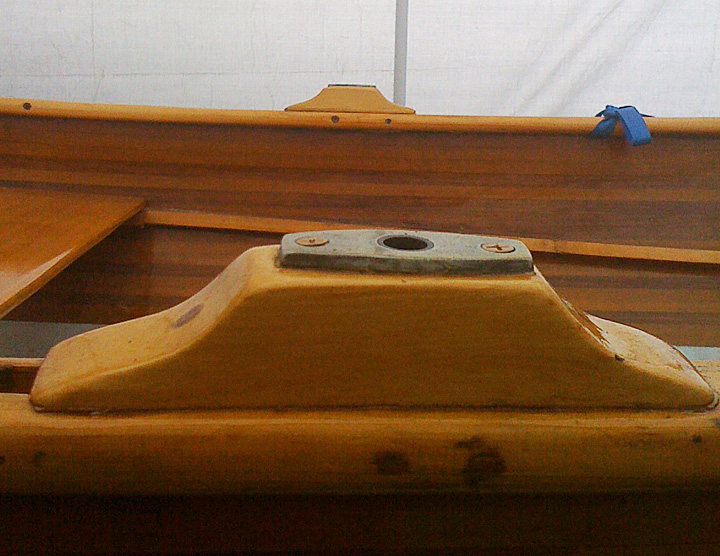
I’d start by screwing a 4-6in by 1 1/2in by 1 1/2in block with chamfered ends onto the gunwale for the rowlock to fit into. It’s easy to do, you see it done very often, and when the block wears you can replace it. Small people and kids won’t need them, but I should add these blocks to the plans. Here’s an example of how it would work; and here’s another from intheboatshed.net reader David Luckhardt.

The Ella skiff is a lightweight general purpose stitch and glue flattie skiff for use in sheltered waters. She’s 12ft long overall by 4ft beam, by 400lbs displacement, and is designed for stitch and glue construction using 1/4in or 3/8in 4ft by 8ft plywood. It is meant to be a simple and quick stitch and glue building job of a size that is convenient for building in domestic garages made to take a small to medium-sized car – which probably describes the building area available to most people. For more on this boat and the plans, click here.