Little Bathtubs, made of ticky-tacky

[ad name=”intheboatshed-post”]

A forest of yacht masts

Plastic boats at Sunderland Marina, photographed by Rob Bishop, and taken from Wikipedia Commons No, I don’t have anything against Sunderland or Sunderland Marina in particular

I greatly appreciate  traditional boats but perhaps even more I admire the brave and determined souls who use and maintain them even more. Many of them maintain important relics of history, and there’s no doubt that they lend huge character to many of our sailing areas. Where would the Broads be without its elderly sailing and motor cruisers, and wherries? What would the East Coast be without its smacks, bawleys and barges? Falmouth without its oyster fishery?

Nevertheless I sail a small plastic boat. Why? Because I kind-of have to – with my family commitments and not especially generous earnings, if I owned a wooden boat I’d struggle to maintain it myself and would not be able to afford the bills that come the way of friends who own such craft. And I’d go sailing less often than I do, and that can’t be allowed to happen. And I suppose one can say that the deck of a plastic boat makes a good vantage point for looking at real boats…

So plastic boats have their uses, and thank heavens for them – heck, if you want a measure of how morally corrupt I am, perhaps I should mention that I’m currently in the market for Laser for my kids. It’s not quite what I would choose, but it’s what they want and no doubt I’ll end up using it too…

But I can’t help sympathising with the author of this entertaining and generally accurate little ditty, whoever they are. My thanks to Bob Telford for passing it on!

Why isn’t it quite accurate? First, it doesn’t mention the important fact that most modern sailing yachts seem to spend their time motoring, not sailing. Second, I do wonder whose kids read Ransome these days? Certainly not mine…

Little Bathtubs (to the tune of Pete Seeger’s hit Little Boxes, which was in fact written by Malvina Reynolds)

Little bathtubs in marinas, little bathtubs made of ticky-tacky,
Little bathtubs at the quayside and the owner in the bar,
There’s a white one and a white one and a white one and a white one,
And they’re all made out of ticky-tacky and they all look just the same.

And they all have roller-reefing and self tailing winches,
Arid they all put a little reef in in anything above a two,
There’s a Jeanneau and a Beneteau and a Moody and a Westerly,
Aud they’re all made out of ticky-tacky and they all look just the same.

And they all have weatherfaxes and global positioning,
And a radar and a little screen that helps you to plot,
There are are gadgets and gizmos which show where the wind blows,
And the skipper is just a passenger ’cause the Autohelm does the lot!

And the owners are all builders or accountants or solicitors,
And they all drive down from Loughton on a Friday afternoon,
And they slip into their blazers and their Henri Lloyd moccasins,
For an evening at the yachty-clubby and they all look just the same.

And the owners all have wifeys who hate to go sailing,
Except around the Greek Islands where they get a good suntan,
And they all sit in marinas and drink up their G&Ts,
And they all come out of Billericay and they all look just the same.

And they all have little children who love to go sailing,
But they’re all sent away to boarding school where they never get the chance,
So they read their Arthur Ransome and dream of great voyaging,
In a pretty little wooden cutter, off to Holland or to France.

Little Bathtubs in marinas, little bathtubs on a swinging mooring,
Little bathtubs at the quayside and the owner in the pub,
There’s a Jeanneau and a Beneteau and a Moody and a Westerly,
And they’re all made out of ticky-tacky and they all look just the same.
Keble Chatterton on the early development of racing yachts, part IV

[ad name=”intheboatshed-post”]

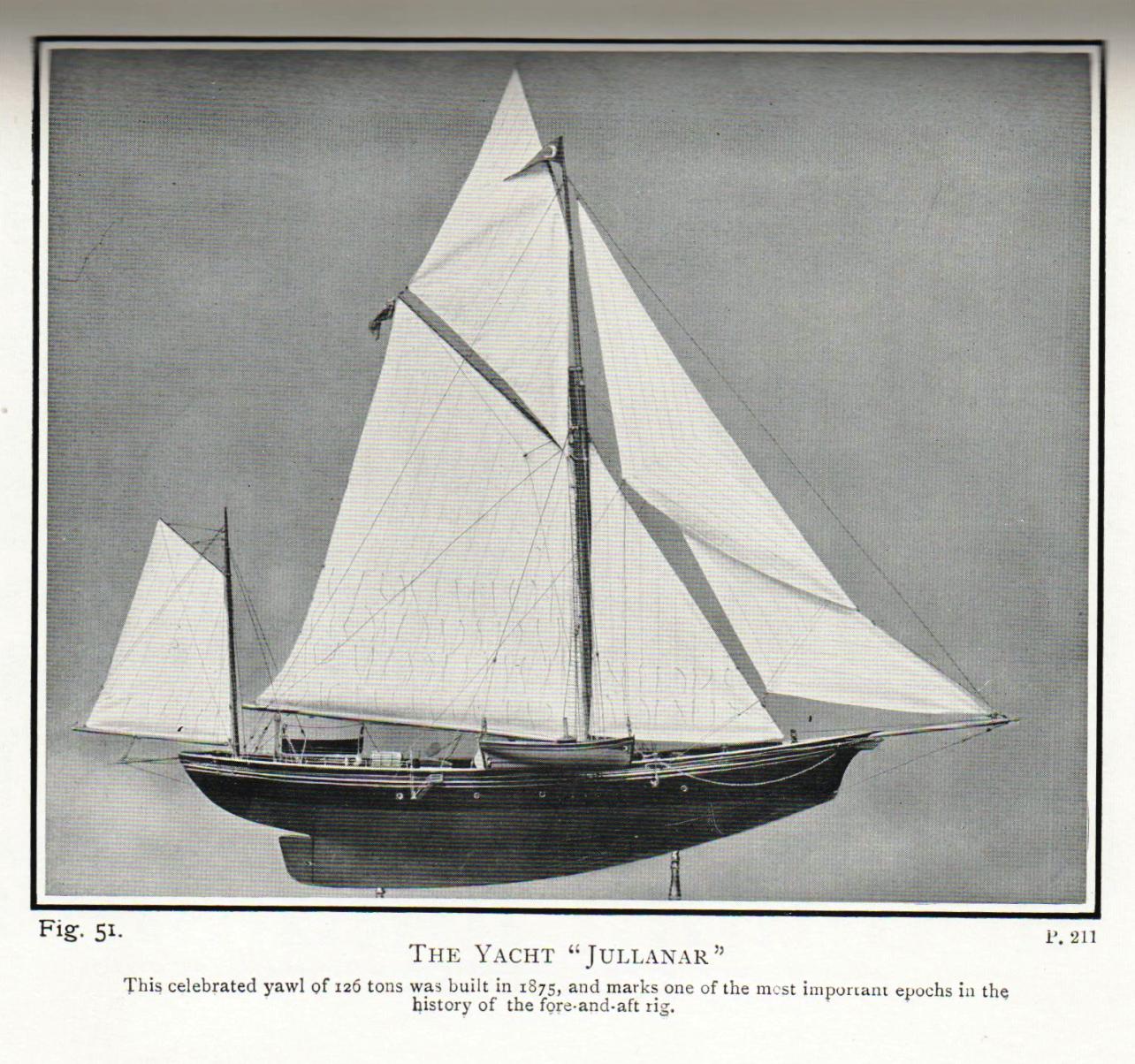
Revolutionary 19th century racing yacht Jullanar from Keble Chatterton

Here’s another small slice from Keble Chatterton’s history Fore and Aft Craft. See the previous extracts here, here and here.

‘But it is when we come to study the ten years that are covered by the dates 1870 and 1880 that we begin to see still greater activity. It had been preceded by a fine fleet of cutter yachts that included the famous Oimara, built in 1867, and still used , but as a houseboat in Poole Harbour, above bridge. Her spars were all big, and her great topmast and lengthy bowsprit were characteristic of that period. The tonnage of this vessel is 135, The Aline and Egeria also belong to this period, the former being historic as having been the first yacht to discard the rake which was always given to the mast previously.

‘The ‘seventies saw a real awakening in yachting – a new birth as it were, There were big schooners, cutters, and yawls, and yacht building yards were busily employed. It was during this period that the famous forty-tonners came into being that numbered in their class among others the well-known Foxhound and Bloodhound. The last mentioned has attracted an increased amount of attention by her return to racing during this twentieth century. She was recently altered by Fife, and has done remarkably well in handicap races when we recollect her great age as compared with modern flyers. Under the new modification the Bloodhound was given a raised sail-plan, and the ballast was brought lower down. In addition to this, the forefoot was cut away, and she was thus made quicker in stays.

‘But besides these celebrated forty-tonners we must call attention to the equally famous Jullanar, which was representative not of a class but as a special and original creation. The Jullanar, which we have here reproduced in Fig. 51 [see above], from a model in the South Kensington Museum, is indeed a milestone on the road which begins in the late sixteenth century and reaches on the the present day. Perhaps there was no designer of the fore-and-aft rig of our own time that did so much for this development as the late Mr G L Watson. His name was associated with a fleet of crack yachts that is too numerous to give here. And when it is remembered that Mr Watson frankly admitted that he himself was considerably influenced by the lines of the Jullanar, we have every right to regard this vessel as one of the highest importance. To some extent the excellent illustration here will speak for itself, and the fewest words will suffice to demonstrate her special features. Her birthplace was in Essex, that county which has brought forth so many famous craft and equally famous sailor-men.

‘Designed by a Mr E H Benthall, the Jullanar, of 126 tons, was built in the year 1875. In this model the old-fashioned straight stem and the old-time stern have vanished altogether. There is not a trace – in detail at least – of the former Dutch influence. Her bow, however, shows some connection with the prevailing schooner of that period, and so with the clipper ships which were then fast coming to the end of their limit of usefulness. This yacht showed herself such a success, and possessed of so great a speed, that Mr Watson based his design for the famous Thistle on the lessons to be learned from the Essex craft, although the Thistle did not actually appear until the year 1887.’

The last time I looked, Amazon had just a few copies of Fore and Aft Craft.

Old fashioned and classic sailing boats of the Norfolk Broads, autumn 2010

[ad name=”intheboatshed-post”]

On Barton Broad 13 Hunter's Yard sailing cruiser

On Barton Broad 8 Broads sailing cruiser

On Barton Broad 14 19th century Broads sailing cruiser Zoe sails by On Barton Broad 14 19th century Broads sailing cruiser Zoe sails by On Barton Broad 11 RNSA dinghy sails by

On Barton Broad 5 A Hunter's Yard boat sails by On Barton Broad 10 Broads sailing cruiser

Norfolk Broads Wherry Albion Norfolk Broads Wherry Albion How Hill boatshed

Photos of traditional sailing craft of the Norfolk Broads, including everyone’s favourite, the 19th century Broads sailing cruiser Zoe, a Royal Navy Sailing Association dinghy, the Norfolk wherry Albion, and a charmingly dilapidated boat shed. Click on the images for a much larger photo

We’re just back from a short trip to the Norfolk Broads in the Broads sailing  cruiser Camellia, hired from the helpful folks at the Broads Yachting Company, of Horning – and these are some of our snaps. If only we could have stayed longer!

We recently rather enjoyed the book The Norfolk Broads: The Golden Years, which we bought in Norfolk earlier this year. It’s a compendium of photos and descriptions by the charming Broads writer and keen sailor Philippa Miller, and include many shots of familiar scenes from the area going back to early in the 20th century. It’s difficult to get now, but I notice Amazon sellers have a few copies.