Humber keels and sloops

Humber keels racing

Humber sloops racing

Correction! I’ve received the following message from Dave Everatt of the Humber Keel and Sloop Preservation Society.

‘Gavin: To correct an error on my part, the photo I sent labelled Keel race was in fact not a race at all. Keel races were mainly in the 19th century and photos are rare and usually of very poor quality. When keels were racing they would usually set both mainsail and topsail and, because it was a special event, would also fly a burgee with the vessel’s name on it. The photo I sent you shows a group of keels heading down the Humber after ‘bunkering’ trawlers (that is, loading them with coal) in St Andrews Dock. They would be heading for the eastern docks, such as Alexandra Dock, to load a return cargo for the Aire & Calder or Sheffield &South Yorkshire Navigation. I have attached a further photo [pasted below – Ed] probably taken at the same time. Regards Dave’

Keels at Hull

I’m very pleased to be able to share these striking shots of Humber keels (top) and Humber sloops, thanks to Dave Everatt of the Humber Keel and Humber Sloop Society.

Taken in about 1900, the upper image in particular is a powerful reminder that many of us who come from the Eastern side of the UK are at least partly descended from the Vikings – and that there’s lots of genetic material to prove it.

The lower photo dates from the 1920s. In each case, click on the image for a much larger and clearer photo.

The society is currently celebrating its new website, so please check it out: www.keelsandsloops.org.uk. You’ll find that it cares for both a Humber keel and a Humber sloop, named Comrade and Amy Howson respectively.

While we’re on the subject, Youtube has a nice clip of the Humber sloop Spider T racing down the estuary on the tide.

PS – In the comments below Jim from Zanzibar asks about the paddle steamer in the lower photo. Here’s what HKHSS’s Dave Everatt has to say:

‘I cannot be 100 per cent sure but I believe the paddle steamer is the PS Humber. If so this is the information I could find on the vessel.

‘Of 131 tons, she was built by J T Eltringham & Co, South Shields 1895, and her propulsion was a paddle  driven by single cylinder engine by Hepple & Co of South Shields. Her tonnage was 131

‘She was owned by J Turner and operated from 1895.

‘She was built as a tug for use on the River Tyne and was converted for pleasure work after her tug career. She was iron-built, 100ft long, with a breadth of 19ft and a draught of 9ft. PS Humber made trips from Grimsby to Spurn, where she would land passengers by local rowing boats.

‘Regards

‘Dave Everatt’

Steel-hulled schooner for sale, lying at Standard Quay, Faversham

Schooner for sale

Schooner for sale

A pal and I dropped by Standard Quay at Faversham to see if we could spot a little lugger that we’d heard a friend is considering buying, so I took the opportunity to bag some photos of how things are there now. I’m sorry if you feel they’re not up to my usual standard – on arrival I discovered the battery of my usual camera was flat and so had to use my mobile phone, which seems to produce quite blue-grey images. I must get a spare.

Anyway, if you’re in the market for a steel-hulled schooner liveaboard, the one currently for sale at Standard Quay may be just what you’re looking for. It looked in pretty good shape to us, though neither of us has ever seen it sailing. The schooner’s pictured above.

Lady of the Lea Thames sailing barge Lady of the Lea Thames sailing barge Cambria being renovated

Roxane at Faversham Thames sailing barge Cambria being renovated

On a more cheerful note, the first two shots above are of the lovely small Thames sailing barge Lady of the Lea, two shots of Bob Roberts’ old sailing barge Cambria in restoration and a nice little Roxane that lives on the creek here.

And below is the bow of another Thames sailing barge Lady Daphne, here in a dry dock being repaired after a racing accident (I believe) and the yuppie flats that have already encroached the area opposite Standard Quay. The blue banner reads ‘Save Standard Quay’. For more on the Standard Quay campaign, click here.

Lady Daphne, Save Standard Quay banner

Lady Daphne, Save Standard Quay banner

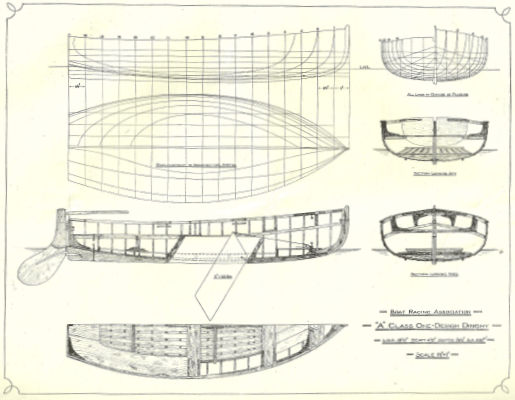
Boat Racing Association A-Class One Design Dinghy specifications and drawings

A-Class one design dinghy specification

A-Class one design dinghy specification

Brian Smith has sent in interesting scans of the specification for the delightful Boat Racing Association A-Class One Design Dinghy, which I gather is a very close relative to the International 12. I’ll let him tell the story:

‘Hi Gav,

‘I attach drawings and specifications of the BRA 12ft dinghy as published in the Yachtsman of 12 June 1913, which could be of interest to your readers as I believe they were little changed for the International 12ft dinghy class.

George Cockshott [the designer of the International 12] was a frequent and sometimes successful entrant in design competitions in the Yachtsman and Yachting Monthly, although it is not certain that any of those designs were ever built. The 12ft dinghy design was the result of a competition run by the BRA. Cockshott may have been inspired by the 12ft restricted class sailed at Hoylake, West Kirby and Rhyl. The design does seem to have been influenced by the class.

‘The largest yacht designed by Cockshott appears to have been the 19 tons TM Nautilus II built by R Lathom at Crossens, near Southport in 1902.

‘Hope this is of interest,

‘Brian’

Thanks Brian – it certainly is. I love all that old-fashioned specification stuff: ‘The whole of each boat, inside and out, to be varnished four coats best yacht varnish. (Or, if desired by the owner, the bottom to be painted three coats and finished with anitfouling composition or enamel externally, and to be painted three coats internally). The name or number to be written in gold leaf and shaded, on the transom or as may be required.

For a post on George Cockshott’s International 12 dinghy, click here.