Three score and ten – the greatest fishing disaster ballad

the_storm_engraving_by_william_miller_after_van_de_velde-470

The chilling engraving The Storm by William Miller after Van de Velde,
published in 1858, taken from the Wikimedia. They’re not English East Coast
fishing smacks, but sadly I haven’t been able to find a suitable engraving
from the correct era

‘As day after day passes and no tidings arrive of the missing Grimsby smacks, it is beginning to be realised that the gale of the 9th ult. will prove one of the most disastrous to the Grimsby fishing trade on record. altogether nearly a dozen fishing vessels, carrying between 60 and 70 hands, are missing.

‘Most of the vessels were provisioned for eight or nine days, and many of them have been out for over a month. Of the safety of seven of them all hope has now been abandoned.’

Report from: The Hull Times, 2nd March 1889

Most people of my generation with a long-standing interest in traditional music have probably sung this song at one time or another, particularly those who like me come from nearby one of the the East Coast major fishing ports.

It’s a big favourite with a magnificent, anthemic chorus, and a powerful theme, and it’s also a song that some of us connect with some remarks  made by old Sam Larner in relation to a storm he remembered from his childhood. Back in the 1950s, he told Peggy Seeger and Ewan MacColl that the big East Coast storm that people remembered was in 1884, and that there was a saying: ‘Oh dear, oh Lor – the dreadful fishing of 1884.’

Well, Jim Potter has been digging around and has discovered that the song actually refers to a storm in 1889, and that  some 70 hands from Grimsby – three score and ten – really did die that February night, as the newspaper quotation above shows.

This is February 2009, almost 120 years to the day since those brave and unfortunate fishermen met their deaths. As many sailed from Grimsby, we can assume that quite a few were orphans or had been abandoned by their parents and were often treated pretty badly by their employers and surrogate guardians, as Anson makes clear in his book British Sea Fishermen.

Anyway, you can read all about Jim’s research at Folk Leads, find the original fisherman’s poem from which the song developed and read about the Three Score and Ten fishermen’s gravestone that he has identified .

I haven’t been able to make the link to his recording of the song work, so if you want to hear how this one goes, you’ll have to make do with my recording of this great old song.

For more songs at intheboatshed.net, click here.



‘I had a beautiful yacht… ‘

[ad name=”intheboatshed-post”]

aerial1

mailgooglecom

Photos of Aerial by Phil Smith

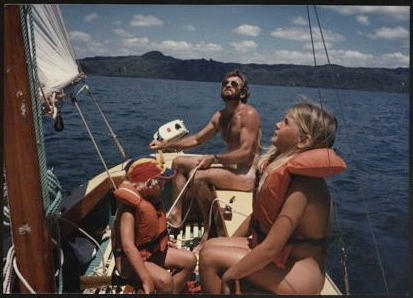
Phil Smith has written to show us these photos, and to tell us about his airborne lifeboat Aerial, which he had in the 1980s in New Zealand.

‘In the early eighties I had a beautiful yacht called Aerial. She was 23 feet long, around six foot of beam, floated in ankle deep water, and went like the wind.

‘Her name derived from the fact that she was an airborne lifeboat designed for use in rescuing downed aircrew from the North Sea during World War II.

‘Built of double-diagonal mahogany on dozens of thin oak ribs with epoxy dynel sheathing, she was a strong but slippery boat and surprisingly seaworthy. Stability was provided by a heavy steel quadrant shaped centreplate and on either side of the centrecase were the tangs from which the parachute harness was attached.

‘The airborne lifeboats were designed by British naval architect and maritime legend Uffa Fox to fit under the hull of a medium bomber.Within the hull were numerous watertight lockers which, as well as providing buoyancy, contained food, water, first aid things and sailing equipment.

‘The boat was dropped by parachute to survivors in the sea who would rig the mast and rudder and sail to safety.

‘On my first day out I was apprehensive about going alone. It was 10 knots, gusting to15, and Aerial looked like she could be a bit of a handful.

‘A very experienced yachting friend, just returned from a solo voyage from Tahiti, came and officiated. To my horror and delight he sheeted her hard in and, with four bums on the gunwale and my friend grinning wickedly at the tiller, we took off up the harbour in a cloud of spray.

‘She tacked perfectly, sat nice and straight downwind, didn’t slam into chop and never looked like putting a spreader in the water though we tried hard!

‘Because of the strong tides and sometimes fluky winds in the area I fitted a 4hp Evinrude to a light transom bracket and she became unstoppable under power.

‘A relative of Uffa Fox’s Flying 15, Aerial was rigged like a small trailer-sailer, and while simple to launch she was a swine to retrieve due to her length and lack of any keel.’

Thanks Phil – that’s a super story. I wonder whether any of these conversions are sailing now?

Follow the link for more on airborne lifeboats at intheboatshed.net.

PS I’ve been sent these photos of an airborne lifeboat looking very like Phil’s being carried by a US Coastguard plane. My informant, a kind chap called Eric, has no idea where he found them, so if anyone feels I have infringed their copyright in putting these small images us, please contact me and I will take them down immediately. However I would be grateful to be able to leave them in place – the airborne lifeboat story is an important one and should be remembered. Thanks Eric!

pb1g_1

pb1g_8


Stirling and Son develops a new 9ft dinghy

[ad name=”intheboatshed-post”]

dscf5402

dscf5408 dscf5396

The new 9ft dinghy from Stirling and Son – the lower
photos show the materials and moulds

The Stirling and Son boatyard down at Morwelham near Tavistock must be one of the most picturesque anywhere – I enjoy the photos Will Stirling sends us for their setting almost as much as the boats.

Here’s what Will has to say about the dinghy in the photo.

‘Dear Gavin,

‘The dinghy is to go to Northumberland – but I can build another with a lead time of approximately six weeks.

‘She is 9ft long of mahogany planking with an oak sheer strake. All other timber in the boat is oak with copper fastenings.

‘The shape is a very stable one, as I’ve had had some near-capsizes getting into dinghies in the past. She has a mid-19th century shape with the bold forefoot and relatively full bow, while she is finer aft with a shapely transom.

‘After building this dinghy I have set down the shape in a full five-page A2 draught with A4 offsets, scantlings and materials list. I am to build the next dinghy from this draught and then make full size mould templates with the planking lined out and a little colour booklet with photos taken along the way. I will let you know when that is all prepared, probably in a couple of months.

‘Best wishes

‘Will Stirling’

I think that booklet might interest quite a few budding home boatbuilders, and when it’s ready I’d like to put up a post about it here Will!

See the Stirling and Son Wooden Shipbuilding and Repairs website at http://www.stirlingandson.co.uk or contact the company at 01822 614 259.

PS – If like me you’ve been admiring Will’s trestles, see some handy trestle plans here. Ok, they aren’t Will’s plans but they look quite similar.