[ad name=”intheboatshed-post”]

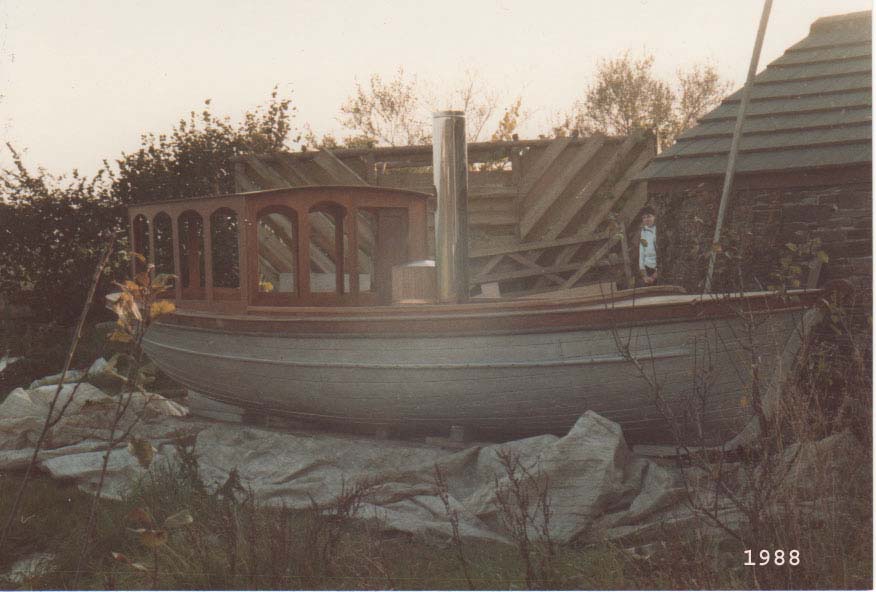
Gazelle in 1988


Gazelle in 1988, and in the 1950s
Keith Johnston has been in touch to say that he’d like to find a new owner for his 1908-built part-refurbished, part-restored 25ft steam launch Gazelle.
I’ll let him tell the story:
I heard about a steam launch completely by accident when I was extracting a large butt of oak with my Fergie tractor and articulated trailer for a forester friend. He knew of an original, but abandoned steam launch hull. The upshot was that in mid-December with the temperature so low that the old-fashioned tractor vapourising oil fuel initially would not vaporise, I got the thing started and I started to pull this steam launch back to my home, a distance of approximately 10 miles. Bearing in mind that double articulated 20’ trailers with a wheel at each corner do not go backwards, this was no mean feat in the narrow lanes of Cornwall. Anyway, we made it but I took two days to thaw out.
When I researched the boat I found that her name was Gazelle and that she was built in 1908 in Nottingham to be used on the River Trent as an electric passenger carrying pleasure boat. However, the operators realised that in those days water and electricity in boats was not as easily managed as today, and converted her to steam, which was the normal propulsion of the day.
She plied her trade for a number of years until being brought to the River Thames after the war and became a private launch covering some very long distances rumored to be up to 2000 miles over period of five years on the Thames and Medway until 1967, when she was laid up. During that period she was owned by the founder of the steamboat association, a Mr Lowe, and his son. There is a long techincal article by W Lowe about her in the May to June,1969 issue of the Light Steam Power magazine published bi-monthly by J N Walton of the Isle of Man in the 1960s. ( I have the copy and others) where Mr Lowe describes Gazelle ‘as a graceful craft with a clipper stem and a counter stern powered by a three horsepower electric motor.’ He then goes on to describe the first Merrweather boiler and three cylinder simple expansion steam engine, and how he and his father replaced the engine with the Simpson Strickland double tandem (steeple) compound engine and oil-fired Lune Valley vaporising burner for the Merryweather boiler.
She was then acquired by some enthusiasts and brought to Cornwall where one of the owners removed the engine and installed it in another boat and the hull was abandoned behind the manor house where I found her. The main owner had been killed in a motor accident and his father was more than pleased to see the boat removed with the possibility of being restored.
Woodwork
Gazelle is a 25 foot launch traditionally built of larch on oak frames and at that time was simply an open boat with no deck or interior or fittings. A survey found that most of the timber between the stern and amidships would have to be replaced and then the question of a new deck and saloon had to be addressed, together with acquiring a new steam plant, shaft and propeller, rudder and steering gear. So there was quite a lot of redesigning to do before work could start.
After we started the restoration, the boat was disappearing at such a rate with the removal of the rotten timber that I had decided that if we didn’t find sound timber in the keel and kelson in the next 12 inches we would burn the hull and save the copper from the fastenings. However, we did find some sound wood and started the restoration. The work included new keel and part kelson, deadwood, new steamed oak ribs, stringers and stem, new planking to approximately 60 per cent of the hull in larch and Douglas fir on new oak ribs, all with traditional copper fastenings and new caulking.
The interior floors and seating are in marine ply, larch and iroko, all fastenings are of brass. The new saloon has an iroko frame with ply panels, shatterproof Plexiglass windows and teak double doors to the main cockpit. Original gunmetal deck fittings and steering wheel of the period were installed. The fore, aft and side decks are of traditionally laid narrow strip 1 1/4” iroko planks horizontally dowled and vertically screwed and plugged.
Machinery
A new purpose-built Leak compound steam engine 4+3 x 2 rated at 7 horsepower at 120 pounds pressure. I bought this as a set of castings from a firm near Bath and after a lot of cajoling got the local Skill Centre to use the machining as a teaching exercise. This was very popular and the three lads that did their training on the job got very high marks for their project work and went on to be international marine engineers in their own right. There are two feed pumps and an Edwards air pump. A twin pipe external keel condenser with hot well and water storage tank and auxiliary hand feed pump. These are all fitted on a removalble tray, which also helps to keep oil etc out of the bilges.
She had a new purpose-built stainless steel oil-fired, mono tube boiler lagged in Kao wool with external cladding of iroko with brass bands and stainless steel funnel with steam siren and copper banding. Powered by a 12 volt oil burner, a new 20in x 30in bronze propeller on a monel 1¼in shaft and cutlass bearing, a new profiled twin-walled balanced rudder and wire steering mechanism to original gunmetal wheel amidships.
Current situation
All the machinery was tested and run in situ, but she was never re launched ! All the work was completed in approximately 1988 and she was under tarpaulins outside for two years. She was then moved to a barn and stored in a dry airy environment for nine years during that time the planks in the bow deteriorated and she was moved to a specialist boat builder’s yard near Plymouth. The agreement was that he would repair the planking and paint the hull ready for launch. That was five years ago during which time despite much urging and promising and even mild threats no work has been done, the boat has been uncovered despite innumerable promises to cover her, and she has deteriorated so that she is in need of very serious and complete restoration. However, all machinery is as installed but will need complete overhaul.
In a way this has been a sad tale, but at the time I thoroughly enjoyed the hands on restoration project and that she was rescued from complete destruction and brought back to almost completion. She is a pretty boat with a good stable design of hull and could be restored again by someone with an interest in old wooden boats.
I am looking to dispose of the boat and am open to offers of cash or part exchange for something interesting, to ensure she goes to a good home.
Keith Johnston
10th November 2009
The following photos show Gazelle as she is today: