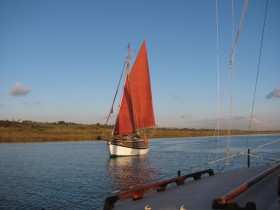
1936 photo of HMY Brittannia being towed to the spot where she was scuttled

Britannia's Last Voyage

This striking photo shows the Royal Yacht Britannia on her way to her final resting place to be sunk off the Isle of Wight on the 10th July 1936, in line with King George V’s wish following his death.

She was scuttled at night, and for this reason boat builder, columnist and general student of these things Adrian Morgan (see comments link below) believes this shot was actually taken the day before.

The Wikipedia has a good page on the original Britannia here (there is of course a magnificent new Britannia is currently being fitted out) and there are more posts on this weblog here.

Thanks to Daniel Simons for sending me this photograph. I should tell you that Daniel has published a new hardback book ‘Valkyrie Weather: Rowhedge and the America’s Cup’, which follow Lord Dunraven’s two America’s Cup challengers Valkyrie II (1893) and Valkyrie III (1895) from their construction through trial races, regattas, Atlantic crossings and Cup races in New York, to their final journeys to the nautical knacker’s yard using contemporary newspaper and yachting journal articles.

It’s likely to be of particular interest to those interested in Rowhedge family and local history.

Only 100 copies of ‘Valkyrie Weather’ are available, and the book is available only through eBay.

Boat Building Academy and National Maritime Museum Cornwall launch short courses at Falmouth

Ropework course

The National Maritime Museum Cornwall and the Boat Building Academy have teamed up to run a series of short three- and five-day courses at the Falmouth museum’s premises.

The first weekend course, ‘Make a fender – decorative ropework and splicing’, with BBA visiting instructor Roy Gollop on 30 and 31 March will teach decorative ropework and splicing, and participants will make a fender to take away.

Roy began his marine career as an apprentice boat builder in 1946 before enlisting in the Royal Marines, where he was responsible first for landing craft operations before becoming senior instructor of seamanship.

He returned to Lyme Regis and managed the family fishing business for several years until he reopened his  toolbox and began building clinker dinghies and working boats for local people.

BBA  principal Yvonne Green says that running short courses at the NMMC gives the Academy the opportunity to offer short practical workshops outside the limited space available at its Lyme Regis premises.

  • hand tool sharpening and timber preparation 4th-5th May
  • basic joints 11th-12th May
  • dovetails 18th-19th May
  • wooden boat restoration 17-21 June
  • bending wood 22-23 June
  • half model making 29th-30th June
  • replace and scarf a plank 6th-7th July
  • repair a ply dinghy 3rd-4th August
  • ‘Knees up’ with Gail McGarva (shape a knee for a 12ft clinker sailing dinghy and have it fitted to a boat) 17th-18th August
  • basic woodworking skills continued 30th September – 4th October
  • oar making 2nd-3rd November

More information is in the programme: BBA courses at the NMMC 2013.

Also new from the BBA is a timber supply and machining service that will also cut timber brought in by customers.

Timber generally in stock includes sapele (25mm, 32mm and 50mm), American white oak (25mm and 50mm), European oak (25mm, 32mm and 50mm), Western red cedar (25mm and 50mm), Douglas fir (25mm, 32mm and 50mm), Far Eastern ply (4mm, 6mm, 9mm, 12mm and 18mm), Robbins Elite ply (6mm).

Machining of strip planking (with bead and cove) at 6mm and 9mm thickness is also available. Contact the BBA on 01297 445545 or email office@boatbuildingacademy.com.

Sawn timber

2013 Finesse meet scheduled for Stangate Creek, 24th May

Ivy May, a gaff rigged Finesse 21 - Swale 2012 - Nick Ardley Mariette, a gaff rigged Finesse 24 in Benfleet Creek - Nick Ardley.

The mate tickles Whimbrel's bottom... Nick's Finesse 24 on the hard. Nick's Whimbrel heeling well, sailing near Southend Pier - picture, Ian Kemp

Author and Thames Estuary sailor Nick Ardley tells me that Finesse yacht owners are planning a gathering for all sizes of the timber-built craft in the Medway area during the late May Bank Holiday weekend.

Finesse builder Alan Platt also built a few one-offs, and these are also welcome too.

The plan is to gather at Stangate Creek on the Friday, and then head up river on the Saturday morning to berth at Chatham Marina, where the events pontoon and marquee have been booked. An evening BBQ is planned.

Sunday is to be a dock day, with dispersal on the Monday 27th May. For details, contact
Nick using the email form at his website: www.nickardley.com.

Tides for the River Medway are a little after noon on the Friday, and the hope is that this will give East Coast boats an opportunity to attend – there is currently a growing fleet of Finesses in the Leigh and Canvey Island area, and another around the Swale and Medway’s creeks.

Some 12-13 owners are already expected, and one South Coast-based Finesse 21 owner has also indicated his intention to sail up and use the meet as an opportunity to explore the swatchways of the Thames Estuary.

Nick’s latest book Jottings of a Thames estuary Ditch-crawler contains a chapter about the Finesse yachts based on an interview with Alan Platt, that includes the story of Platt got his business started in a yard in Hadleigh Woods, by the side of the Thames Estuary.

I gather from Nick that the original Finesse 21 hull was designed by Laurie Harbottell, with a deck structure and fit out by Platt. The F21s were either gaff or bermuda rigged, sloops and cutters. All had centre plates and a shallow long keel.

The F24 was stretched out from the F21, and that there were no official drawings – it was all done by eye, Nick says the design works well.  [There’s a boat designer’s saying that almost all existing hull designs can be improved by simply making them 10 per cent longer, so this seems to make sense – Ed.]

The F24s were also gaff-rigged, but most were Bermudan sloops and cutters. They have a fairly deep long keel that makes them great ditch-crawlers, and many also had centre plates that take their draft to around 7ft when right down; however, some had plates and bilge keels or no plate and bilge keels…

Platt then built a F27, the Tugela. She was a one-off: following further demand for the larger boat, Alan asked another well designer, Maurice Griffiths, to re-design his F27 – and she came out as the F28. All of these were long keeled with no centre plate.

Nick tells me he’s had Whimbrel, F24 number 64, from her build in 1983/4 (she was launched in April 84) and has enjoyed her ever since – he believes his boat is the longest in same ownership, though there is apparently an F21 that has been in the same hands for even longer.

Many of the boats have been owned for lengthy periods: for example F24 number 1 has been in the same family since her build in 1969, and passed from father to son some years ago.

For more information about Finesses, see the Google Finesse forum and the brand new Finesse Owners Association website.
