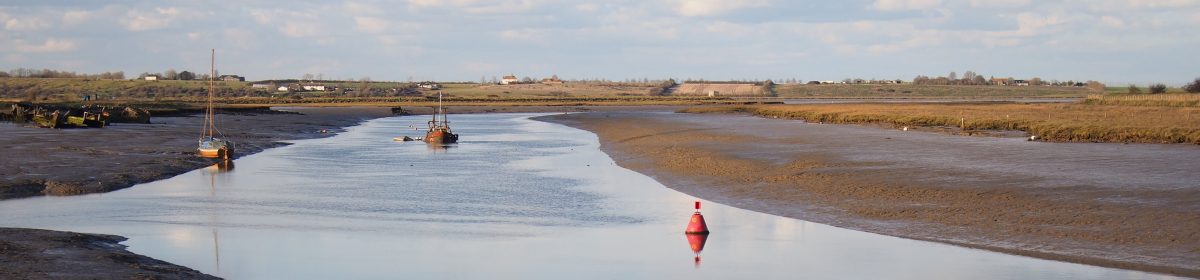
Stangate Creek. It makes you think about times past…

These days Stangate Creek on the south side of the Medway is a popular stop for cruising sailors and motorboaters – it’s sheltered, and visitors are surrounded by low-lying land and islands and saltings, and some impressive bird life.

But this peaceful spot has a heck of a past, and was frequently a less than happy place.

With the Naval dockyards at Chatham just a few miles away up the Medway, the Navy has at times used it intensively as a place to moor ships when necessary.

From 1712-1896 it was used for quarantining ships. For example, there’s a story that in 1832, the barque Katherine Stewart Forbes set out from Woolwich with a complement of male convicts for Australia but then anchored in Plymouth Sound after cholera broke out. She was sent back to Stangate Creek for many months – of 222 convicts aboard, 30 men developed cholera and 13 died.

There’s an account of how the quarantining started here.

During the Napoleonic era, French prisoners of war were coonfined in prison hulks on the River Medway, where they were subject to cholera, smallpox and typhoid, and many of those who died were buried on Deadmans Island on the eastern side of the Creek.

And of course it was close at hand in 1667 when the Dutch captured Sheerness, invaded the Medway and threatened Chatham. The Wikipedia has the story, including a wonderful painting.

In the early part of the 19th century Turner depicted it in one of his watercolours of English rivers, and much more recently, the extraordinary cruising film-maker Dylan Winter visited Stangate and seemed to fall in love with the place.

Most of the photos of Stangate Creek above including the Finesse class small yacht, the  smack, Buccaneer and the barge yacht Whippet above are mainly Julie Atkin’s shots. Only the shots showing the flooded saltings are mine…

Rescue Wooden Boats celebrates its second birthday

Norfolk’s Rescue Wooden Boats has just celebrated its second birthday and published the latest edition of its newsletter – and there is lots of news to share.

The first phase of the visitor centre just beyond the High Sands Campsite office at Greenway Stiffkey (NR23 1QP) is now open at weekends from 10:30am to 4:30pm for the summer. On display are films, photos and artefacts, and the restoration work going on in the workshop on the lifeboat and Dunkirk veteran Lucy Lavers. George Hewitt and Ben Riches have been fitting a new centreboard, and David Hewitt is working her canopy.

Rescue Wooden Boat’s online collection has now reached 80 short films and sets of photographs that provide an insight into the lives of the people who crewed the boats and used them to make livings through them using them.

Built by Billy May in 1974, the Norfolk crab boat Pegasus has been in Scotland for about 15 years in the hands of Bernard Thain.

During this time she has earned her keep supplying their restaurant and farm shop with seafood, but Bernard and family have decided to give Pegasus to the Rescue folks, and she arrived home in July.

See the Rescue Wooden Boats newsletter here.

OGA celebrates 50 years in colourful style despite strong winds

Start of Clog race by Keith Allso

Strong winds meant that just 60 boats completed the OGA’s 50th anniversary race at Cowes on Saturday, but it didn’t prevent the organisation’s members having a lot of fun.

Almost 200 traditionally rigged sailing boats gathered in Cowes Yacht Haven and Shepards Wharf Marina from all round the UK, and from as far afield as Holland, Belgium and France.

Some 141 boats registered to participate in Saturday’s big race, which would have set a new record for gaff-rigged boats racing together. However, strong winds deterred entrants, and only 94 boats started the race. Many then retired as the wind got up and the sea became rougher. But 60 stalwart boats soldiered on and finished the course.

One of the photos below by Keith Allso shows the 18ft Chough owned by Christine and David Christine Hopkins, which at 18ft the smallest boat to finish the race.

At the other end of the scale, the deep sea smack 68ft Pioneer was the oldest boat at the festival. originally built in 1864 and recently restored by the Pioneer Sailing Trust in Brightlingsea.

She once worked the fishing grounds off Terschelling, but now she takes groups of up to 12 young people from all sorts of backgrounds out to sea for an experience of a lifetime. This weekend she was crewed by a group of young carers.

Pioneer picked up more than one prize in the racing: she was first over the finish line, second in her class on handicap, and to top it all she was awarded the Youth Cup for the crew with the lowest average age.

OGA president Mike Shaw announced the launch of an OGA-sponsored youth fund to support the work of Pioneer and others like her.

Dutch visitors to the festival challenge the different UK OGA areas to make up a simple model racing boat using a kit comprising a clog, a shaped wooden keel and a lump of lead for ballast. A race was held in the marina as part of the regatta, and the winner was awarded a carved wooden tulip awarded by the Dutch skippers.

There’s more to read on the Sailing By website, and more here from Bonita.

Photos by Keith Allso, except deep sea smack Pioneer, which was taken by OGA officials