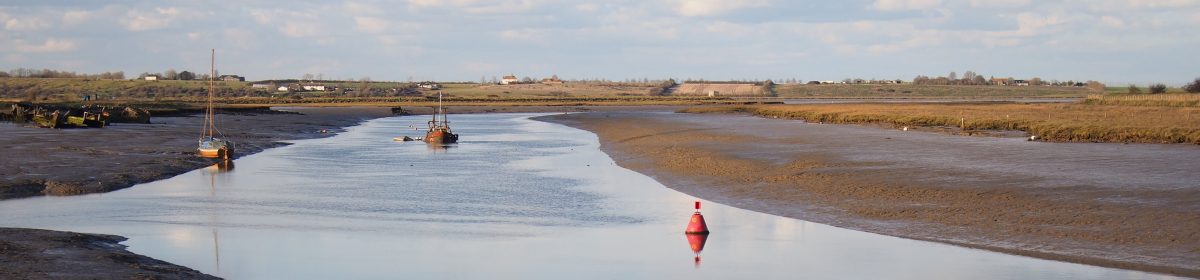
Restored Norfolk Broads half-decker Jamesia II back on the water

Jamesia II afloat April 2011

Restored Norfolk Broads half-decker Jamesia II back on the water. Click on the image for a larger shot

Mat Gravener has sent us this shot of his repaired and restored Norfolk Broads half-decker Jamesia II back on the water following lots of work over the winter. She’s certainly looking as pretty as a picture.

Mat reports that she was launched on the 23rd April 2011 and immediately floated on her marks. She took on a little water but, as he says, that was to be expected after being out of it since 2004!

He then sailed her back to her moorings and found she performed very well, even with just the mainsail set.

For more posts featuring Jamesia II and Mat’s earlier projects, click here.


Retired skipper Captain H Morris describes how he started in Thames sailing barges

Carr and Mason on barges2

Thames sailing barge illustration fromVanishing Craft, written by FGG Carr and illustrated by Frank Mason

Reading Hervey Benham’s book Down Tops’l yesterday eveing, I was very struck by the contents of a letter from Captain H Morris to the author. Captain Morris’s career in Thames sailing barges began when he decided to spend a holiday on a sailing barge, well away from his usual job in town.

‘I said to myself, this is the job for me, not sitting on an office stool making out invoices all day long. Of course my parents were all much against it. “All beer and bad language,” they said. However, the call was too great and I went to Faversham and got a job for two more trips as third hand and then mate. Incidentally, there was no beer and no bad language with my first skipper, and he never got under way on a Sunday if he could help it. The two other skippers at Faversham never sailed on Sundays.

‘There were then 125 sailing barges and 14 coasters working to and from that little port.’

Of course, I do understand that all 139 vessels were unlikely to arrive and try to tie up at the same moment, but it’s still very difficult to imagine where all those craft put themselves – much more of the creek must have been in use as wharves than can be seen today.

And speaking of Faversham I have three items of news.

First, the new Faversham Creek Trust will be manning a stall in the town’s market square on Saturday. Do get along to chat with Trust officials and offer your support!

Second – the Westmoreland is afloat after years of being washed by each tide. Read all about it here.

Third – Giacomo de Stefano (Man on the River), who is rowing and sailing his Iain Oughtred-designed small open boat from London to Istanbul plans to leave Faversham’s Standartd Quay on the 1st May, in order to draw attention to efforts to save it. Naturally I plan to be there if I can find out what time he’s planning to go (the tides suggest it will be some time after 11am) and will share any information I get…

PS – Here’s a photo of Giacomo and pal rowing his Iain Oughtred-designed Ness Yawl named Clodia just after 12.30 on Sunday. The last I heard was that he had wisely decided to get a tow over to the River Stour however – the idea of sailing a small open boat round the North Foreland in yesterday’s winds didn’t appeal and I can’t blame him!

Giacomo rowing Clodia off Standard Quay, Faversham Creek Giacomo rowing Clodia off Standard Quay, Faversham Creek 2

Stirling & Son’s latest clinker dinghy

Stirling & Son 9ft clinker dinghy

Stirling & Son 9ft clinker dinghy Stirling & Son 9ft clinker dinghy Stirling & Son 9ft clinker dinghy


Boat builder and historian Will Stirling has sent in these shots of his latest beautiful 9ft clinker dinghy – Will has a great eye for a photograph and these shots are up to his usual standard, even if it was a miserable day.

These dinghies are a regular product line for Devon-based Stirling & Son and should be better known. This particular example is mahogany on oak with copper and bronze fastenings, spoon oars, with the name relief-cut with gold leaf.

Will also sent over a photo of half a whole mahogany butt sawn at 1/2in. ‘Dinghies in kit form’, he says wryly… There should be enough for seven to ten dinghies worth of timber in this part of the log – the rest arrived in a second delivery on the same trailer.

Will and his workmates had to cut hundreds of softwood sticks to place between the planks to allow the timber to season – softwood is chosen for the job because it does not stain. I gather teabreak at the Stirling & Son shed was dominated by question of how to calculate the optimum size of spacing stick to provide effective airflow and drying while using the least timber – and Will has asked whether any intheboatshed.net readers can advise?

By the way, Stirling & Son run twice-yearly courses during which students build their own 9ft traditional dinghy under the guidance of a skilled shipwright. The courses are part-time, running for three days a week for sixteen weeks, and cost £3,500 including materials.

For more posts relating to Stirling & Son boatbuilding projects and boat design work, click here.

Mahogany log for building clinker dinghy