Interested in Bob Hinks’ Cirrus? Contact him to arrange a date to sail her

[ad name=”intheboatshed-post”]

DSC00210_2

DSC00178_2 DSC00211_2 DSC00199_2

DSC00179_2 DSCF1137

Cirrus

Bob Hinks, who graduated from the Boat Building Academy a little while ago, is looking for commissions to build up-market day-sailors along the lines of his widely admired Cirrus.

He explains:

Cirrus was conceived as a classic gentleman’s daysailer, designed to be fast, sail beautifully and look a picture. A miniature J class yacht is what we set out to achieve, and I think we got pretty close.

‘She was designed with a particular sailor in mind – someone who might have a larger boat but who wants to get back to the fun and excitement of sailing a smaller boat on offshore and inland waters. She is unashamedly a luxury item built to exacting standards in everything from her teak decks to her purpose built fittings.

‘I think her market is Poole, Mylor and Chichester Harbours, the Norfolk Broads, the Solent, Western Isles of Scotland, the Caledonian Canal, Lake Windermere and many other beautiful locations worldwide. With a lifting keel and rudder, and a minimum draft of only 500 mm, she can easily be moved on her trailer from one sailing area to another.

‘The price of £40,000 might seem high – but she cost £20,000 in materials alone, and took 2400 hours to build. If I took the drive system out of the equation she would be £7000 cheaper – but it is such great thing I don’t want to. The electric motor just makes the boat very easy to control. Getting in and out of a harbour is quick simple and nearly silent. When motoring up a creek to the pub there’s no smelly fuel or exhaust, and the quiet engine is blissful.

‘I enclose some pictures of Cirrus at the Beale Park Boat Show, which was a great success. She was sailing most of the time and looked wonderful – we had as many as five and a dog on board at one point. The pond is only just over a meter deep so we had to sail with the board and rudder up but she still performed like a dream. She was described as the belle of the ball, and I spent my time doing interviews and sailing, and dealing with many interested enquiries.

‘There are various changes I plan to make on the next boat, including a slightly heavier keel with an electric winch, repositioned bilge pumps and a modified rudder lift device. If the orders come in, I’d like to build two or three boats, one of which would be similar but a bit longer and with a small cuddy.

‘I hope to sail the boat in the South of England this summer starting with Mylor harbour in a couple of weeks – if anyone is interested in the boat and would like an opportunity to sail have a go at sailing her, I’m sure we can arrange it.’

Bob can be reached by phone at 07785 346072 and by email at bobhinks@btinternet.com.

cirrus_flyer-10 cirrus brochure

Cirrus publicity material


The new James Caird at the Beale Park Thames Boat Show this weekend

[ad name=”intheboatshed-post”]

more-james-caird-3

more-james-caird-4 more-james-caird-1 more-james-caird-2

The new James Caird, photographed a few days ago

If you’re wondering what to do this weekend – perhaps now’s the time to decide, for Friday sees the first day of the three-day Beale Park Thames Boat Show at Pangbourne!

An important attraction of the show this year is a recreation of the small ship’s boat that Sir Ernest Shackleton and his small crew used to reach Elephant Island, the James Caird, which is currently being built by students of the International Boatbuilding Training College (IBTC) at Lowestoft. We saw it during a brief visit to the college last week, and were made very welcome – the college is always pleased to receive visitors.

I was particularly amazed by the scale and diversity of the traditional boatbuilding projects under way at the IBTC, and will be writing more about it shortly.

At the Beale Park show students are scheduled to work on the James Caird’s deck beams and caulking. If you don’t know the story, after Shackleton’s expedition ship Endurance became trapped in pack ice in the Weddell Sea he and 28 men crossed a chaotic maze of ice in three salvaged boats and finally a small group including Shackleton sailed across the Southern Ocean to South Georgia to safety and to organise the rescue of the rest of the crew. The successful journey stands as one of the most impressive small boat voyages ever made – there were gales almost all the way, and it took 17 days of constant constant pumping and chipping ice from the hull and rig to prevent capsize before the little boat landed at South Georgia.

Three of the crew then climbed a four thousand foot mountain climb before staggering into Stromness whaling station to raise the alarm.

Commissioned by The Honourable Alexandra Shackleton, the new James Caird is to be used by by an expedition to re-create the voyage and mountain climb led by environmentalist and explorer Tim Jarvis.

The original boat was constructed of Baltic pine on steamed elm frames; in the absence of these, the students are using European larch on steamed oak. She is copper fastened with keel stem and a stern of grown oak. The students have planked her to the same original sheer and then built up with a further three planks in the same way as the original James Caird, and she will be decked in and canvassed. Caulking will be with cotton and she will be paid up with white lead putty, and then the whole boat will be painted white.

For more intheboatshed.net posts on the James Caird voyage and project including stunning photos of South Georgia, click here.

For more intheboatshed.net posts relating to the Beale Park Thames Boat Show, click here.

Don’t miss something good – subscribe for free and start receiving the weekly intheboatshed.net newsletter now!

Artist seeks help – she needs rusty ships in dried-out-looking seas

[ad name=”intheboatshed-post”]

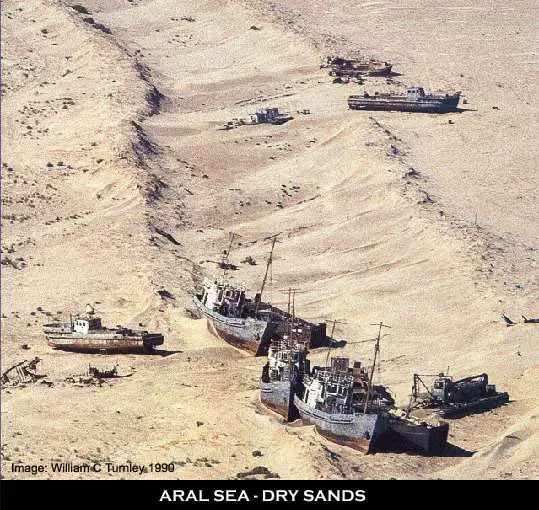
aralship

Ship in the dried out Aral Sea, photographed by Staeker, and
taken from the Wikimedia

We’ve just received this intriguing and unusual request from art student Mary Wharmby. Can anyone out there help her? I’m pretty sure that boat users who visit remote spots are most likely to be able to help.

‘Hi Gavin,

I’ve just found your blog and am really hoping you or one of your readers can help me out. I’m a grad student at the Academy of Art in San Francisco. I’m working on my MFA thesis, an interactive ecological mystery game inspired by the Aral Sea crisis in Central Asia. The project is about looming water shortages with the prototype about the plight of fishermen when they lose their fisheries. I am trying to digitally recreate a desert seabed with medium-to-large old rusty ships that players will navigate around and eventually board. I need to photograph from multiple angles and am having trouble finding appropriate ships. I found your site by searching google for ship graveyards and turned up the post about the Staten Island site (which could possibly work for me). I am looking for a place or places where I can find ships like these:

http://keralaarticles.com/wp-content/uploads/2008/05/aral-sea.jpg

http://www.global-greenhouse-warming.com/images/AralSeaDriedup.jpg

http://www.uwsp.edu/geo/courses/geog340/Photos&Illus/Aral1.jpg

The ships don’t have to match exactly by any means, just be in the same ballpark (old, rusty, medium-sized). A huge amount of touchup can be done digitally, but I need something to start with.

Because of costs, ideally I am looking for a place on the West Coast but if necessary I am willing to travel where ever I need to go. Please let me know if you know of a ship or location which may work me.

Many for reading this and for any help you can offer!

Mary W
mwharmby@inch.com’

I’m sure she means the West Coast of the USA and I’m sure too that she will obtain permission from the photographers who supply the images and credit them properly.

So – if you know any ships that appear to be lost on land anywhere, can you help Mary?