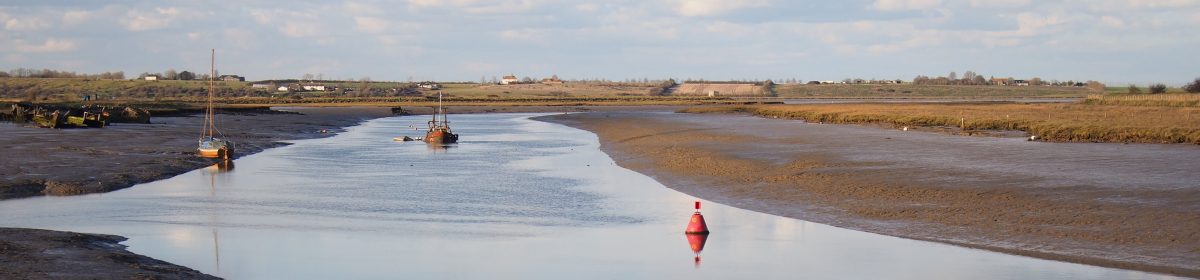
Stangate Creek. It makes you think about times past…

These days Stangate Creek on the south side of the Medway is a popular stop for cruising sailors and motorboaters – it’s sheltered, and visitors are surrounded by low-lying land and islands and saltings, and some impressive bird life.

But this peaceful spot has a heck of a past, and was frequently a less than happy place.

With the Naval dockyards at Chatham just a few miles away up the Medway, the Navy has at times used it intensively as a place to moor ships when necessary.

From 1712-1896 it was used for quarantining ships. For example, there’s a story that in 1832, the barque Katherine Stewart Forbes set out from Woolwich with a complement of male convicts for Australia but then anchored in Plymouth Sound after cholera broke out. She was sent back to Stangate Creek for many months – of 222 convicts aboard, 30 men developed cholera and 13 died.

There’s an account of how the quarantining started here.

During the Napoleonic era, French prisoners of war were coonfined in prison hulks on the River Medway, where they were subject to cholera, smallpox and typhoid, and many of those who died were buried on Deadmans Island on the eastern side of the Creek.

And of course it was close at hand in 1667 when the Dutch captured Sheerness, invaded the Medway and threatened Chatham. The Wikipedia has the story, including a wonderful painting.

In the early part of the 19th century Turner depicted it in one of his watercolours of English rivers, and much more recently, the extraordinary cruising film-maker Dylan Winter visited Stangate and seemed to fall in love with the place.

Most of the photos of Stangate Creek above including the Finesse class small yacht, the  smack, Buccaneer and the barge yacht Whippet above are mainly Julie Atkin’s shots. Only the shots showing the flooded saltings are mine…

Faversham Creek Trust’s Purifier Building premises is declared open!

Admiral Michael Boyce declares the Purifier Building open

Last night the Purifier Building, which is to be used by the new shipwright apprentice scheme as a training workshop and premises was declared open by the Faversham Creek Trust’s guest of honour Admiral Michael Cecil Boyce, Baron Boyce, KG, GCB, OBE, DL.

I could not hear all that he said, but I did form the impression that Admiral Boyce made an articulate and encouraging speech, and I certainly heard him declare his strong support for the Trust’s aims. Admiral Boyce is chairman of HMS Victory Preservation Company and trustee of the National Maritime Museum, and also as chairman of the Royal National Lifeboat Institution – he’s clearly as busy as he is decorated.

I also got a chance to find out about Mayhi, the unusual skimming-dish of a racing yacht that the first batch of apprentices are to work on, and to talk with Griselda Musset about Creek’s history potential for regeneration, which with the right management and support could be tremendous.

Check out the photos. The Purifier Building itself is a relic of the town’s gas works, but behind it is an area where gunpowder used to be made on a series of islands set between ditches – the reason for the ditches is that it was safer to move the gunpowder by punt rather than using iron-rimmed cartwheels that might cause a spark.

Despite this precaution, however, there was at least one large explosion that brought down one of the two towers of the neighbouring Norman parish church at Davington.

The wharves around the Purifier Building date back two hundred years – the one on which the building stands is known as Ordnance Wharf, and I gather gunpowder from this site was used against the Spanish Armada and at Waterloo.

This area of the Creek is a pool controlled by sluices and a swing bridge that was built at the time of the horse and cart and is now no longer working due to damage caused by the weight of the vehicles that cross it in the modern age.

Griselda explained all this and suggested I consider how the area could be, with the brickwork of the old wharves restored, the pool dredged and full of barges and Creek itself an important centre for traditional boats and boat building and repair. I have to say that for me it certainly made a compelling picture – and more than enough reason to give the Trust my support.

PS – Richard Fleury has put two short videos on Vimeo – one of Griff Rhys Jones visit to the Purifier Building a couple of weeks ago, and one recording the arrival of Mayhi.

Click on the thumbnails below to see larger photographs.

Cormorant fishing and rafting at Yangshou, China, photographed by Matthew Atkin

 - photograph by Matthew Atkin 2013
– photograph by Matthew Atkin 2013

My brother Matt has been taking more fabulous photos in the Far East – this time of rafting activities in the Chinese county of Yangshou. The photos are his  copyright, naturally.

Perhaps the most striking images here are those of fishermen on narrow bamboo rafts working with cormorants at night.

Matt was told by locals that the fishermen tie the birds’ beaks during the day to make them hungry, and take them out at night, this time with their necks loosely tied. Once the cormorants dive down and catch the fish they can only swallow the small ones – the large ones they take back to the fisherman and the birds voluntarily stay with their masters.

It’s a strikingly strange way of making a living and seems very harsh on the birds, which are of course prevented from pursuing their natural behaviours. But it you’d have to say that it’s very inventive.

The rest of the photos are largely of tourist rafting – the holidaymakers are largely Chinese, says Matt – but there is one fascinating photo of a boat that’s clearly an ancient prototype of the Mouseboat. This Googlewhack may give you some idea, and there are various plans at the Duckworksmagazine website. You can even a book from Amazon, Ultrasimple Boat Building: 17 Plywood Boats Anyone Can Build, that includes plans for several of them…

For more of Matt Atkin’s photos, click here.