Keble Chatterton on the early development of racing yachts, part I

[ad name=”intheboatshed-post”]
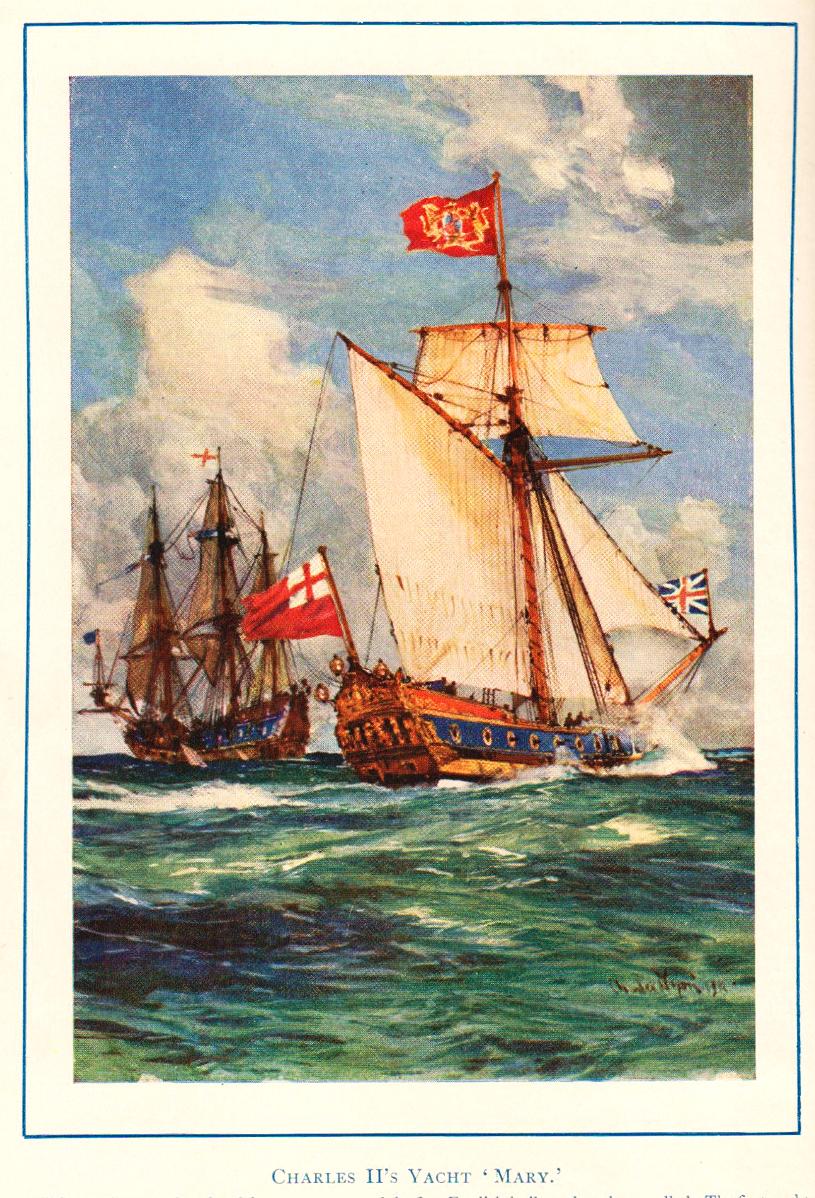
King Charles II's yacht Mary

King Charles II’s yacht Mary. Progress in the developments of yachts remained slow until after Waterloo

‘I’m still reading Keble Chatterton’s entertaining if possibly dodgy history Fore and Aft Craft, and I thought intheboatshed.net readers might be entertained by his account of yacht racing’s development during the 19th century. It comes, of course, from an early 20th century perspective.

‘Among the famous yachts of the ‘twenties must be mentioned the Pearl, the Arrow and the Alarm. These were all built as cutters. The Pearl was launched in 1820 at Wyvenhoe and was of 95 tonnes. The Arrow was 84 tonnes. She was altered and rebuilt many times since she first appeared in 1822. The Alarm, which came out in 1830, was only seven tons short of two hundred, and was one of the very largest cutters ever built. What a gybe must have been like round a mark-boat in a smart breeze we can well wonder. Her origin is not without interest, for she was designed from the lines of a celebrated smuggler that was captured off the Isle of Wight.

‘It was owing to the fact that no time allowance was granted that the development of size in yachts had gone on unchecked: otherwise such a monstrosity as the Alarm would not have appeared. Right away as far back as Charles II the English yachts had been ballasted with shot. It was suggested to Christopher Pett that stones should be used for this purpose, but he wisely declined to entertain such an idea on the ground that it took up too much room. In this respect, Pett was more ahead of his time than might appear, for the ocean-going ships had for centuries had a considerable amount of their valuable internal space taken up by gravel ballast, which left but little room for the ship’s stores.

‘In some of the early nineteenth century yachts gravel or stone blocks were still used, just as one still finds to this day in the case of some of the open fishing craft which go out from the shore to their lobster pots. After that, iron blocks were introduced, and finally a reversion to the idea of lead. Bags of shot were employed in the last century so that they could easily be moved up to windward at each tack. In 1846 lead pigs were used, and finally, ten years later, in spite of the frownings of pessimists, the lead, instead of being used as inside ballast was transferred to the keel outside.’

‘After the battle of Waterloo the sport of yachting and so the development of yacht architecture and everything connected with the yacht from ballast to running gear, received the advantage of an enthusiasm which had never previously been granted: and both immediately before and after the Crimean War this enthusiasm and interest had been increased tenfold. It was because there had been so little personal interest on the part of the owner, such scant encouragement given to the builder, such universal ignorance in regard to problems of naval design, such infrequent races for testing certain types of hull and rigs, that the progress since the introduction of the first Mary into our country had been slow.’

And then:

‘But now all this was changed. The Victorian sovreignty had brought about peace and contentment, and the effects of the great industrial revival of the previous century had already caused so much increased wealth to our countrymen that there was an unprecedented army of rich sportsmen from whose ranks to draw a large band of yachtsmen. Here then was the needful force of encouragement to builders. This was intensified by the formation of powerful yach clubs having for their object, as the preamble to almost every yacht and sailing club reads, “the improvement of yacht building and the encouragement of yacht sailing”, “giving the greatest latitude in the construction, rigging and sailing of vessels, consistent with their aptitude to yachting.’

To be continued…

Amazon has original hardback copies of an earlier edition of Keble Chatterton’s book, Fore And Aft, The Story Of The Fore & Aft Rig From The Earliest Times To The Present Day, and also scanned copies of Fore & Aft Craft and Their Story; another relevant book that looks particularly interesting in this connection is Lennarth Petersson’s book Rigging: Period Fore-And-Aft Craft, which describes the rigging of three 18th century vessels in detail – an American schooner, an English cutter and a three-masted French lugger, and includes some 200 diagrams.

Keble Chatterton on the origins of the schooner

[ad name=”intheboatshed-post”]

E Keble Chatterton on the origin of schooners

I’m reading the 1922 second edition E Keble Chatterton’s book Fore and Aft Craft, which explains the history and development of the fore and aft rig, and in particular the influence of the Dutch. It’s an eye-opening work and I was particularly struck by this section on the invention and origins of the schooner. I remain puzzled by the fact that two-masted fore and aft rigged craft are depicted earlier in the book and I’d be intrigued to know what other countries known for their schooners (such as the Portuguese) would say were the origins of their craft. Even more, I find the image he includes difficult to interpret – but what he says is intriguing and certainly makes a good story. (Beware though – the comments below strongly suggest it may not be entirely true!)

It all starts with mention of two masted sloepes depicted in painting dating from 1629 to 1642.

‘Some of these so-called sloepes were about 24 ft long in the mainmast, 42 ft in length overall, with a beam of 9ft. Now we referred some pages back to the colonisation of northern America by the Dutch, who called their territory the New Netherlands, and that which is now known as New York was called by them New Amsterdam.  Along that Atlantic coast stretching northwards to Gloucester and Boston, are to be seen to this day perhaps the very finest class of schooners in existence, or ever conceived by the mind of designer. The reason is to be found in the fact that the Dutch colonists took over the Atlantic not merely their ideas of cutters and single-masted sloops, but also the other notions of craft, including this kind of vessel depicted in the Boijmans’ Museum.

‘It was in 1664 that, during the Anglo-Dutch War, the British seized New Netherlands, but that did not mean that the whole Dutch colony vanished , nor that the Dutch-American shipping was instantly to be swept out of sight. Undoubtedly, this two-masted sloepe held on. But in the year 1713 there came a change: there was seen to be room for improvement, for it was realised this “two-sticker” could be made a better craft by adding a triangular jib as in the single-masted sloops. And so this was done. The foremast was already very far forward in the eyes of the ship, and so a broeksprit or bowsprit, had to be added also on which to set the jib, and so with this the schooner as belonging to the years 1800  to 1850 came into being. It was then distinctly a Dutch-American craft, and not British, and the date of the first of this new type was, as stated, 1713. Captain Clark relates that as she was leaving the launching ways some one exclaimed: “See how she scoons,” and from that day this prototype and her descendants have been called schooners.

‘The place where this vessel orginated was Gloucester, and this early reputation for the two-masted fore-and-after has been since continuously maintained by that port. Two separate reasons have contributed to the development of the Gloucester schooner. First there was a demand for an able type of vessel that should be capable of riding out bad weather in the Atlantic; and, secondly, the type that was required muust also have a good turn of speed, for two separate kinds of people needed just such a vessel as possessed these qualifications. In the first place there was the brotherhood of pilots, who were so keen on getting to the incoming ship that they would race for many a long mile out into the ocean so as to arrive first. Secondly, there were the fishermen who earned their living by going to fish off the Grand Banks. Having filled up with the spoil of the sea, it was their duty to hurry back to market, and obtain the best prices for their catch.’

Keble Chatterton analyses the astonishing Portuguese muleta

[ad name=”intheboatshed-post”]

muleta, muletta, moletta, portugal, fishing boat, trawler, lateener, tagus, keble chatterton, water-sails, lugger, st paul, artemon,

Portuguese muleta illustration from The Story of Sail by GS Laird Clowes and Cecil Trew. Click on the image to see some of the amazing details, including the weird sails at the stern

E Keble Chatterton’s book Fore and aft craft – the story of the fore and aft rig turns out to be a fascinating document, despite my instinctive distrust of any writer with such an extravagantly salty writing style.

Much of this book is drawn from personal observations of old paintings over the centuries, and there are some real gems here in among the old-fashioned hyperbolic rambling.

As I was reading the other day I particularly liked his analysis of the wonderful Portuguese muleta illustrated above. Here’s what he has to say – as you read it, you may like to consider that Keble Chatterton didn’t manage to include a picture of a muleta in his own book and also that this is a fairly restrained example of his writing!

‘Another characteristic to be noted is that whereas the lateen of the Orient tends to become practically a rectangular shape, the Spanish fishing craft retain their strictly triangular form. But it is the Portuguese moletta or muletta which, though a lateener by descent and nationality, does her very best to disguise herself from any other vessel afloat in any part of the world. Looked at for the first time, it seems impossible to place her in any category of sailing craft. Her sail plan seems less like that of any rational vessel than a terrible nightmare of a geometrician. Everywhere it seems all angles and squares; the number of straight lines is bewildering and apparently utterly meaningless. You would put her down at the best as a freak of an exceptional type and past the wit of any sailing man to comprehend, let alone the average layman accustomed only to pleasure craft or the picture of full-rigged ships. But it is when we begin to examine the muletta that we find out her true nature. In the main she is still a lateener, as her biggest sail shows.  Forward she carries those square “water-sails” which belonged to the first full-rigged ships of the Middle Ages, and handed down to us through the Tudor and Elizabethan periods even to the early part of the  nineteenth century, when our sailor-men used to call them “Jimmy Green’s”. Right aft a jigger projects something over the stern something after the manner of a West of England lugger, and thus additional after-canvas can be set. Forward of the lateen a staysail is set, which reaches from the top of the mast to the bowsprit or sometimes to the stemhead. Forward of that, again, comes the jib, and besides the lower water-sail there is also an upper square-sail which extends from a small foremast with considerable rake forward, after the manner, and a survival of, of the classical artemon which existed even in St Paul’s time.

‘What is the meaning of all this complication, do you ask? The answer is very simple. These mulettas are employed in the trawling industry, and the intention is to balance the sail of the bows against that of the stern so that they may easily regulate the speed of the ship when the trawl is down. These beamy black-hulled craft are about fifty feet in length and carry a crew of ten men, their home being the Tagus. The muletta is evidently very proud of her ancestry, for she still paints eyes on her bows, still fits those curious spikes forward above the waterline, features which are curious but interesting survivals from the time when Roman galleys used to ram each other on the waters of the Mediterranean.’

If you’re having trouble relating all this to the drawing above, you aren’t alone – but I still contend that the muleta is nevertheless a wonderful thing to contemplate.

For an earlier post on this topic, click here.