
‘I had a beautiful yacht… ‘

[ad name=”intheboatshed-post”]

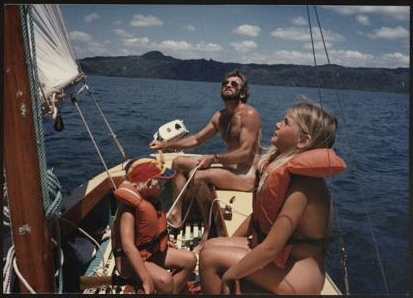
aerial1

mailgooglecom

Photos of Aerial by Phil Smith

Phil Smith has written to show us these photos, and to tell us about his airborne lifeboat Aerial, which he had in the 1980s in New Zealand.

‘In the early eighties I had a beautiful yacht called Aerial. She was 23 feet long, around six foot of beam, floated in ankle deep water, and went like the wind.

‘Her name derived from the fact that she was an airborne lifeboat designed for use in rescuing downed aircrew from the North Sea during World War II.

‘Built of double-diagonal mahogany on dozens of thin oak ribs with epoxy dynel sheathing, she was a strong but slippery boat and surprisingly seaworthy. Stability was provided by a heavy steel quadrant shaped centreplate and on either side of the centrecase were the tangs from which the parachute harness was attached.

‘The airborne lifeboats were designed by British naval architect and maritime legend Uffa Fox to fit under the hull of a medium bomber.Within the hull were numerous watertight lockers which, as well as providing buoyancy, contained food, water, first aid things and sailing equipment.

‘The boat was dropped by parachute to survivors in the sea who would rig the mast and rudder and sail to safety.

‘On my first day out I was apprehensive about going alone. It was 10 knots, gusting to15, and Aerial looked like she could be a bit of a handful.

‘A very experienced yachting friend, just returned from a solo voyage from Tahiti, came and officiated. To my horror and delight he sheeted her hard in and, with four bums on the gunwale and my friend grinning wickedly at the tiller, we took off up the harbour in a cloud of spray.

‘She tacked perfectly, sat nice and straight downwind, didn’t slam into chop and never looked like putting a spreader in the water though we tried hard!

‘Because of the strong tides and sometimes fluky winds in the area I fitted a 4hp Evinrude to a light transom bracket and she became unstoppable under power.

‘A relative of Uffa Fox’s Flying 15, Aerial was rigged like a small trailer-sailer, and while simple to launch she was a swine to retrieve due to her length and lack of any keel.’

Thanks Phil – that’s a super story. I wonder whether any of these conversions are sailing now?

Follow the link for more on airborne lifeboats at intheboatshed.net.

PS I’ve been sent these photos of an airborne lifeboat looking very like Phil’s being carried by a US Coastguard plane. My informant, a kind chap called Eric, has no idea where he found them, so if anyone feels I have infringed their copyright in putting these small images us, please contact me and I will take them down immediately. However I would be grateful to be able to leave them in place – the airborne lifeboat story is an important one and should be remembered. Thanks Eric!

pb1g_1

pb1g_8


Kingston Rowing Club, 1902

The filmk shows a number of coxed fours and a single or two, one of which capsizes, and what I take to be a working boat. But what’s the source of power here?

[ad name=”intheboatshed-post”]

kingston-rowing-club-19021

Here’s another YouTube presentation of some footage made public by the British Film Institute. The film shows a number of coxed fours and a single or two, one of which capsizes, and what I take to be a working boat. But what’s the source of power here – is it a steamer, or is she just drifting with the tide? There’s steam or smoke or both coming out of a small chimney, but I’m unable to decide what’s happening here. Answers via the comment link below please!

Follow the link for more boats from the Humber Estuary.

More of Roger Davies’ classic marine paintings

To bookmark a post, double-click on the headline, let the post open, and bookmark

Roger Davies has been a marine artist for 30-odd years, although he claims it wasn’t a conscious decision – rather, it seems that living in a series of seaports had a powerful influence on his work. Over time, he lived in Newport, London, Belfast and Hull, and became drawn into the history of boats and ships, and those who sailed them. Perhaps unusually, his interest was caught by both the world of wealthy yacht-owners (and the crews, who were often fishermen also) and by the world of working sail.

The foundation of his very detailed work is undoubtedly his almost obsessive research. The atmospheric quality of his paintings probably derives from most of his career being spent as a watercolourist: ‘For a long time, I found I couldn’t develop sharp and precise detail with thick, sticky oil paint, and so I preferred working in watercolours.’ However, he’s now back working in oils, attracted by what he calls the extra ‘oomph’ of the medium. His classic yacht paintings in particular are almost exclusively in oils.

The Big Five
THE BIG FIVE,1926
Named by journalists of the time, The Big Five were a mixed class of superyachts who raced on handicap throughout the mid-1920s. They were:(L to R) White Heather II, Westward, Lulworth, Shamrock, Britannia, and are shown here at the start of a race during Cowes Week 1926.

Lulworth dominated the class during the year, as she had the year before. This painting was commissioned by her owner to be the centrepiece of the newly restored Lulworth’s saloon below:

The Rebirth: Lulworth off Portonvere
THE REBIRTH: LULWORTH OFF PORTOVENERE
After working for over two years on Lulworth commissions, Roger decided to commemorate her restoration himself with this painting of her sea trials in the waters of northern Italy. He was a privileged guest at her regatta debut at the Argentario Sailing Week in June 2006, and says that racing on Lulworth was unforgettable.

Sloop off Hessle Cliff
SLOOP OFF HESSLE CLIFF
A Humber Sloop sailing eastwards past a mill at Hessle on the north bank of the Humber, circa 1920. Hessle Cliff refers to a nearby quarry visible from the river. This the site of the Humber Bridge today.

Sloop approaching the river hull

A SLOOP APPROACHING THE RIVER HULL
A Humber Sloop about to leave the Humber and enter the river Hull. The mate is beginning to work the foresail halyard winch to reduce sail for the journey through the confines of the narrow river. I should explain that the location is given by HMS Southampton in the background. She was a borstal ship moored just to the east of Hull until 1912.

Thames barge in a blow
THAMES BARGE IN A BLOW
Originating in the Thames region, these capable vessels ranged far and wide round Britain, wherever they could find work. They could be sailed by just a man and a boy.

In a Clearing Mist
IN THE CLEARING MIST
Roger’s notes: The painting shows a Humber Sloop and Keel. These later barges were iron or steel hulled, while the earlier ones were wooden. The Sloop, being unladen, shows the typical bluff bow. Her mast is stepped further forward than the Keel’s to accommodate that long boom.

The Big Five and Sloop off Hessle Cliff are sold, but the other four are recent work and still available. These and other paintings and prints by Roger Davies can be seen at Top Pictures, 7 Hepworth Arcade, Silver Street, Hull, HU1 1JU. Go to: http://www.toppictures.co.uk

Roger also undertakes commissions.
