So, Turner’s paintings aren’t so far off…

JMW Turner’s paintings can sometimes seem a bit theatrical – well, I suppose it helped sell his pictures – but as this YouTube shows, the sea really /can/ be the way he depicted it.

My thanks to author, campaigner and kipper magnate Mike Smylie for passing this one along.

One thing though… If you’ve ever wondered what Val Doonican’s 1960s hit might have sounded like in Icelandic, turn your speakers up. If  not, it might be wise to turn them down…

‘Build me straight’ 1963 Scottish documentary about the building of a fishing boat

[This has been pulled from YouTube but is still available from the Scottish Film Archive. My thanks to Iain McAllister of the Peggy Bawn Press for letting me know.]

Thanks to Hans Christian Rieck for pointing this one out.

The poem, by the way (isn’t the Internet wonderful!), the title comes from a poem by the American poet Longfellow, which turns up on the Poetry Foundation website among other places.

Poetry can be a complicated thing, and at a big distance in time its meaning can be lost if no-one explainsd it. So here’s a short quotation from the Poetry Foundation’s piece about Longfellow:

‘The Building of the Ship combines a tribute to the master builder who designed the ship with a love story linking the master’s daughter to the ‘fiery youth’ employed in its construction while making clear that the Union stood allegorically for the United States on the eve of secession. Fanny Kemble performed this poem in dramatic readings, bringing herself and audiences to tears in the memorable emotional crescendo of the last stanza with its invocation to an imperiled country that is nonetheless the best hope for the world: ‘Thou, too, sail on, O Ship of State! / Sail on, O UNION, strong and great!’ President Abraham Lincoln, hearing these lines recited in the midst of the Civil War, is reported to have wept before remarking, ‘It is a wonderful gift to be able to stir men like that.’

Nowadays, of course, we tend to titter at ‘ship of state’ analogies and patriotic idealism, and instead of high hopes for the future, instead worry that our political leaders may be influenced a little too much by the rich and powerful. Such different times…

I also note that Longfellow clearly had an inkling about the aims of the ship designer – not too much tophamper, centre of gravity not too high, the importance of hull form in steering, and a stern designed to allow the water to close nicely aft…

(By the way – there’s a fairly recent post on this weblog about another famous nautical Longfellow piece, The Wreck of the Hesperus.)

The Building of the Ship

By Henry Wadsworth Longfellow

‘Build me straight, O worthy Master!
Stanch and strong, a goodly vessel,
That shall laugh at all disaster,
And with wave and whirlwind wrestle!’

The merchant’s word
Delighted the Master heard;
For his heart was in his work, and the heart
Giveth grace unto every Art.
A quiet smile played round his lips,
As the eddies and dimples of the tide
Play round the bows of ships,
That steadily at anchor ride.
And with a voice that was full of glee, Continue reading “‘Build me straight’ 1963 Scottish documentary about the building of a fishing boat”

The latest issue of the wonderful The Marine Quarterly and two books: Mike Smylie’s Traditional Fishing Boats of Europe and an account of cruising in canoes in the 19th Century

flyer-big

Novelist Sam Llewellyn’s other project, the unfailingly beautifully edited The Marine Quarterly,  continues to impress, and I’m enjoying the new edition as much as I have each of the previous nine editions. I say it’s essential reading, and that a full set – if one could keep them together – would be an asset when waiting for the tide.

This issue includes an illuminating history of pilots and piloting by Tom Cunliffe, Ken Duxbury’s account of visiting his first Greek island aboard his Drascombe Lugger Lugworm,   and an introduction to the story of pier-head painting by artist and illustrator Claudia Myatt.

In fact, if anything it gives me even greater pleasure because it includes a piece from Ben Crawshaw. Ben, as regular readers may remember, built one of my small boat designs, the Light Trow, and his book Catalan Castaway recounts his remarkable adventures. (See the ad at the top right of this weblog.)
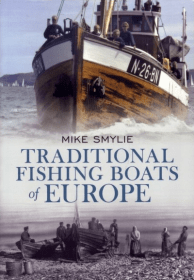
Mike Smylie Traditional Fishing Boats of Europe

I’m also just beginning to read Mike Smylie’s latest book, Traditional Fishing Boats of Europe, which aims to tell the story of how the various types of fishing boats evolved over hundreds of years in line with the catches they were built to chase, the seas and climates in which they must work, and of course the cultural influences involved.

It’s a complicated story and clearly an important project, and I’ll be fascinated to find out just how he can cram all of that information between two covers! No doubt he can, though, because he’s done this kind of thing before and knows what he’s doing…

Those Magnificent Men in Their Roy-Roy Canoes

Jim Parnell’s Those Magnificent Men in Their Roy-Roy Canoes is clearly a must for  anyone interested in the remarkable story of sailing in these little boats.

It’s really a historical record of the adventures of the three New Zealand canoeing Park brothers, George, William  and James, who were active in the late 19th and early 20th Century, and includes material from their logs and from newspaper cuttings, and is written very much in the quite formal, slightly detached style of that era.

Still, the adventures they describe are quite something, and include crossing South Island (including a long portage, naturally) and crossing Cook Strait on a night with no moon. I needn’t mention how dangerous the Southern Ocean can be – but the Parks, particularly George Park, seem to have been indomitable.