
[ad name=”intheboatshed-post”]
Here’s another small slice from Keble Chatterton’s history Fore and Aft Craft. See the previous extracts here, here and here.
‘But it is when we come to study the ten years that are covered by the dates 1870 and 1880 that we begin to see still greater activity. It had been preceded by a fine fleet of cutter yachts that included the famous Oimara, built in 1867, and still used , but as a houseboat in Poole Harbour, above bridge. Her spars were all big, and her great topmast and lengthy bowsprit were characteristic of that period. The tonnage of this vessel is 135, The Aline and Egeria also belong to this period, the former being historic as having been the first yacht to discard the rake which was always given to the mast previously.
‘The ‘seventies saw a real awakening in yachting – a new birth as it were, There were big schooners, cutters, and yawls, and yacht building yards were busily employed. It was during this period that the famous forty-tonners came into being that numbered in their class among others the well-known Foxhound and Bloodhound. The last mentioned has attracted an increased amount of attention by her return to racing during this twentieth century. She was recently altered by Fife, and has done remarkably well in handicap races when we recollect her great age as compared with modern flyers. Under the new modification the Bloodhound was given a raised sail-plan, and the ballast was brought lower down. In addition to this, the forefoot was cut away, and she was thus made quicker in stays.
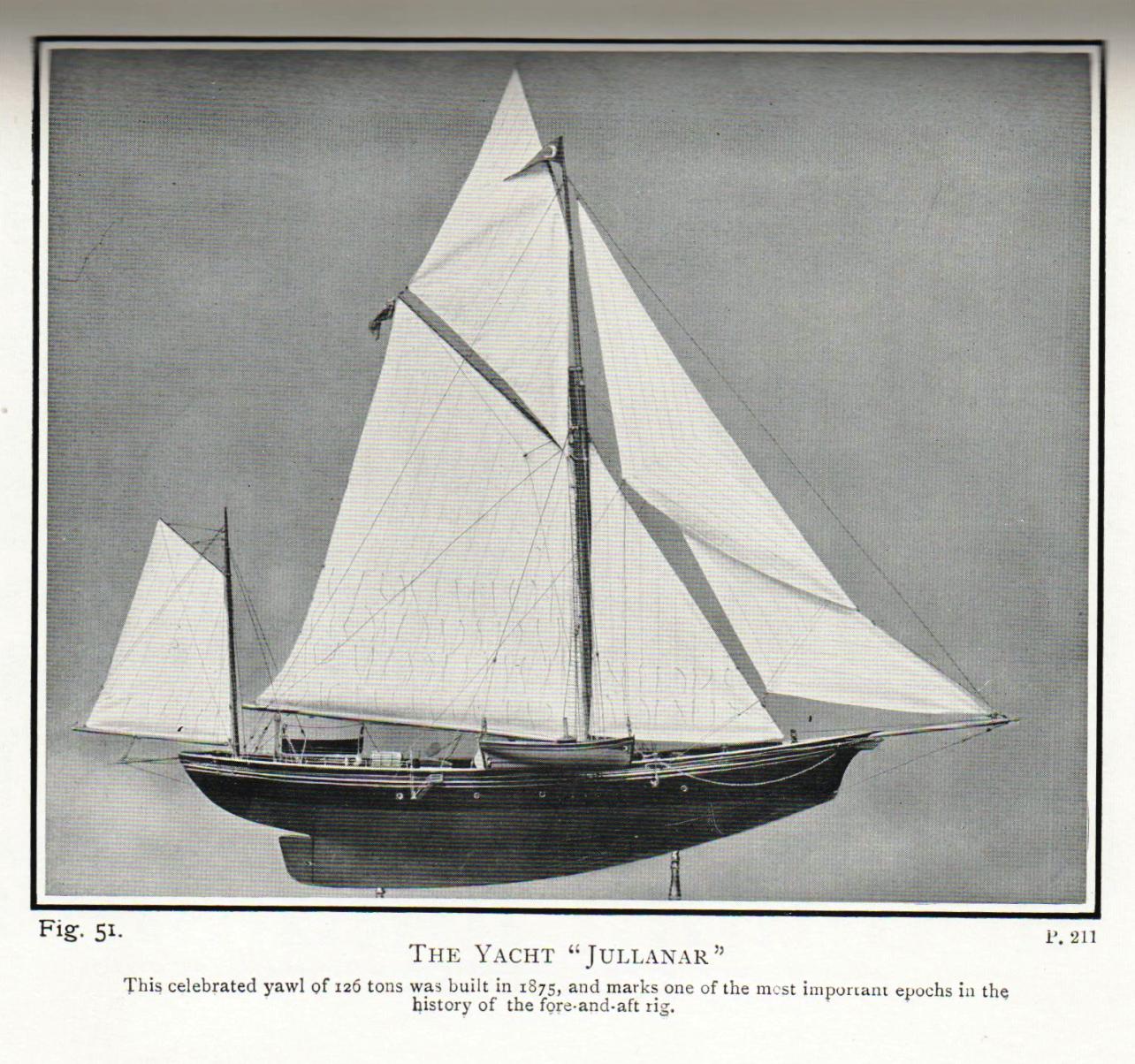
‘But besides these celebrated forty-tonners we must call attention to the equally famous Jullanar, which was representative not of a class but as a special and original creation. The Jullanar, which we have here reproduced in Fig. 51 [see above], from a model in the South Kensington Museum, is indeed a milestone on the road which begins in the late sixteenth century and reaches on the the present day. Perhaps there was no designer of the fore-and-aft rig of our own time that did so much for this development as the late Mr G L Watson. His name was associated with a fleet of crack yachts that is too numerous to give here. And when it is remembered that Mr Watson frankly admitted that he himself was considerably influenced by the lines of the Jullanar, we have every right to regard this vessel as one of the highest importance. To some extent the excellent illustration here will speak for itself, and the fewest words will suffice to demonstrate her special features. Her birthplace was in Essex, that county which has brought forth so many famous craft and equally famous sailor-men.
‘Designed by a Mr E H Benthall, the Jullanar, of 126 tons, was built in the year 1875. In this model the old-fashioned straight stem and the old-time stern have vanished altogether. There is not a trace – in detail at least – of the former Dutch influence. Her bow, however, shows some connection with the prevailing schooner of that period, and so with the clipper ships which were then fast coming to the end of their limit of usefulness. This yacht showed herself such a success, and possessed of so great a speed, that Mr Watson based his design for the famous Thistle on the lessons to be learned from the Essex craft, although the Thistle did not actually appear until the year 1887.’
The last time I looked, Amazon had just a few copies of Fore and Aft Craft.

