Boatbuilder Adrian Morgan’s latest projects

Norwegian-derived 15ft boat designed by Adrian Morgan

Norwegian-derived 15ft boat designed by Adrian Morgan

15ft water ballasted small boat designed by Adrian Morgan for Loch Torridon

Stuck last week at home in the ice and snow like many in the UK, writer and Ullapool-based traditional boatbuilder Adrian Morgan got stuck into something he hasn’t done for a while – he sent intheboatshed.net some words and photos.

Naturally, I’m very grateful though I too could do without all that tedious white stuff.

In fact, it all got so bad for Adrian that he decided to start a very interesting weblog: The Trouble with Old Boats.

Here’s what Adrian has to say about the boat above:

‘This was launched in late summer for a client with a cottage on Loch Torridon. It’s built to my design developed from Norwegian original, but beamier and flatter-floored for more stability. She carries water ballast, so is light to tow and launch, but sits deeper for stability. She’s 15ft in length, and built of larch and oak with a standing lug.’

Guillemot rowing boat designed by Iain Oughtred and adapted by Adrian Morgan Guillemot rowing boat designed by Iain Oughtred and adapted by Adrian Morgan Guillemot rowing boat designed by Iain Oughtred and adapted by Adrian Morgan

Guillemot rowing boat designed by Iain Oughtred and adapted by Adrian Morgan Guillemot rowing boat designed by Iain Oughtred and adapted by Adrian Morgan Guillemot rowing boat designed by Iain Oughtred and adapted by Adrian Morgan

Oughtred Guillemot adapted by Adrian Morgan

And here’s what he has to say about this Iain Oughtred-designed Guillemot:

‘Built to replace a 12ft family dinghy that had been well used and loved for 40 years, this Oughtred Guillemot will be rowed on the choppy waters of the Firth of Forth. Stretched to just over 12ft from Iain’s plans for an 11ft 6in dinghy, she has enough length now to allow a rower forward and passenger aft, with another midships, or she can be rowed, swiftly, by one rower sitting centrally.

‘The planking followed Iain’s lines to the letter, once they emerged from below the waterline. Drawn for plywood, there was no way the garboards in larch could match the plywood’s width. I must admit to giving her a little more freeboard forward, as I was concerned she might dip her bow when fully loaded and punching into a head sea. I am not convinced I should not have stuck ruthlessly to Iain’s plans, but where’s the fun in building a one-off boat in solid timber if you can’t tinker a wee bit?

‘With her white-painted bilges, well protected against the rain water that is destined to fill her on her mooring, and varnished topsides, she is a simple, unpretentious little rowing boat of the kind once thrown up in their hundreds and thousands. The finish is smart, but not fussy. You can see your face in the transom, but a little wrinklier than for real. I hope she’ll last looking this good. If she lasts as long as her predecessor, then I will be happy – and in my 90s!’

Many thanks Adrian. I hope you enjoy your weblog as much as I enjoy this one!

If either of these boat tickle your fancy or even meet your needs, contact Adrian via his website: www.viking-boats.com
Book celebrates John Welsford’s Navigator

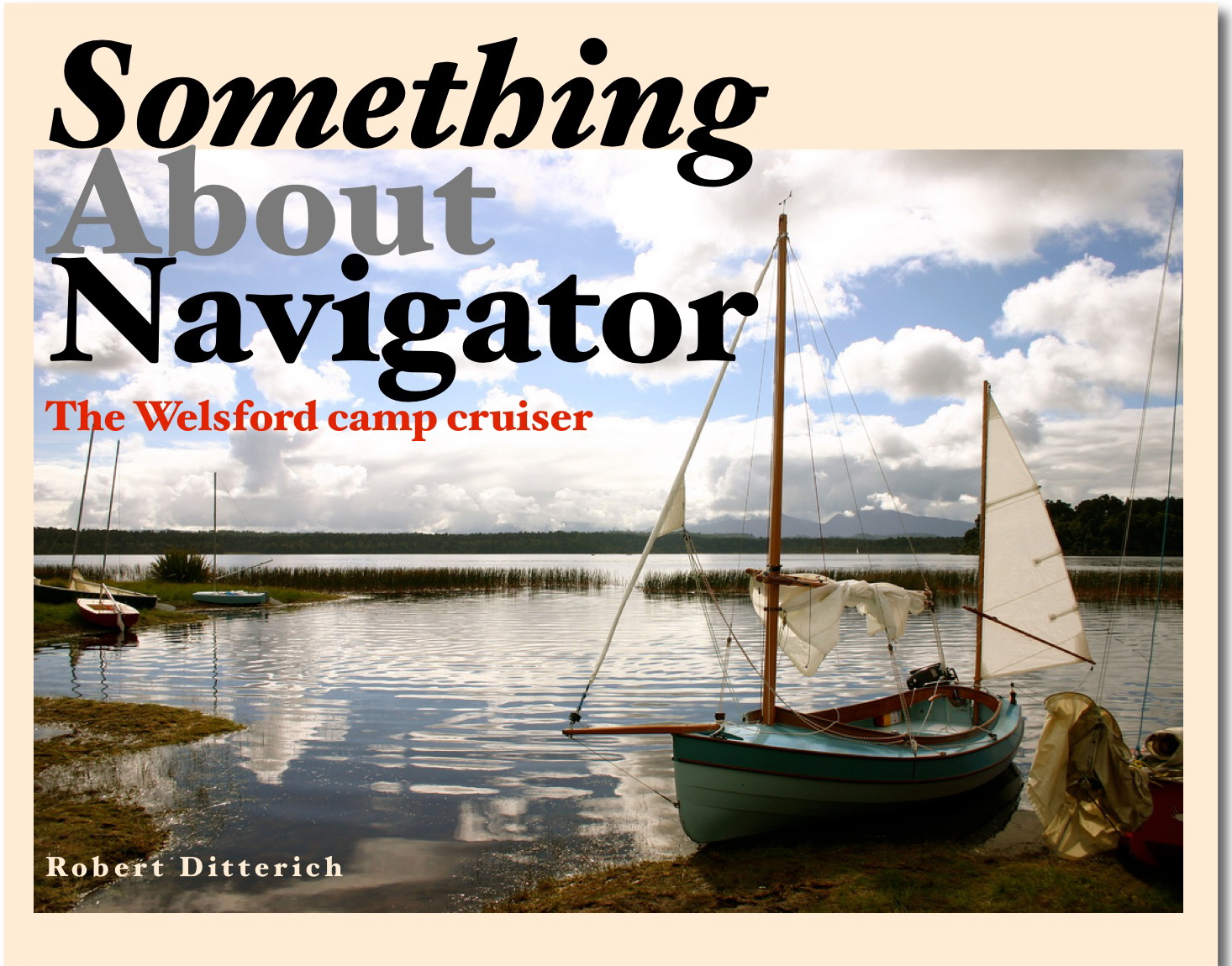
An enthusiast’s self-published book about designer John Welsford’s popular Navigator design is out now.

Robert Ditterich is a violin maker among other things, and clearly both a craftsman and a networker, for in addition to John Welsford himself he’s persuaded some well known names in the Navigator world to donate their experiences. Just some of his contributors are Steve Parke, Owen Sinclair, Richard Schmidt, Chuck Leinweber, Kevin Brennan, Martin Welby, Dave Perillo, Dave Johnstone and Barrett Faneuf.

In Something about a Navigator Robert outlines the development of the design and the aspects of the boat that have made it popular, and a bit of an analysis of the aspects of the boat that have made it such a success, some stories by Navigator owners, sailors and builders. There’s also a chapter about building a hull and another detailing fittings and a list of useful resources.

I haven’t seen the book itself, but if the Navigator is on your boat-dreaming list, I’d say Robert’s book is likely to be both informative and inspirational. Here’s what he says about it:

‘It is my sincere hope that this little book will give some pleasure, not only to Navigator enthusiasts, but to dreamers, builders and sailors who just want something simple, real, and creative in their lives and who find that thinking about little boats is helpful and maybe even inspirational in all that.’

Something about a Navigator is available in two editions, a low cost black and white version priced at $20 and a colour version at $42. Both are available from Robert’s weblog The Middle Thing.

Btw, if anyone has already got a copy, I’d be most grateful for a brief review!

250 year-old birch bark canoe in Cornish barn to be returned to Canada

Enys birch bark canoe sees daylight for the time in decades

The birch bark canoe on location on the Enys Estate A painting by historical artist John Buxton showing similar birch bark canoes as they would have been used over 200 years ago

Enys birch bark canoe sees daylight for the time in decades; the canoe on location on the Enys Estate; painting by historical artist John Buxton depicting similar birch bark canoes as they were 200 years ago

National Maritime Museum Cornwall curators are working to conserve what may be the oldest birch bark canoe in existence, before it is sent back to Canada.

For over 200 years, the canoe has belonged to the Enys family having been brought to Cornwall by Lt John Enys after he fought in the American War of Independence in 1776. It is estimated to be over 250 years old.

‘Lt Enys sailed from Falmouth in a packet ship to join his regiment in Canada to relieve the city of Quebec, which was under siege from the Americans,’ said NMMC boat collections manager Andy Wyke.  ‘He fought many military campaigns and toured the area for his personal interest – discovering this canoe along the way. It’s incredible to think its legacy has been resting in a barn in Cornwall all this time.’

The canoe has been kept near Penryn in an Enys Estate barn for many years but this week it was moved to the NMMC, where it will be conserved, preserved and put on show from late January until it is  repatriated to Canada in September.

The canoe came to light when Enys family descendent Wendy Fowler called the museum to request they look at the canoe lying in the Estate’s barn.

Captain George Hogg NMMC archivist and trustee said ‘When we received the call from the Enys family to identify their canoe in a shed we had no idea of the importance of the find. We knew we had something special, but having worked with the British Museum on the artefacts and the Canadian Canoe Museum in Peterborough, Ontario, we now believe that this is one of the world’s oldest birch bark canoes. This is a unique survival from the 18th century.’

Canadian Canoe Museum researchers hope to identify where the boat may have been built and by which tribe.

PS – Duckworks has an excellent post explaining how birch bark canoes are made.