Standard Quay cause makes the national press

Standard Quay story in The Guardian

The developers planning to turn the Standard Quay area of Faversham into a yuppie flat and restaurant area seem to be gaining momentum with their project. We gather have given the traditional craftsmen of the area notice to quit.

It’s desperately sad to see such an important maritime centre ruined for the sake of the awesome but stupid god Mammon, but it’s heartening too that the opposition is also gathering strength, and this article published in The Guardian this week is an excellent example.  I hope the developers and more particularly the Swale planning authority read this, realise what they’ve done and do something urgent to improve the long term position.

The issue has also been covered by the local TV station’s news team, as the The Quay website explains.

Read an earlier post to find out more about Standard Quay and the issues involved.

PS – One of the reasons why Standard Quay is important is that it is one  of very few places where the skills and facilities exist to maintain Thames sailing barges. I’ve been asked to tell readers that there’s a new film in production about Thames sailing barges, and that a trailer can be viewed here. I’m sure I recognise Bob Roberts in it by the way, so it probably also features Cambria, which is arguably the most famous Thames sailing barge of all. And guess which barge is currently at Standard Quay for a major overhaul? Yes, it’s the Cambria…

Outrigger canoes of the Phillipines photographed by Matt Atkin

Phillipine Islands outrigger canoes photographed by Matt Atkin

Phillipine Islands outrigger canoes photographed by Matt Atkin Phillipine Islands outrigger canoes photographed by Matt Atkin Phillipine Islands outrigger canoes photographed by Matt Atkin

Matt Atkin’s been on his travels again, and this time my brother has bagged some shots of craft used in the Phillipines – and brought back more striking evidence of the diversity of human life.

The modern world hasn’t yet made us all the same, and Matt was very struck by how different these fragile-looking outrigger canoes are compared with anything he’s seen before – the fact is that folks in these islands are still using craft very like the Phillipines Islands banca that HC Folkard included in his wonderful mid-19th Century classic The Sailing Boat.
.

Phillipine Islands banca in HC Folkard The Sailing Boat

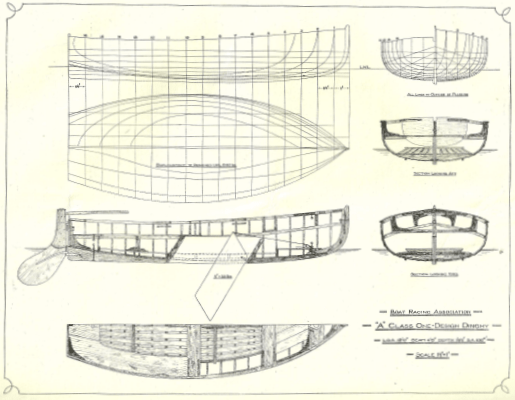
Boat Racing Association A-Class One Design Dinghy specifications and drawings

A-Class one design dinghy specification

A-Class one design dinghy specification

Brian Smith has sent in interesting scans of the specification for the delightful Boat Racing Association A-Class One Design Dinghy, which I gather is a very close relative to the International 12. I’ll let him tell the story:

‘Hi Gav,

‘I attach drawings and specifications of the BRA 12ft dinghy as published in the Yachtsman of 12 June 1913, which could be of interest to your readers as I believe they were little changed for the International 12ft dinghy class.

‘George Cockshott [the designer of the International 12] was a frequent and sometimes successful entrant in design competitions in the Yachtsman and Yachting Monthly, although it is not certain that any of those designs were ever built. The 12ft dinghy design was the result of a competition run by the BRA. Cockshott may have been inspired by the 12ft restricted class sailed at Hoylake, West Kirby and Rhyl. The design does seem to have been influenced by the class.

‘The largest yacht designed by Cockshott appears to have been the 19 tons TM Nautilus II built by R Lathom at Crossens, near Southport in 1902.

‘Hope this is of interest,

‘Brian’

Thanks Brian – it certainly is. I love all that old-fashioned specification stuff: ‘The whole of each boat, inside and out, to be varnished four coats best yacht varnish. (Or, if desired by the owner, the bottom to be painted three coats and finished with anitfouling composition or enamel externally, and to be painted three coats internally). The name or number to be written in gold leaf and shaded, on the transom or as may be required.‘

For a post on George Cockshott’s International 12 dinghy, click here.