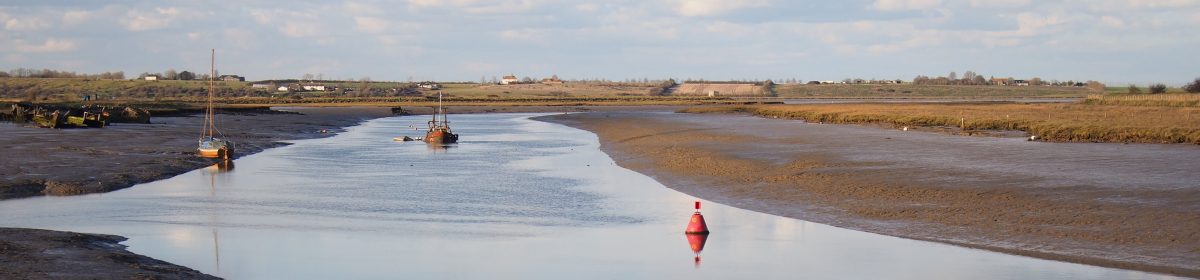
Scoter is being restored – does anyone have information or photos that might help?

[ad name=”intheboatshed-post”]

Scoter in early 2010

Jan Carpenter has written in to report that he has acquired Scoter – the boat from which Maurice Griffiths took much of his inspiration for the design for Idle Duck.

Idle Duck belongs to a friend, and I have posted photos of her once or twice, while  Scoter has come up in comments on a post about boats used for wildfowling.

A beamy 14-tonner, Scoter was built in 1894 with shallow draught, a transom stern and a heavy iron centreboard and was originally rigged bawley-fashion.

I don’t yet know for what purpose she was originally built, but we do know that some time after she was built she belonged for a time to a leading wildfowler, and it’s said that with two guns mounted on each side of the foredeck for a period she became the terror of the Essex marshes in misty weather.

Jan acquired Scoter because he felt compelled to save her from being burned. Here’s what he says:

‘I’m researching the maritime history of the River Lynher in Cornwall and was made aware of her lying on one of the Lynher’s many tributaries. I felt compelled to save her and have since found out her historical significance, which led me via a Google search to the comments on your website… She’s now safe on dry land and soon to be covered for a full restoration.

‘Any info or images of her in the glory days would be gratefully accepted. So far I have info from Lloyds Register, a copy of a article by Griffiths that talks about the Scoter in relation to Idle Duck and a copy of the book Coastal Adventure by John Wentworth Day.’

In the series of comments mentioned earlier Idle Duck owner Bob Telford reveals that Wentworth Day’s book describes the owner of the original Scoter, a certain Xavier Victor Alfred Octave de Morton, Count de la Chapelle, co-founder of the Wildfowlers Association.

I’m sure we all wish Jan well with his project. If anyone has any information that he will find interesting, encouraging or useful, please send it to me at gmatkin@gmail.com, and I will pass it on. He hasn’t yet revealed whether the restored Scoter will be complete with an impressive set of guns however…

The Griffiths article linking Scoter with Idle Duck has been made available by the Eventide Owners Association; the particular link of interest is here.

PS Don’t miss the comments below – some really good information has been coming in, some of it from a previous owner.

PPSScoter is now being restored by John  Owles’s company Roving Commissions. See more on the Roving Commissions website.

Book review: London’s Waterways

[ad name=”intheboatshed-post”]

Thames barge, River Thames, London

London’s Waterways is an attractive and account in photos and captions of the capital’s rivers and canals by waterways cameraman and writer Derek Pratt, and published by Adlard Coles. You can pre-order a copy from Amazon as the book isn’t out until 1 March 2010: London’s Waterways.

I’ve lived in and around London for much of my life, and either cycled or walked along most of the canals, but I confess I hadn’t heard of the Rivers Crane and Brent, and the Wandle was only known to me as the name of a line of buses. More, I’ve always connected the name Tyburn with public executions and barely noticed that it could be the name of a river.

So, although Pratt has done a good job of many the great set-piece River Thames photos – pleasure boats, the busy London Pool and so on – as well as the canals, there are quite a few surprises here.

For example the little River Tyburn feeds the lake in Regent’s Park, and runs through Grays Mews Antiques Market, where it provides a home for a colony of goldfish.

The prosaically named New River runs for an astonishing 38 miles and was laboriously built in 1603 to carry fresh water from Hertfordshire into London. It’s still in use.

The River Neckinger, which meets the Thames near London Bridge, is said to have got its name from a spot where pirates used to be hanged using a rope called a neckinger or Devil’s neckcloth; in the 19th century it was a seriously unpleasant place that it also went by the marvellous name of The Venice of Drains.

My only complaint is that although he’s a boating writer, Pratt hasn’t devoted much of this book to boats, or, more particularly the traditional boats of London’s rivers. Perhaps these are yet to come in a future volume; it would be nice to think so.

What we have here is a coffee-table book full of nice big photos, including many set-piece scenes – Pratt seems to be particularly good at catching brightly sunlit bridges with moody backgrounds of black cloud – but it’s also more informative than many similar books, and would make a great birthday or Christmas present for anyone who has a soft spot either for London’s history or for old waterways water, or both.

Ben Crawshaw’s Onawind Blue flies past in glorious sunshine


Ben Crawshaw sailing Onawind Blue in ‘entertaining’ conditions

Not for the first time, in the middle of a grey British winter, Ben Crawshaw has posted a Youtube clip of himself enjoying sailing his boat Onawind Blue on a sunlit blue sea. He’s obviously having a riot and I’m filled with envy.

There’s a serious message here for all of us: even in the UK this could be you, this summer. Get or build a boat and let’s all go sailing!

For more posts about our friend Ben and his Light Trow, click here.