Gavin Atkin's weblog for the sort of people who like looking inside boat sheds. It's about old boats, traditional boats, boat building, restoration, the sea and the North Kent Coast
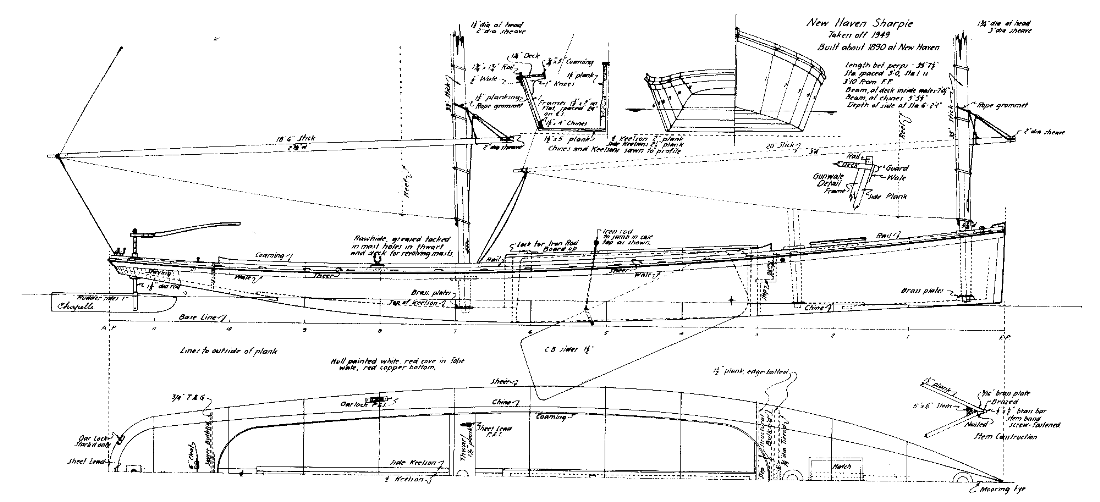
Howard Chappelle’s classic study of the sharpie, The Migrations of an American Boat Type, is available from the Gutenberg Project among many other wonderful things.
It comes complete with the drawings and photos that have fascinated so many boat dreamers over the years – including myself.
The relaunching of Bob Roberts’ barge Cambria at Standard Quay following repairs
Skipper of sailing barge WyvenhoeMartin Phillips has called for a more positive view of sailing barges and the yards and skills that maintain them.
His comments appear on a weblog published by the Society for Sailing Barge Research, and follow wide publicity surrounding the loss of Faversham’s Standard Quay as a centre for the work. This includes the powerful film The Quay about the issue, made by Richard Fleury and Simon Clay.
(See the Comments link below for Richard’s response to Martin Phillips remarks.)
Campaigners have seen the loss of Standard Quay as a centre for barges as part of a wider trend, in which water-front areas have been developed for housing, restuarants and other non-maritime businesses, and so are no longer available for maintaining traditional craft.
However, Mr Phillips says we should not forget that barges and the yards that maintain them are thriving in Essex and Suffolk.
‘It is very sad that the landowner’s wish to develop the site has destroyed what had been developed at Standard Quay; however I feel that the coverage of this to date rather ignores reality of what has been achieved by the Thames barge and traditional boat community in East Anglia.’
‘Why can’t someone make an optimistic film publicising the achievements of the Thames Sailing Barge Trust (formerly the Barge Club) in keeping its barges sailing over the last 64 years, rebuilding two (Pudge and Centaur) without National Lottery support, and taking thousands of people sailing?
‘The trust’s training has produced about eight of the current sailing barge masters, including myself. It has done so much good to preserve barges and helped to bring people into the barge scene who go on to work on barges. Let’s celebrate this success please!’
Mr Phillips said Maldon and the Blackwater are home to a very active fleet of barges and two yards (Cook’s and Blackwater Marina) capable of working on barges, with blocks and two dry docks operating, and that there is also Andy Harman’s yard at St Osyth.
Topsail Charters has built a successful business over a quarter of a century preserving a fleet of active barges carrying thousands of passengers a year and employing a group of skippers and mates.
‘There is a host of evidence that the area is a hotbed of traditional skills and specialist shipwrights, riggers, metal workers, a blacksmith and much much more all based around the rich maritime heritage of the area. Traditional skills are actually thriving in East Anglia and the fleet of barges and smacks is a gem. Where else in the UK has a fleet of traditional craft in their home waters preserved and transformed from cargo carriers and fishing boats to working and pleasure vessels?’
It’s the bowsprit that hits you between the eyes. Clock the size of it: with something like that you could sail her into port and knock the back wall out of a dockside crimper’s best bedroom…
The 73ft schooner HMS Pickle is a replica of the 1799-built original HMS Pickle, which had the honour of bringing the news of the battle of Trafalgar back to Britain. It was a big, bittersweet moment: one one hand it was victory in the war with the French, but on the other hand the commander of the British fleet, Horatio Nelson, 1st Viscount Nelson, 1st Duke of Bronté, had been shot and killed.
The excuse for publishing these striking photos is that from mid-September the superyachts at Gibraltar’sOcean Village Marina will have HMS Pickle for a neighbour. Gibraltar’s gain is the UK’s loss, but there’s something appropriate about the move.
HMS Pickle’s is to sail from the UK to her new home in Gibraltar via Cape Trafalgar – a route that the original Pickle would have followed many times.
The ship’s operator, Robin James said ‘The connection she has with Gibraltar and the part they both played in British Naval history is a great story to share and I am sure her arrival will be a real boost to tourism… We have received fantastic support from the government of Gibraltar and Ocean Village and can’t wait to get there.’
Robin comes from a family of mariners, and in 2004 took time off work to set off around Europe and America in search of a tall ship of his own – and then found Pickle in Gloucester where she had recently arrived from Russia.
‘Pickle had real appeal because of the original’s rich history and adventures in the Caribbean and Europe. The first Pickle was wrecked and sunk off southern Spain in 1808 but this 1996-built replica is uncannily similar and gives us a great insight into the methods and technologies of the time.’