
The plantation-grown stuff hasn’t worked in this case, and it has led to some nasty rot and a repair job? So what is a boat builder to do? Charlie Hussey sets out the problem and discusses the issue with intheboatshed.net regular Tiernan Roe.
Gavin Atkin's weblog for the sort of people who like looking inside boat sheds. It's about old boats, traditional boats, boat building, restoration, the sea and the North Kent Coast
The plantation-grown stuff hasn’t worked in this case, and it has led to some nasty rot and a repair job? So what is a boat builder to do? Charlie Hussey sets out the problem and discusses the issue with intheboatshed.net regular Tiernan Roe.

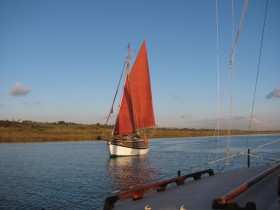


Author and Thames Estuary sailor Nick Ardley tells me that Finesse yacht owners are planning a gathering for all sizes of the timber-built craft in the Medway area during the late May Bank Holiday weekend.
Finesse builder Alan Platt also built a few one-offs, and these are also welcome too.
The plan is to gather at Stangate Creek on the Friday, and then head up river on the Saturday morning to berth at Chatham Marina, where the events pontoon and marquee have been booked. An evening BBQ is planned.
Sunday is to be a dock day, with dispersal on the Monday 27th May. For details, contact
Nick using the email form at his website: www.nickardley.com.
Tides for the River Medway are a little after noon on the Friday, and the hope is that this will give East Coast boats an opportunity to attend – there is currently a growing fleet of Finesses in the Leigh and Canvey Island area, and another around the Swale and Medway’s creeks.
Some 12-13 owners are already expected, and one South Coast-based Finesse 21 owner has also indicated his intention to sail up and use the meet as an opportunity to explore the swatchways of the Thames Estuary.
Nick’s latest book Jottings of a Thames estuary Ditch-crawler contains a chapter about the Finesse yachts based on an interview with Alan Platt, that includes the story of Platt got his business started in a yard in Hadleigh Woods, by the side of the Thames Estuary.
I gather from Nick that the original Finesse 21 hull was designed by Laurie Harbottell, with a deck structure and fit out by Platt. The F21s were either gaff or bermuda rigged, sloops and cutters. All had centre plates and a shallow long keel.
The F24 was stretched out from the F21, and that there were no official drawings – it was all done by eye, Nick says the design works well. [There’s a boat designer’s saying that almost all existing hull designs can be improved by simply making them 10 per cent longer, so this seems to make sense – Ed.]
The F24s were also gaff-rigged, but most were Bermudan sloops and cutters. They have a fairly deep long keel that makes them great ditch-crawlers, and many also had centre plates that take their draft to around 7ft when right down; however, some had plates and bilge keels or no plate and bilge keels…
Platt then built a F27, the Tugela. She was a one-off: following further demand for the larger boat, Alan asked another well designer, Maurice Griffiths, to re-design his F27 – and she came out as the F28. All of these were long keeled with no centre plate.
Nick tells me he’s had Whimbrel, F24 number 64, from her build in 1983/4 (she was launched in April 84) and has enjoyed her ever since – he believes his boat is the longest in same ownership, though there is apparently an F21 that has been in the same hands for even longer.
Many of the boats have been owned for lengthy periods: for example F24 number 1 has been in the same family since her build in 1969, and passed from father to son some years ago.
For more information about Finesses, see the Google Finesse forum and the brand new Finesse Owners Association website.

National Historic Ships has fired the starting gun on its fourth photo competition aimed at photographers of all ages and dedicated to encouraging everyone to engage with historic vessels or maritime themes in their local area – but the organisers are particularly keen to interest the young.
There are prizes, including an overall prize of £1,000 to be awarded on a theme or activity involving a vessel from the National Register of Historic Vessels – good themes might include, restoration and repair, sailing, racing, coming into a mooring, or generally working around or enjoying the vessel.
Competition entries will be accepted online from 1 April to 31 August 2013.
For the first time, the competition this year includes a new category, ‘Faces of the sea’ in which the public will vote online.
Entrants also stand to win a small prize if their image is selected as one of a series of favourite images.
The competition’s ‘Young photographer’ category is supported by downloads aimed at younger children, including a whale-based wordsearch and a printable colouring page featuring classic sailing craft, both provided by the well known illustrator Claudia Myatt, who is also a competition sponsor. (See an earlier post about Claudia’s tips for drawing boats here.)
Schools and teachers are invited to get involved with the aim of inspiring children and families to find out more about maritime history. Posters for schools can be obtained from National Historic Ships via email at info@nationalhisotircships.org.uk or by phone 020 8312 8558.