[ad name=”intheboatshed-post”]

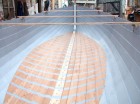
Nick Smith has now finished planking his latest 20ft motor launch project, which he’s given the working title of Bamboo Viper II. The name comes from an earlier similar boat named Bamboo Viper that he built some years ago and has exhibited regularly at the Beale Park Thames Boat Show.
Reaching this point in the build caused him to reflect for a moment on how boats these days are expected to last much longer than in years gone by, and on how builders have changed their approach. Here’s what he says:
‘Gav,
‘So Bamboo Viper II is all planked up, the boat is to be painted throughout except for varnished topstrake, and so the hull primed inside before the ribs go in, which will protect the timber under the ribs in the bilge.
‘Back in the day, these boats were built quickly and with a built-in short life – they were built bare and painted or varnished only after the build.
‘I’m reminded of the night in Clovelly when there was the famous storm many years ago when some 50 dinghies were smashed up on the beach. Losses like that were a regular occurrance years ago, so why bother to build boats to last?
‘It’s different now, the boats are pleasure boats that are not heavily used, and and are cotton-wooled compared with the old boats. So I build them to yacht standards both structurally and finish-wise.
‘Now gearing up for steaming out of the green oak timbers. More photos will be on their way after the steam out.
‘Regards
‘Nick’
Thanks Nick. I guess there are quite a few factors here; there’s obviously no doubt that working boats have a much harder life than most boats built for leisure use. I’d guess also that in the old days in many places there would simply be more working craft needing moorings – and that some would necessarily be moored in more vulnerable locations than others. I wonder also about the quality of the moorings – have we got better at this kind of thing, I wonder?
I’d also guess that another factor is that boats used for pleasure purposes get left for months at a time, often because of work commitments, family issues and so on. A working boat is much more likely to get regular use, and therefore regular care and maintenance.
And hey, Nick, how about a stop-time video of the steam out? Has anyone got a camera that can do it automatically?
Click here for more posts relating to Nick’s impressive old-fashioned motor launches.
Nick, who is a WBTA member, comes from Devon, learned boatbuilding the traditional way and specialises in new builds in clinker and carvel for sail, motor and rowing power from 8ft to 28ft with a special emphasis on West Country style and design, and also takes on repairs and refits from 25ft to 50ft. These days he’s based in Hampshire, and can be contacted by email at nick_smith_boatbuilder@yahoo.com and by phone on phone on 07786 693370.
Want to learn more about boatbuilding using the clinker technique? Try John Leather’s book Clinker boatbuilding at the revived intheboatshed.net A-store.