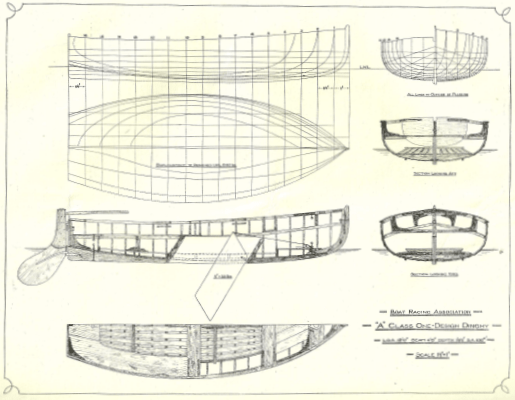
Boat Racing Association A-Class One Design Dinghy specifications and drawings

A-Class one design dinghy specification

A-Class one design dinghy specification

Brian Smith has sent in interesting scans of the specification for the delightful Boat Racing Association A-Class One Design Dinghy, which I gather is a very close relative to the International 12. I’ll let him tell the story:

‘Hi Gav,

‘I attach drawings and specifications of the BRA 12ft dinghy as published in the Yachtsman of 12 June 1913, which could be of interest to your readers as I believe they were little changed for the International 12ft dinghy class.

‘George Cockshott [the designer of the International 12] was a frequent and sometimes successful entrant in design competitions in the Yachtsman and Yachting Monthly, although it is not certain that any of those designs were ever built. The 12ft dinghy design was the result of a competition run by the BRA. Cockshott may have been inspired by the 12ft restricted class sailed at Hoylake, West Kirby and Rhyl. The design does seem to have been influenced by the class.

‘The largest yacht designed by Cockshott appears to have been the 19 tons TM Nautilus II built by R Lathom at Crossens, near Southport in 1902.

‘Hope this is of interest,

‘Brian’

Thanks Brian – it certainly is. I love all that old-fashioned specification stuff: ‘The whole of each boat, inside and out, to be varnished four coats best yacht varnish. (Or, if desired by the owner, the bottom to be painted three coats and finished with anitfouling composition or enamel externally, and to be painted three coats internally). The name or number to be written in gold leaf and shaded, on the transom or as may be required.‘

For a post on George Cockshott’s International 12 dinghy, click here.

The migrations of an American boat type

Sharpie drawing

Sharpies have rather gone out of fashion since they were the talk of the boating forums a decade ago, but I still think it’s worth reminding ourselves about these strikingly elegant North American craft.

This drawing of a typical New Haven sharpie comes from a Project Gutenberg eBook of Howard Chappelle’s classic study of the sharpie, The Migrations of an American Boat Type, which I first read on paper long ago.

I vividly remember the excited anticipation of waiting for it to arrive in an exotic foreign – but thanks to the Gutenberg Project  folks you, dear reader, can obtain access to this stuff in a moment, and completely free of charge.

PS – I picked this up through reading the excellent US website Duckworksmagazine.com.

Photos from the Stirling & Son yard

Stirling & Son Victorian cutter Integrity counter

Stirling & Son Victorian cutter Integrity is that straight! John Gallagher fitting the mast step Stirling & Son Victorian cutter Integrity Stirling & Son Victorian cutter Integrity safety boots

Will Stirling’s had his camera out over at the Stirling & Son yard and has come up with these photos.

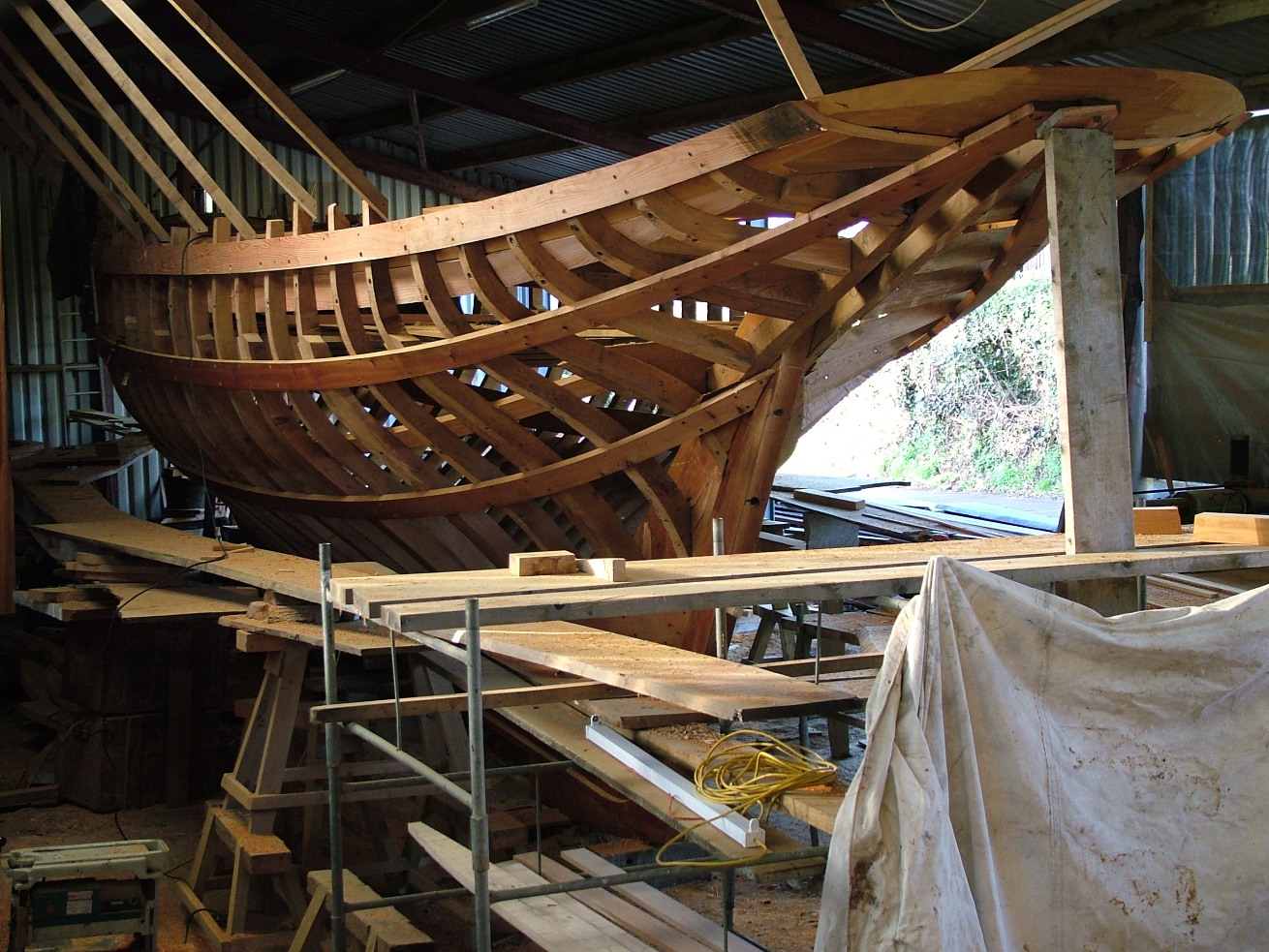
They starting with the cutter Integrity’s impressive counter stern – click here for more about this project.

I’m strongly reminded of an original Victorian cutter named Leila we saw some months ago. Leila is  currently being restored at Southwold; see a post about her here.

The others show John Gallagher fitting the mast step; Ted Luck eyeing up the sheer and Will’s son Alf adjusting a batten he feels perhaps could be a little fairer. I can’t imagine a better place for any of these boys to play.

Thanks Will – you take a nice shot!

Stirling & Son traditional yacht building and wooden boat repair is based at Tavistock, Devon. For more information see www.stirlingandson.co.uk.