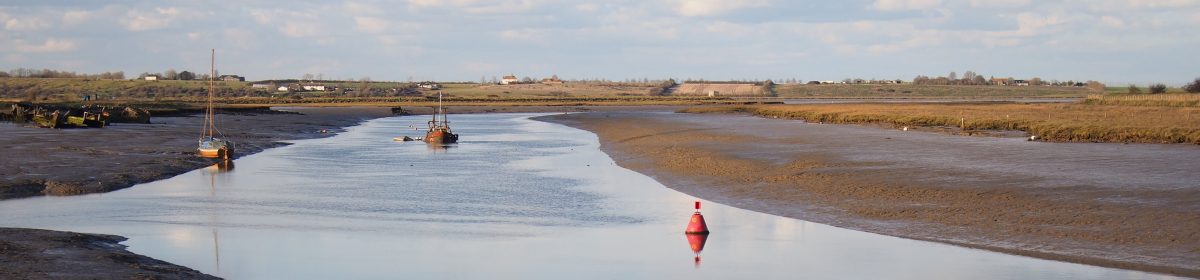
Mat Gravener has kindly written to tell us about one of his earlier restoration projects, a 1940s Broads cruising yacht named Perfect Lady 9. (Mat’s the chap who’s currently working on the very cute half-decker Jamesia II.)
‘The advert read along these lines: ”Perfect Lady Broads yacht, needs work before launching, diesel inboard, heating, new sails, bunk cushions etc.”
‘The name Perfect Lady appealed to me and although she was not a gaffer, she epitomised the classic wooden Broads hire yacht in many ways: she was roomy, with a lifting roof with mahogany sides, sliding windows, and a warm, homely interior, yes, exactly as I remember from my childhood.
‘So, did I really want to take on another restoration? Becks, my wife, thought the boat looked a lot better than I’d described, wow, said she, heating, proper cooker, where’s the shower going. ‘Huh’ said I, ‘this is a sailing boat. We’ll soon get rid of all that unnecessary gear.’
‘My mates thought it was a great idea, although I’ve since found out they were just humouring me.
‘Enthusiastic comments all round saw me handing over the cash, and, although I was aware that I could have got away with a quick patch up that would have let me get some sailing in, I wanted to take it further and do a more thorough job that would get her back in shape and looking something like when she was new.
‘My one big advantage was being able to tackle most of the work myself, which in due course considerably reduced the amount of money needed to put the boat right.
‘The real problem lay in the sheerline along the starboard side, it all started well, up on the foredeck, then somewhere between the cabin front and cockpit coaming it travelled first downhill, then uphill, then back downhill before tapering off the stern. I checked the old Blakes hire catalogues; the Perfect Ladies definitely had the transom out of the water, not a foot in! It also became apparent that the old girl had twisted, bow over to starboard, transom over to port.
‘On the 8th August 2007, Perfect Lady 9 arrived at Wayford Marina. Not only was the keel touching the ground, but the rudder also! The first job was to set the boat up as square as possible, for even at this early stage the hull was fairly flexible and she could be twisted fore and aft.
‘Next we got some of the weight out of the totally unsupported cockpit. This included two 25 gallon water tanks, weighing around sixty pounds each empty, a Yanmar diesel wing engine, along with shaft log, exhaust system, diesel tank, two heavy-duty batteries and steel engine bearers. The complete heating system was next, then the cockpit seating, which was a right mis-match of different levels. I’m sure I heard the old hull let out a sigh of relief when all this gear was finally removed.
‘The two top planks the length of the boat were next; these four lengths had been made up from around twenty pieces of wood, all with unglued butt pads, which of course did not help the boat’s shape. A few cockpit and stern locker timbers were cut through and I now started the jacking-up process. It never ceases to amaze me when doing this job how flexible these old boats are; Perfect Lady 9 has a 9 by 2 inch thick English oak hog and this curved back somewhere to its original shape with very little effort. It proved difficult to view the boat side on to see if the sheer line was coming back due to other boats close by, but by using ladders and viewing from every possible angle and making a few measurements I felt fairly confident that we were somewhere near. The port side now looked better than the starboard, most of the hump in the deck had disappeared and the back was up, but it still did not look right.
‘After some careful measuring I decided to make the new sheerstrake for the port side and epoxy scarf the two boards together to make up the full length and an exact replica was made for the starboard side. The port side was then fitted, then a number of cross battens fixed to the bottom edge of the board, which then projected out through the starboard side. These were all checked for squareness. The starboard sheerstrake was plonked on top of these battens and clamped in place. Round the end of the cabin and cockpit coaming area there was a gap of at least 4 inches!
‘Eventually I found the cause. Disconnecting the main cabin bulkhead from the cabin side, then removing the screws holding the cabin side to the side decks, there was an almighty bang and the deck settled back down to its rightful place! It appears that half the cabin side had been replaced at some stage and rather than getting the deck line straight, the new cabin piece followed the deck hump that had been caused by badly fitting, out of shape hull planks. The deck edge could be forced down on to the top plank, but an additional wedge-shaped piece of mahogany was necessary to give the bottom of the cabin side the correct shape.
‘Over the next few months 35 timber (ribs) were replaced along with 350ft of planking, 60-odd foot of deck planking, skinned over in 4mm marine ply, and finally epoxy sheathed. All hull seams except the first five out from the hog have been routed and filled with West System epoxy. The remainder were caulked and Sikaflexed, a technique a friend used when rebuilding his Broads yacht, and which had proved successful over four years.
‘The cockpit has been totally rebuilt using sapele hardwood, and now consists of two raised lockers at the forward end, similar to the original with two simple side benches back to the stern locker bulkhead.
‘Two good friends, John and Paul, started picking at the old varnish on the mast while thinking about lunch one day, and two hours later the 38ft mast had been stripped and sanded back to bare wood, and looked stunning!
‘The real time-consuming bit followed with final sanding in preparation for varnishing. It became obvious that the boat was not going to be completely finished in my allocated time scale, (I don’t know why I set deadlines with boats, as they always take at least twice as long as expected), so the exterior took priority, cabin sides, decks, hull, cockpit and rig were worked on whilst the boat spent fourteen luxurious weeks in a nice, big dry shed at Wayford.
‘During this time the decks were epoxy sheathed, new toe-rails, cants and rubbers were fitted and six coats of varnished applied to all her brightwork. The lifting roof came off and my father removed every scrap of paint from the inside, fine sanded it and applied fresh paint. It took four of us to lift it back on to the boat.
‘On the 29th March 2008 at around 11 am Perfect Lady 9 was relaunched, and the inevitable taking-up began, and stopped about an hour later, over the next couple of days the bilge pump needed switching on three times for a couple of minutes.
‘With the mast resting in the tabernacle, the real concern of the whole job was how to get the extremely heavy mast weight on. We managed to manhandle this huge lump of lead on to a borrowed sack barrow and drag it to the boat. Fortunately John, who runs the yard, took over using a Hymac digger with a bucket! Simple.
‘Viewing the boat bow on she still has a slight twist, but I am very pleased with the way she has turned out.
‘PL9 had come with a good set of fairly new sails and these set very well. For a heavy family boat still with her original hire friendly rig she sails easily and is close-winded.
‘The previous owner had taken part in the annual Three Rivers Race ten years on the trot and managed to finish only three times, apparently with minutes to spare. We rustled up a team and took part.
‘Out of the hundred or so starters we finished around the half way mark having done the 55-mile course in around 18 hours. We also took her to a couple of local regattas and she did pretty well in those also. During her first season it was clear she need a good strong breeze to get her going, although she also proved an excellent family boat, being extremely safe and predictable whilst cruising with my wife and two young daughters.
‘I’d like to thank a number of people who contributed in some way towards getting Perfect Lady 9 back in commission, and these are: Steve Evans of South River Marine who sold me the boat; Mike Barnes of Norfolk Broads Yachting Company for so much history of this particular class and encouraging words; my good friend John Davison, who despite his health was always lending a hand; Paul for crawling under the boat and routing out those seams, along with lots of other jobs I did not want to do myself; timber merchant Tim Collin of Wroxham for the excellent selection of timber they supplied; Colin for the brilliant paint job on the hull; my father for all sorts of miscellaneous stuff, especially that great big roof; John and Lee at Wayford Marine for putting up with my sense of humour and providing first class facilities, and last, but not least, Becks, my wife, and my two lovely daughters, Bethany and Emily for being so patient and understanding with this boy and his big toy!’
Many thanks Mat! Please send us more when you have the time and energy!