Scottish Coastal Rowing – a reminder

[ad name=”intheboatshed-post”]

St Ayles skiffs Scottish Coastal Rowing

St Ayles Skiff Coigach Lass beating Ulla in the Ladies Open at the Loch Broom Sailing Club regatta. My thanks to Chris Perkins for use of this photo


Who’s having big fun this summer? All of you, I hope, but most of all I’m quite sure the Scottish Coastal Rowing Association folks are having a riot!

I’ve been meaning to write another post about the SCRA for a little while, but have been distracted by all sorts of busy-ness – with the result that a lot of people have beaten me to it. So this is just a short post designed to serve as a reminder that this project to create a new class of rowing racing around the coast of Scotland is proving amazingly successful with races taking place at Portsoy and at Eyemouth.

Apart from the main association website, photos and information can be found at:

PS – I’d also like to draw readers’ attention to Osbert Lancaster’s thoughtful and informative comment below. It’s well worth a look. Thanks Osbert!

BBA students build a clinker YW Dayboat

14ft Yachting World Dayboat 14ft Yachting World Dayboat

14ft Yachting World Dayboat

Yachting World Dayboat Tailwind – first three photos thanks to Jenny Steer, the final one thanks to Tracey Marler

Six months at the Boat Building Academy gave Lachlan (Locky) McKenzie enough time to build a Yachting World Day Boat with help from fellow students Tom Trevessey and Tim Price.

The traditional clinker build began in January 2010 after the initial foundation carpentry and joinery phase of the 38-week course. Locky chose the design because he is a keen dinghy sailor, and intends sailing her competitively.

Tailwind is spruce planked on a mahogany backbone, case, thwarts and frames with oak timbers. Locky has great hopes that his wooden boat will perform well against her plastic opponents when he races her out of Bosham – although he says she’s faster than the crew so anything is possible.

Instructor Justin Adkin modified the plank lines to allow better water flow around the hull, and altered the deck structure and layout, incorporating five full frames, to stiffen the hull and allow it to be tensioned up in a similar way to a Salcombe Yawl.  A photodiary of the build can be seen on the BBA website.

Tom, from Cheltenham, and Tim, originally from South Africa, shared the main work on the build. Tim, who is a Maritime and Coastguard Agency Master of Yachts, has worked as crew, a water taxi, sailing instructor and in yacht delivery, and straight after the BBA course he started work at the Elephant Boatyard at Southampton. Tom, who joined the course because he wants to work in the marine industry, is heading off to New Zealand some time before the end of the year.

Locky’s Yachting World Day Boat has attracted a lot of attention, not just because it is a return to traditional wooden construction for the class, but also because of its beauty; the elegant decking and combing make great finishing touches.

Marcus Lewis launches Fowey River Dinghy number 58 – Penguin

[ad name=”intheboatshed-post”]

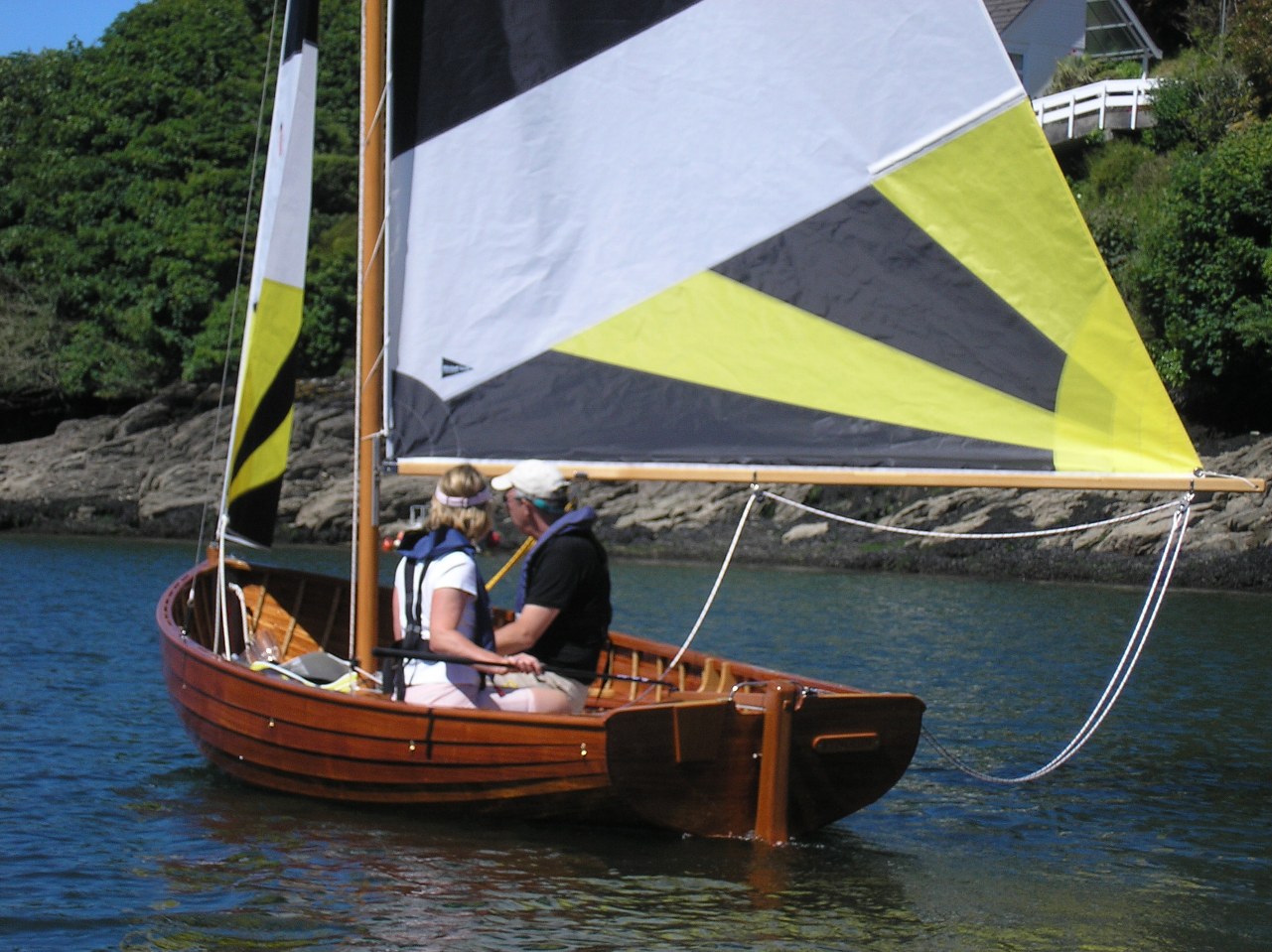
Marcus Lewis launches Fowey River Dinghy

Marcus Lewis launches Fowey River Dinghy Marcus Lewis launches Fowey River Dinghy Marcus Lewis launches Fowey River Dinghy

Marcus Lewis launches Fowey River Dinghy

Penguin is number 58 in the Fowey River Dinghy Class, and was built by Marcus Lewis for a local customer.

There’s much more about the class at Marcus’s website, but the class developed from 15ft knockabout dinghy designed in the late 1940s by Reg Freeman, and the plans were published in Yachting Monthly to encourage readers to go out and build a boat.

Marcus points out that Fowey River Dinghy number 1 was built in 1950, so in 60 years there have been nearly 60 boats.

Penguin is built of FSC mahogany, copper riveted, with steam bent oak ribs, finished with Hempel Woodseal and International Varnish. Her sails and cover were made by Mitchell Sails of Fowey.