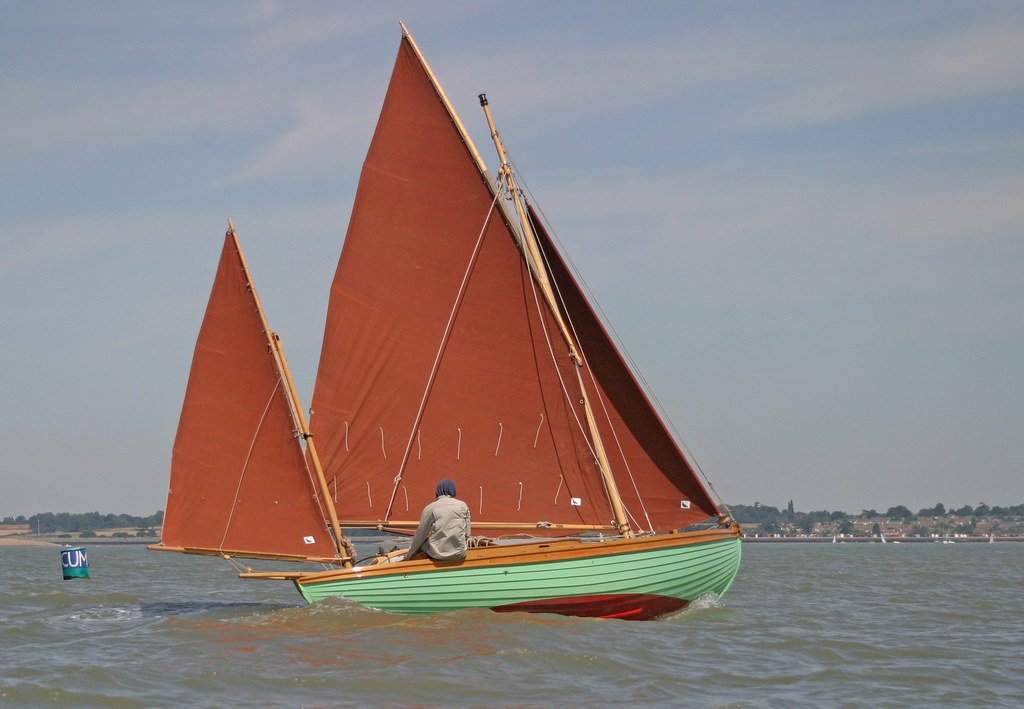
Restored 1943 type K Montagu whaler, good condition, for sale in London

[ad name=”intheboatshed-post”]

vancouver

Montagu whaler Vancouver is now sold

Dick Wynne is selling his 27ft 6in type K Montagu whaler. I’m sure it has been a painful decision and it’s a damn shame for all those who have enjoyed crewing her, but no doubt two traditional boats like this is too much for one man!

This could be the offer of a lifetime for someone. Here’s what he says about the boat:

Vancouver is an ex-Royal Navy ship’s boat built in 1943 and lovingly restored and maintained over many years regardless of expense.

Construction is mahogany and larch on oak, with gunwales, thwarts etc in solid teak. She is probably the finest example of the type in existence. Her equipment includes:

– five matching 15ft spruce Admiralty oars plus many spares

– full sailing rig – lug main, jib and mizzen

– 6hp Mariner outboard on a lifting quarter bracket, with lock, and separate fuel tank mounted in sternsheets

– two bilge pumps

– ample buoyancy

– 12 x 150N automatic XM lifejackets with recharging kits

– two paddles for tight spots

Admiralty pattern anchor

– mooring lines, fenders, full-length tent/cover

– nearly new four-wheel braked trailer with sealed hubs and brake flushing system

All her external paintwork was renewed in 2008, and all her exposed timber stripped of varnish and oiled (with Deks Olje #1 and #2) for ease of maintenance. Although of traditional timber construction, she is in superb condition and is easily maintained so. A faultless recent professional survey report is available to serious enquirers.

She is a robust, stable and versatile workhorse fully equipped for pulling, sailing and motoring in a variety of applications including raids, races, expeditions, pleasure trips under power, race/committee boat use, etc. She would make an excellent school or club boat.

Vancouver has plied the tidal Thames in London under oar and sail for the past few years, and is a regular in the annual Great River Race. She has been trailed farther afield to locations including the East Coast, Western Highlands, and Milford Haven, and attracts much attention wherever she goes. She is only reluctantly for sale as, rather improbably, she is my second boat and I can no longer find the time to do justice to two traditional wooden boats. She is currently lying afloat in London.’

For a pdf including more photos from last year click here, and for more on the boat and what he’s been doing with it, click here.

Also, if you’re curious about what his other boat might be, this photo and the knowledge that he’s a leading member of the Albert Strange Association will probably tell you all you need to know.

Complete with a full inventory including trailer, Dick is asking for £9,500 or offers. Call him on 07990 573160.

We don’t often see whalers, but for some photos of one I spotted in the Fal Estuary some time ago, click here.


Why use wood to build boats?

[ad name=”intheboatshed-post”]

528397904_65ab1263e7_b2

Rowing boat built from wood in the traditional way – and isn’t
it so much more attractive than plastic? Photo from Flickr
Creative Commons, taken by Rick Rowland

Several times now I’ve been promised short articles that answer this question, but as yet no-one has sent me any clear answers – not even those who really should have the information at the top of their heads and have an obvious interest in making the case.

So I was intrigued to find some answers to this question about wooden boatbuilding laid out in a recent post at Tiernan Roe’s weblog Roeboats.  Here are his key points (some are slightly paraphrased):

Where light weight and strength are needed wood is the best material to use.

Pound for pound, wood is stronger than than steel, most fiberglass and aluminium.

On the same basis, wood is stiffer than fiberglass, kevlar or steel.

Wood absorbs vibrations and this includes sound, so wooden boats are quieter.

Wood does not fatigue with repeated loading.

Wood is a renewable resource and the growing of wood removes carbon dioxide from the atmosphere.

Wood is eco friendly in that it can be recycled, fiberglass cannot.

Wood looks good.

Wood allows economical, in both materials and cost, custom production of boats.

Wooden boats require similar maintenance to fiberglass boats. Gel coat is not the wonder material it was thought to be.

Tiernan adds that the reason most boats for sale today are made of fiberglass is that they can be made by semiskilled and unskilled workers who are cheaper to hire than the skilled craftspeople needed to build a wooden boat.

I’d add a couple of points to Tiernan’s list. One is that traditional wooden boats bring so much to the landscape – there are many precious places in the UK that would be utterly changed without their characteristic wooden boats – including The Broads, the River Thames, the creeks of the East Coast, and the beaches at Cromer and Hastings.

Another is that when we build in wood or commission others to do so, we are helping to maintain an important tradition. Boatbuilders teach each other, and the skills have long been conveyed by oral transmission. To my mind, this makes boatbuilding a culturally important tradition.

But although I’m obviously an enthusiast for wooden boats and boatbuilding, I’m sure the cause of the wooden boat is best served by a realistic view of the issues, and that many readers of this weblog will have different perspectives based on their own exeriences.

For example, I’m not sure the maintenance argument is entirely justified. I’ve learned that anything in the open air that is covered with gelcoat or a epoxy and a two-part paint requires far less maintenance than anything wooden that’s covered with alkyd paints, varnish or even teak oils. With our busy working and family lives I have no hesitation in saying that we own and use at least one boat that we wouldn’t be able to keep up it on a DIY basis if it was made from wood.

I wonder also whether the argument that building from wood is environmentally friendly has really been made. I’m inclined to believe in global warming and the trouble it is bringing, but I feel also that the arithmetic we presume when we’re making judgements about environmental issues is often overly simplistic. For example, when wood eventually rots its breakdown must release carbon dioxide and the much worse global warming gas methane. So what is the lifetime cost of a wooden boat to the environment compared with a plastic one? I haven’t a clue, but I don’t think the answer should be taken as obvious until someone clever works it through and provides us with the result of their calculations. Just to add a factor that seems relevant, what is the contribution to global warming made by the drying of spirit-based paints and varnish?

These are just a few thoughts of mine.What do you think? Are there any points here you’d argue with? Are there any arguments to add? Comments via the comment link below and at Tiernan’s weblog please!

PS Fans of the US designer John Atkin will be interested to know that Tiernan is currently weblogging the build of a clinker-built Atkin Ninigret.

PPS I’d draw your attention to some of the comments below, particularly those of West Country boat designer, occasional building and general sailing man John Hesp.

Nick Smith planks up Louise – and uses a novel steaming technique

[ad name=”intheboatshed-post”]

2009_0301louise1stmarch0008

2009_0301louise1stmarch0013 2009_03094planks0004

Planking Louise: Nick uses an on-the-spot steaming
device for the garboards

Hampshire-based boatbuilder Nick Smith is currently planking up a new project, Louise. She’s  a 16ft loa, 6ft beam and will draw about 14in, and built with khaya mahogany planking.

She’s destined for customers in Newton Ferrers,  and won’t be kept on a mooring but will be dry sailed on estuaries and rivers. Her internal layout will be identical to  Nick’s last project Lisa but compared with that boat she will be smaller and more lightly built for ease of launching and recovery, and with finer ends and a flatter sheer.

She’ll have an 11hp Vetus twin diesel installed.

Nick has kindly sent us these photos illustrating his method of steaming garboards and often the first couple of planks in situ using a piece of old inner tube.

The arrangement here looks a bit Heath Robinson – it uses an old thinners tin with an old style kettle element in it – but Nick says it’s very effective and he also uses it to steam frames.

My suggestion, gentle reader, is that it might be a bit scary for most of us to try at home, unless you happen to have the skills of an electical engineer! I’d guess that a big, stable two-ring camping stove would be safer.

However, steaming on the spot is obviously a very neat trick. Nick says: ‘I can’t think who invented this method but I’ve not seen anyone else do it. It’s very effective, however: in the old days the boy would run with the hot plank from the steam box to the boat, but by the time he got there the board was almost cold. But this way the plank is in place already: you just slide the inner tube off, and cramp the hood end up in place.’

Click here for posts mentioning Nick’s previous project, Lisa. If you don’t already know him, Nick comes from Devon and specialises in new builds in clinker and carvel for sail, motor and rowing power from 8ft to 28ft with a special emphasis on West Country style and design, and also takes on repairs and refits from 25ft to 50ft. He can be contacted by email at nick_smith_boatbuilder@yahoo.com and by phone on phone on 07786 693370.