
The SS Robin arises and settles onto her new home – and Dylan Winter films it all

[ad name=”intheboatshed-post”]
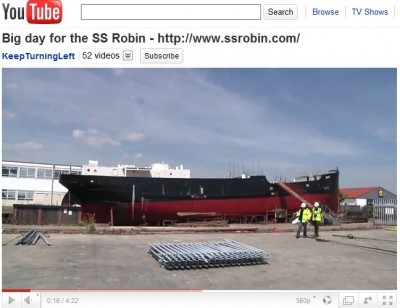
As I write, the last remaining steam-coaster SS Robin should have just been airlifted by two 600-tonne cranes and placed on a pontoon where she will become a floating museum.

Keep Turning Left film-maker Dylan Winter has been filming the event, and I hope his record will be made public at some point. In the meantime, the clip linked above offers a sense of the preparations involved.

I glad I’m not in charge! The cranes involved are two of the heaviest in the UK; their job is to raise the newly-restored 300 tonne vessel off the quayside onto her permanent new home, which is currently at Lowestoft. (PS – I’ve just heard the good news that the SS Robin has landed – see Dylan’s speeded-up video account on Youtube here.)

From Lowestoft she will be taken to London to become new museum and learning centre for young people.

She was brought to Lowestoft in 2008 from London (I used to see her each morning on what was then my daily commute) to undergo essential conservation work and repairs to her historic riveted structure. For earlier posts on the SS Robin, click here and here. Also see the SS Robin project website here.

Built at Bow in 1890, the SS Robin is listed by the National Historic Fleet register and is regarded as one of the most important British-built ships in existence, for there were once thousands of similar steam coasters – they were the heavy goods vehicles of their day, and were immortalised in John Masefield’s poem Cargoes. I don’t know whether kids today study it, but it was certainly taught to my generation. If like me you can’t recall how it goes, here it is:

Cargoes

Quinquireme of Nineveh from distant Ophir,
Rowing home to haven in sunny Palestine,
With a cargo of ivory,
And apes and peacocks,
Sandalwood, cedarwood, and sweet white wine.

Stately Spanish galleon coming from the Isthmus,
Dipping through the Tropics by the palm-green shores,
With a cargo of diamonds,
Emeralds, amythysts,
Topazes, and cinnamon, and gold moidores.

Dirty British coaster with a salt-caked smoke stack,
Butting through the Channel in the mad March days,
With a cargo of Tyne coal,
Road-rails, pig-lead,
Firewood, iron-ware, and cheap tin trays.

John Masefield

As I read this, I’m reminded that I saw the SS Robin’s smokestack in a boatyard not so many weeks ago.

Tjalk Jantje is back on the water and will soon have a new cotton rig

[ad name=”intheboatshed-post”]

tjalk, dutch barge, sailing boat, holland, nordhorn, jantje

tjalk, dutch barge, sailing boat, holland, nordhorn, jantje tjalk, dutch barge, sailing boat, holland, nordhorn, jantje

tjalk, dutch barge, sailing boat, holland, nordhorn, jantje

Tjalk Jantje now, before she was restored, the celebration, and her sail arranged for tanning – and the pot used in tanning

In Nordhorn in Germany near the border with Holland, poor Hans-Christian Rieck has broken his foot working on his organisation’s tjalk named Jantje. Having broken my own ankle last year he has my heartfelt sympathy, and I can only hope his recovery is rather better than mine has been.

A small consolation is that he’s at last had time to tell us about the boat. Here’s what he has to say about Jantje:

‘Jantje is one of the Dutch Tjalks, in this case of a subtype called Steilsteven – it’s equivalent in England would be the Thames barge.

‘She was built in 1923 at Delftzijl on the Dutch side of the River Ems estuary and worked the Frisian Lakes until the 1960s, when she was laid up, being to small and to slow to be competitive. Sadly neglected, she spent 30 or so years on a mooring at Makkum on the Ijsselmmer.

‘Fortunately, some businessmen of our town Nordhorn came upon the idea to aquire a historic ship as a reminder of the glorious maritime past of our city, and when the treasurer of our association and myself were asked to find a suitable craft, we found Jantje.

‘She was bought, sandblasted, sprayed and then fitted out with an advanced system of ballast tanks to enable her to enter the city, as in recent times our city fathers have built bridges with very limited headroom over our canals and rivers.

‘The ship now floats at a jetty by the old town port and will frequently leave her mooring for special maritime events in our area.

‘I’ve added some photos of the renewed boat’s christening – the guy with the crutches is me by the way!

‘We have tanned Jantje’s sails the traditional way with the help of Hermann Ostermann, whom you may have heard of, one of the last guys to knows how to tan a cotton sail the proper way. We hope to have the traditional rig ready by next spring, so we can have a test sail on Lake Vechte at the next canal festival.’

Many thanks Hans-Christian! I look forward to hearing more in the not too distant future.

Keep Turning Left at the Three Rivers Race

[ad name=”intheboatshed-post”]

three rivers race, norfolk broads, horning sailing club, keep turning left, racing boats, racing yachts

A Brown Boat at the start of the Three Rivers Race, 2010

Troubled as I am by continuing problems with our Internet connection – please get on with it Plusnet and BT, it’s been more than two weeks now! – I can’t actually look at Dylan Winter’s videos of the start of the Three Rivers Race this year.

Still, I’m more than sure they’re well worth seeing; those starts must be a sight in themselves, and it’s difficult to imagine any where else in the UK where one could see so many well kept traditional craft on the water in one place.  Dylan would like information about the boats in the videos, if anyone can help.

If he was watching the start of the Three Rivers, he must have been in the area at the same time we were at Barton Turf, enjoying the good company of the HBBR meet there this year, and sailing the Barton Activity Centre’s boats on Barton Broad.

Now, though, apart from getting a decent Internet service, I want to hear how he gets on sailing around the North Norfolk coast, the Wash and the southern end of the long Lincolnshire coast.