More information emerges about Jantje’s sails – but what about Nordhorn’s anchor?

Nordhorn anchor from Byers foundry, Sunderland

Nordhorn anchor from Byers foundry, Sunderland Nordhorn anchor from Byers foundry, Sunderland Nordhorn anchor from Byers foundry, Sunderland

A little more information has emerged about the source of Jantje’s sails. Hans-Christian Rieck has written to say that the sister of the previous owner, the late Mr Struik, has volunteered the information that they were purchased second-hand from a Frisian sailmaker. Now the Graf Ship Association’s volunteers are trying to find out which sailmaker was involved in supplying the steilsteven or sailing tjalk’s sails.

They’re also close to overcoming the last bureaucratic obstacles to obtaining a certificate to allow Jantje to work as passenger ship on her home waters.

However, it seems the good folks of Nordhorn have another question. It seems a local businessman gave an old anchor to the City as a display item for its now historic quay. The anchor was found in mudbanks of the mouth of the River Schelde near the port of Rotterdam during dredging works.

It’s clearly of British origin, as on one fluke it is possible to read the name of Byers and the place name Sunderland, and a serial number that is now impossible to decipher. The other fluke bears the code ‘VV’.

It seems clear that it was cast by a foundry named Byers, but is there a way of discovering which ship lost it in the mouth of the Schelde? Can any reader help? My guess is that it’s likely to be listed as an insurance loss somewhere, or on the foundry ledgers, if they still exist.

From its shape local experts think the anchor dates from the late 19th or early 20th century, and that it must be from either of a British or at least a British-built ship because at that time of overheated nationalism there is every reason to doubt that a Dutch, French or German shipyard would buy foreign parts for the ships built on their own yards.

There’s an interesting listing of Sunderland-built ships here.

PS – I’m grateful to Ian Wedderburn for writing this weekend to point out this link at the England’s Past for Everyone website, which is about a very similar looking anchor that’s now outside the maritime museum at Palermo, Sicily. Thanks Ian!
http://www.englandspastforeveryone.org.uk/Counties/Durham/News/Mystery_of_the_Sunderland_anchor?Session/@id=D_ke2YxeRe5gVh7J4uDkpD

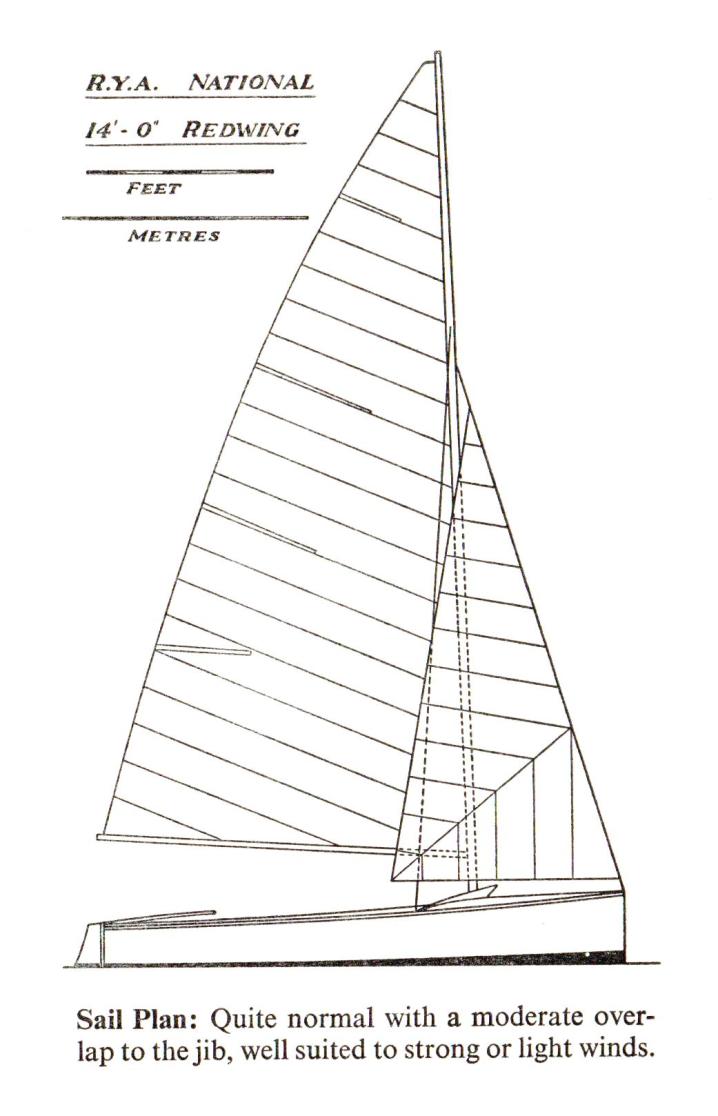
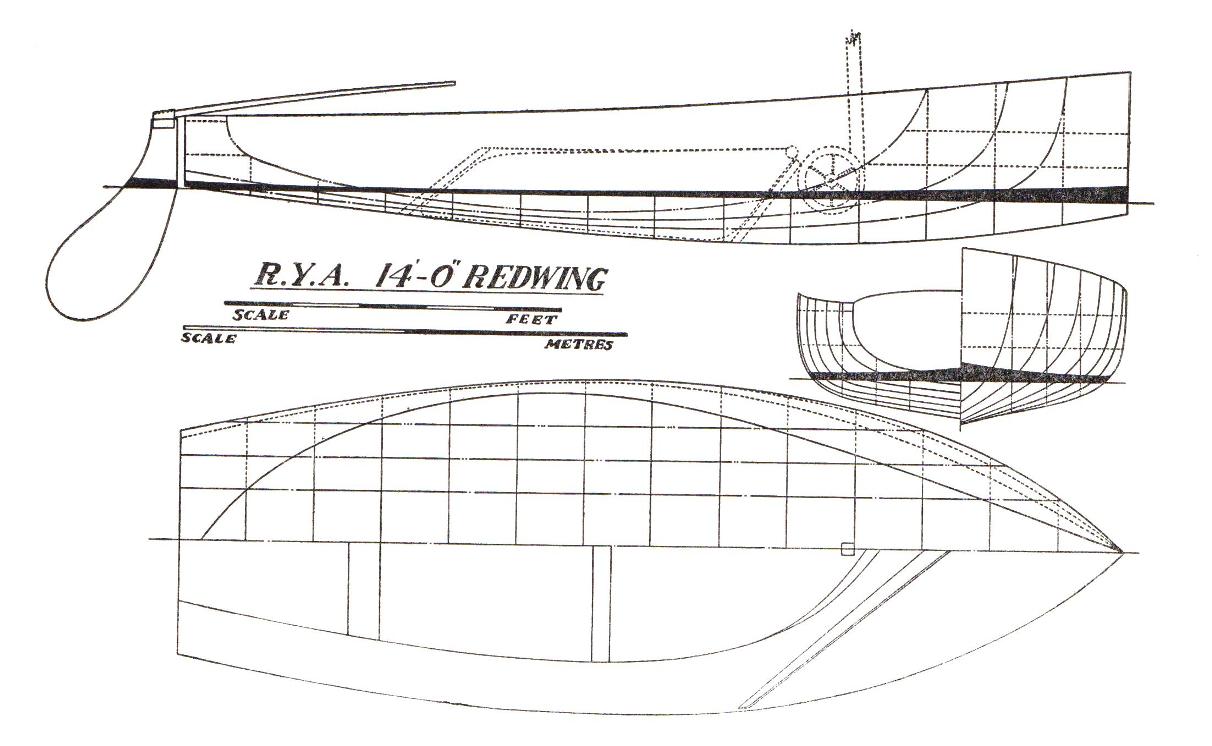
The Redwing sailing dinghy explained

Redwing dinghy scan

Redwing dinghy

Jeff Cole asked about the Redwing dinghy that featured in a post a couple of days ago. The Redwing is an Uffa Fox design created for sailing off the Cornish coast, and seems to have been designed for Looe Sailing Club.

‘Having enjoyed and endured the tumbling seas off the Cornish coast I was in full agreement with the Commodore of the Looe Sailing Club when he outlined the type of 14-footer he would like designed for their turbulent waters, and delighted at the prospect of designing such a boat,’ wrote Fox many years later in his book Sailing Boats.

What the good commodore got was a classic Fox hull with a clean run and a waterline stretched to the maximum, but with good freeboard, half-decked and with a substantial breakwater designed to cope with the rough and tumble of the local sea. In those days it also had a 132lb iron drop keel with a 5ft draught, though I gather that today it’s more likely to be of wood.

Renamed the West of England Redwing, the design became popular and was adopted as a national class by the RYA.

Not surprisingly, given its features and design aims, the boat gained a reputation for seaworthiness and for speed in strong wind conditions.

In the book Sailing Boats, Fox describes the results of the 1958 Cross-Channel Race which included a Redwing.

‘The Redwing Nimbus had sailed remarkably well. She had beaten boat for boat 16ft 6in Hornets, 17ft 6in Ospreys, all the Merlin Rockets except one, 16ft Snipes, 16ft 6in 5.0.5s, 15ft Finns, Albacores and Swordfish. She had sailed so well that world renowned sailor Beecher More was so impressed by the Redwing’s performance that he was certain that a mistake had been made, and when the committee re-checked their figures they found this was so and announced the Redwing Nimbus the winner… ‘

And finally he becomes completely misty-eyed about his handsome baby:

‘She is an outstandingly brave little boat, from which one can learn that the sea is to sail upon, in a boat in which we can enjoy the sea in all its moods and not fear it if there is a hatful of wind.’

For more posts featuring Uffa Fox, click here.

Emmanuel Pariselle’s romantic song about an old boat: La Nonchalante

I can’t understand more than a few words of this beautiful-sounding little song, but I’m told its about an elderly man and his old boat on the Canal du Midi. The boat’s at the end of its useful life, but somehow her skipper finds it difficult to part with her. I guess many intheboatshed.net readers probably feel much the same way as the chap in the song, as they set off each morning to work on their projects.

I hope you like it as much as we did when we met Emmanuel Pariselle at Melodeons and More, at Mendlesham in Suffolk a couple of years ago – he was teaching a group to make melodeons (he’d call them diatos, btw) and playing in a concert, while we were some way down the bill (there’s a photo to prove it!).

There’s some more of Emmanuel’s lovely music at MySpace, and via Amazon.

For more songs at intheboatshed.net, click here.

PS – It’s taken a while, but a chap called Jack Humphreys has succeeded in creating a credible English language version of this song.