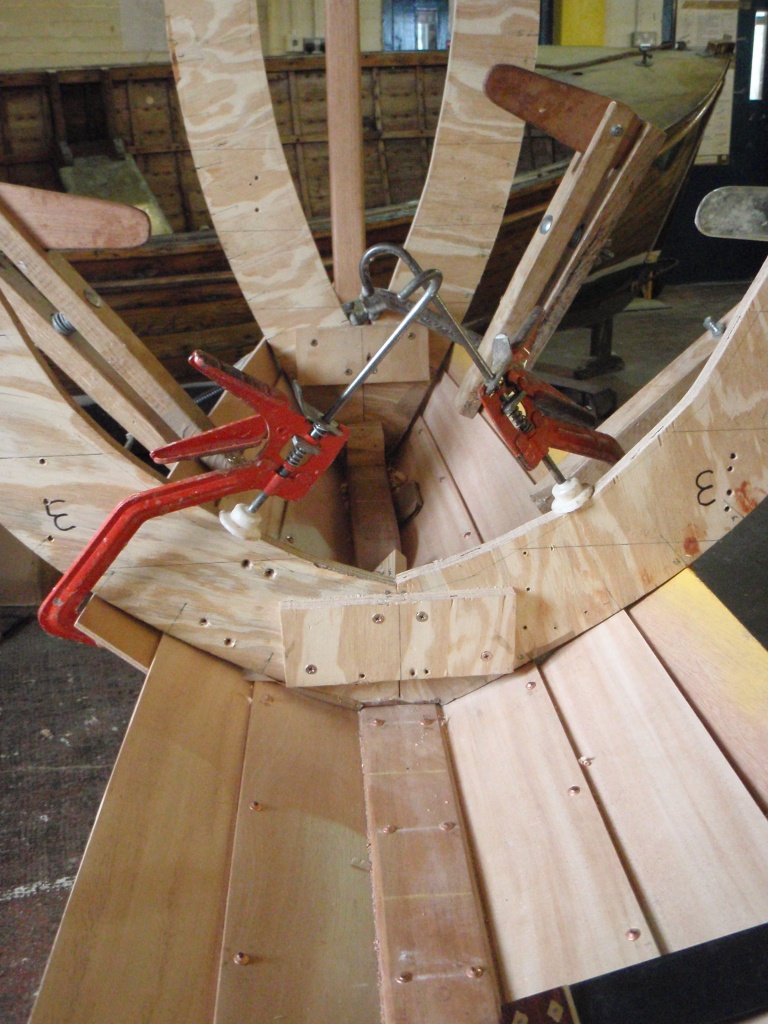
Johnny Tyson builds a 14ft Whitehall at the Boat Building Academy

Johnny's boat leaves the workshop

Johnny’s 14ft Whitehall leaves the workshop on launch day

Johnny workshop 1 Johnny workshop_1 Johnny workshop

And thats all there is to it AK Johnny champagne Johnny Tyson

Boat Building Academy student Johhny Tyson built this John Gardner-designed 14ft Whitehall together with his pal Jerry Reeves, and launched it down at Lyme along with other students’ projects back in June.

The materials Johnny used were West African mahogany on oak with a West African mahogany keel. I gather that following the launch he took it to the Portsoy Scottish Traditional Boat Festival.

There are photos of the build here at Johnny’s website.If you happen to run a boatbuilding business, need staff and like what you see, I gather he’s looking for a suitable job…

I should point out that John Gardner’s books are a tremendous body of work if you’re interested in American boat types, and some of them have been available at very keen prices in recent years it’s well worth checking Amazon – I’d suggest in particular that Building Classic Small Craft including 47 sets of boat building plans is a bargain at less than £15.

My thanks to Academy principal Yvonne Green for the photos.

For more on student launches at the Boat Building Academy, click here.

Dr Strangelove goes gunning – H C Folkard’s scary wildfowling boats

[ad name=”intheboatshed-post”]

Folkard01

Folkard’s remarkable shooting boat with a gun on its bows – click on the thumbnail for a bigger image

A few days ago a correspondent named Graeme reminded me that H C Folkard’s 19th century book The Sailing Boat includes a fair number of pages about boats used for shooting wildfowl, and commented that some of them seemed a little extreme.

So I looked out my copy, and sure enough I found the illustration above – a sailing punt of what must be 40ft fitted with a gun on a swivelling mount. The sharp eyed will note a group of ducks wisely flying out of range, that the helmsman has brailed up a section of sail to allow him to spot the quarry, and, of all things, what seems to be a lateen-rigged gunning punt in the background. (Is that really a lateen?)

Folkard makes some memorable points.

The advantages of two-handed punts are, that they carry a larger gun than others; sometimes a full-sized stanchion gun that throws from one and a half to two pounds of shot at a charge, making fearful destruction among large numbers of wild-fowl, and, when loaded with mould-shot they sweep the water from sixty to one hundred and twenty yards, spreading terrible slaughter among the feathered tribe.

It sounds more like a kind of madness than a sport, at least to me. Sailing the small gunning punts does sound like fun, however, but Folkard issues a clear warning about what they can and cannot do safely.

‘But the inexperienced are warned of the peril of carrying sail on a punt in any but smooth water. The effect of venturing into rough water with such a long low craft, whilst pressing her ahead under sail would be to drive her bows under water; and the weight of the gun at the head of the punt must tend to increase the danger. If the punter moves forward to lower the sail, his extra weight thrown suddenly forward would, in such a case, inevitably send  the punt under water head first; and independently of such a glaring indiscretion, it is impossible to prevent the water flying over the gunwales in a heavy sea. Therefore, the wild-fowler is cautioned not to venture into rough water with the sailing punt, for a sportsman’s life is supposed to be of more value than a duck.’

I have a feeling that this is the voice of experience, and that Folkard may have had had to swim for it on at least one occasion in the past…

For an intheboatshed.net post about gun punts in the East of England including a splendid quotation from Victorian scholar and man of the cloth Sabine Baring-Gould, click here.

For a little on a gun punt in Ireland, click here.


King George the Fifth, the king who was first yachtsman in the land, and his love for a boat

[ad name=”intheboatshed-post”]

Bild 102-13720

King George the Fifth at the helm of Britannia, taken from the Wikipedia

I’ve just bought a copy of Frank Carr’s book The Yachtsman’s England, published in the spring of 1937. Carr could write carefully turned and well researched material, but on this occasion he seems to have been employed to provide lots of colour with special emphasis on the Empire and old socks school of writing, and he certainly included some fine sentimental stuff in this one!

Writing about the yachtsmen of England, he has this to say:

‘It requires,’ said a writer in the London Review over seventy years ago, ‘a combination of those attributes which distinguish a modern Briton to make a racing-man or genuine yachtsman.’ What was true in 1862 is equally true today; and no-one can think of those fine qualities which go to make a great yachtsman without remembering first the man in whom they were so perfectly combined – our late sovereign, His Majesty King George the Fifth. He who so dearly loved the sea, who by his subjects was so dearly loved, had won a place in the hearts of all of us who know the ways of little ships, not as our King alone, but as the First Yachtsman in the land. Most of us knew him only as a slight figure on the deck of the splendid old Britannia; or from the happy photographs taken of him at the helm, or hauling on a halliard, or looking up at a sail to see with a master’s eye that they were all well set and drawing. But we knew that he was a sailor as well as a King, who could see with a sailor’s eye and feel with a sailor’s understanding. We knew that he felt the power of a little ship to win the love of those who sail her, and we loved him for the love he bore Britannia.’

Many of us who enjoy sailing can get pretty misty eyed about our boats, perhaps particularly when they’ve seen us through a trying passage, but King George V’s affection for Britannia seems to have been a bit extreme. Perhaps it was from jealousy that anyone else might sail his yacht or maybe it was to avoid the sad effects of decay and decline that have afflicted other great racing yachts, but his dying wish was for his yacht to follow him to the grave. And so in 1936, probably just weeks before Carr sat at his desk to write, Britannia’s stripped hull was towed out to deep water near the Isle of Wight, and sunk.

To many of us now it seems like a big and unnecessarily wasteful gesture, but it turned out to be more than that – for it also marked the end of big yacht racing in Europe.

For more on Britannia at the Wikipedia, click here.

For Uffa Fox’s view, click here.

For more on Britannia at intheboatshed.net, including film clips, old photos of her racing and news of a revitalised Alfred Mylne company, click here.

For more on Frank Carr, click here.