[ad name=”intheboatshed-post”]


Our new Auray punt tender on the lake behind Jim and Eileen’s house
We finally launched our new Phil Bolger-designed Auray punt tender with the help of our good friends Jim and Eileen Van Den Bos yesterday.
Thanks Jim and Eileen, and many thanks also for the dinner!
A collaborative effort between Julie, myself and Jim, it was made to plans included in an early chapter of his book Boats With an Open Mind, published by International Marine, and bearing in mind that tenders have hard lives, it is built using 3/8in marine ply rather than 1/4in material. DIY boat builders may also be interested to know that the oars we’re using are the ones described by R D Culler and by Jim Michalak, who has published plans for them online. I can confirm that they’re quite easy to make (though you’ll want a power planer) and work every bit as well as Jim says.
Bolger based his design on the Auray punt on a description by Claude Worth in his book Yacht Cruising, which was written in the early years of the 20th century. Worth, who observed fishermen’s boats when cruising the southern coast of Brittany thought that one particular type, which he dubbed the Auray punt, would make a good tender. Awareness of the boat type redoubled in the 1990s, when Bolger wrote about the type in Boats with an Open Mind and included his design.
One reason for Bolger’s interest in this type of boat no doubt arises from the fact that it is a traditional boat that conforms closely to his well known ‘seas of peas’ analogy relating to the design of chine boats – many of Bolger’s designs including the Micro and his flat-bottomed sharpies share the shape of the Auray punt in an elongated form.
So how does this little boat perform? On flat water with one person on board, I can say it feels light and effortless to row until it reaches hull speed on its short water line. Three-up it seems to reach its design displacement, at which it rows rather more steadily but is very well behaved. Two up, it does exactly what you’d expect with a sharply rockered hull form…
I think it will make a handsome tender, particularly if I remember to put something heavy near the bows whenever there’s someone in the stern.
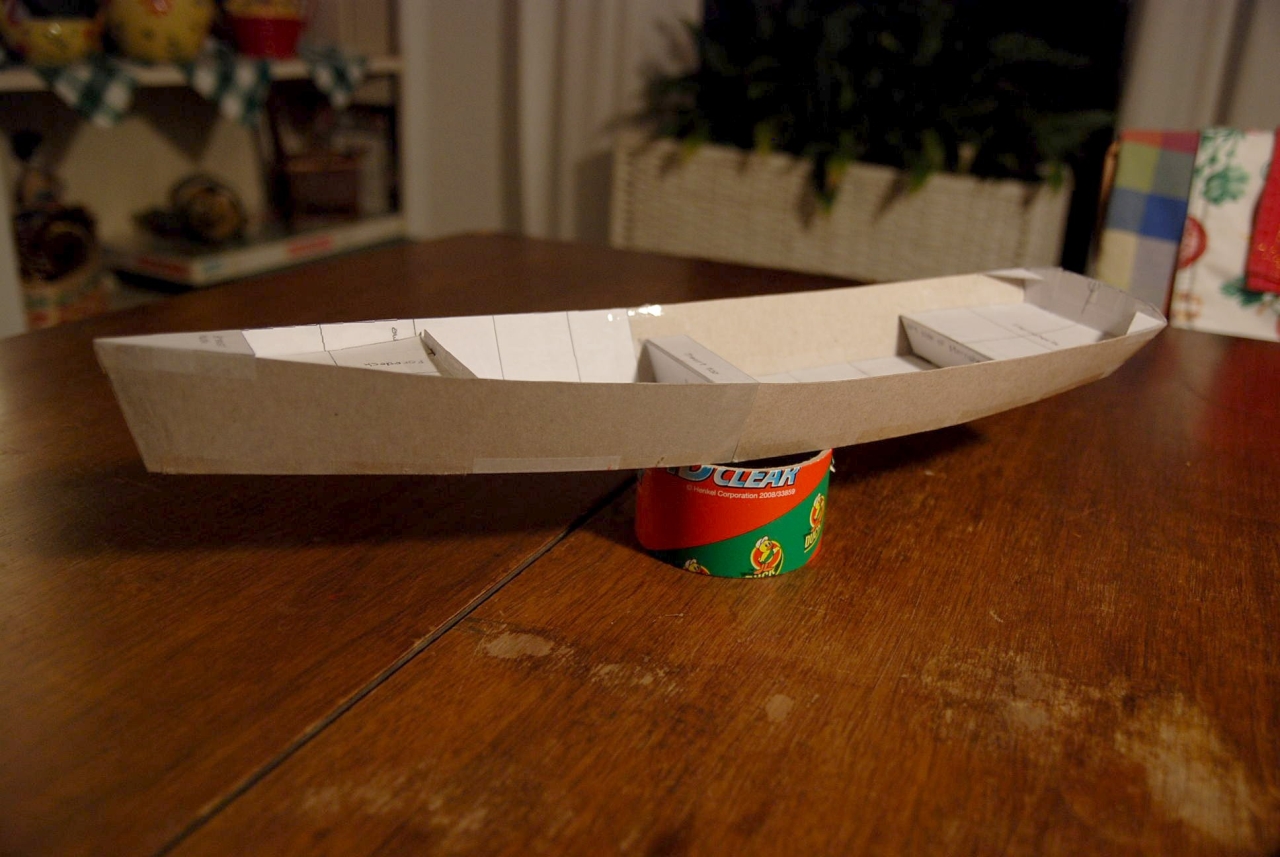
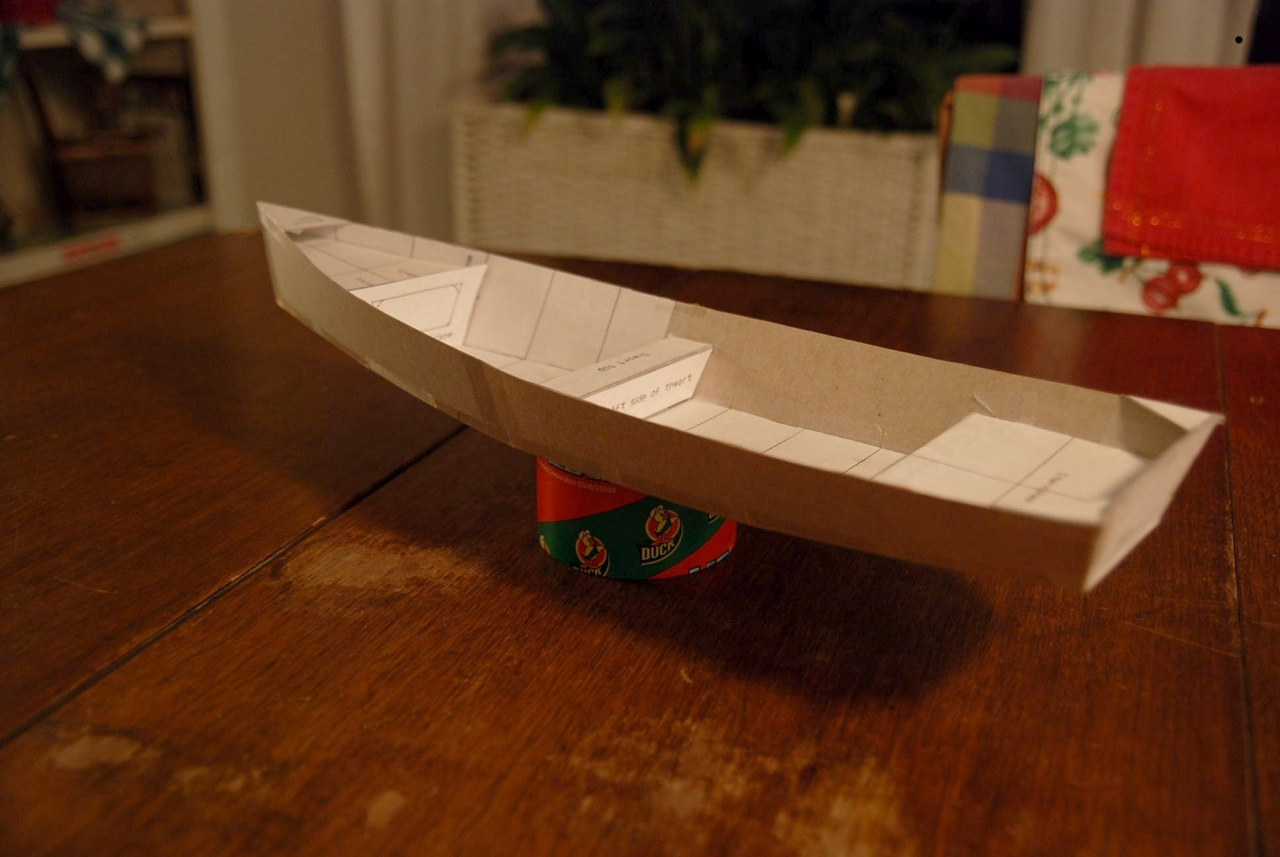
The only caution I would offer is that if you find a copy of the book and decided to build the boat, make a model first!
For more on the Auray punt and Worth’s description at intheboatshed.net, click here.

Just feet from our launch site, a moorhen resolutely sits on her floating nest made from reeds
Don’t miss something good! Subrscribe to intheboatshed.net’s weekly email newsletter.