250 year-old birch bark canoe in Cornish barn to be returned to Canada

Enys birch bark canoe sees daylight for the time in decades

The birch bark canoe on location on the Enys Estate A painting by historical artist John Buxton showing similar birch bark canoes as they would have been used over 200 years ago

Enys birch bark canoe sees daylight for the time in decades; the canoe on location on the Enys Estate; painting by historical artist John Buxton depicting similar birch bark canoes as they were 200 years ago

National Maritime Museum Cornwall curators are working to conserve what may be the oldest birch bark canoe in existence, before it is sent back to Canada.

For over 200 years, the canoe has belonged to the Enys family having been brought to Cornwall by Lt John Enys after he fought in the American War of Independence in 1776. It is estimated to be over 250 years old.

‘Lt Enys sailed from Falmouth in a packet ship to join his regiment in Canada to relieve the city of Quebec, which was under siege from the Americans,’ said NMMC boat collections manager Andy Wyke.  ‘He fought many military campaigns and toured the area for his personal interest – discovering this canoe along the way. It’s incredible to think its legacy has been resting in a barn in Cornwall all this time.’

The canoe has been kept near Penryn in an Enys Estate barn for many years but this week it was moved to the NMMC, where it will be conserved, preserved and put on show from late January until it is  repatriated to Canada in September.

The canoe came to light when Enys family descendent Wendy Fowler called the museum to request they look at the canoe lying in the Estate’s barn.

Captain George Hogg NMMC archivist and trustee said ‘When we received the call from the Enys family to identify their canoe in a shed we had no idea of the importance of the find. We knew we had something special, but having worked with the British Museum on the artefacts and the Canadian Canoe Museum in Peterborough, Ontario, we now believe that this is one of the world’s oldest birch bark canoes. This is a unique survival from the 18th century.’

Canadian Canoe Museum researchers hope to identify where the boat may have been built and by which tribe.

PS – Duckworks has an excellent post explaining how birch bark canoes are made.

A tale of three Halcyons

[ad name=”intheboatshed-post”]

The original Halcyon

The first Halcyon

The second Halcyon in 1930 The second Halcyon in 1912 Mamie

The first Halcyon sailing in 1930, the second in 1912 and in around 1930-35

The second Halcyon in the workshop The second Halcyon in the workshop The second Halcyon in the workshop

The first and second Halcyons in Roving Commissions’ workshop

John Owles of Roving Commissions at Southdown in Cornwall has been in touch to tell us something of what he’s been up to.

He’s currently working on two half-decked gaff cutters built by Paynters’ at St Ives, of carvel construction with pine on steamed oak timers, and both originally carrying the name of Halcyon:

  • a 28-footer built in 1904 with plumb stem and square counter, very much along working boat lines. The asbestos tycoon, Sir Samuel Turner, learnt to sail in when he was a youngster
  • a 30-footer from around 1910-12, which was commissioned by Sir Samuel, which is more yachty with a spoon bow and finer counter

Sir Samuel later had the 90ft Halcyon built that is currently owned by Andrew Armour and featured in the July 2007 issue of Classic Boat.

The older boat had moved to the Isles of Scilly and had  her name changed by the time the 30-foot Halcyon was built. Then, in the 1920s, Sir Samuel had the 90-foot yacht built and, in order to retain the name, gave the younger Halcyon to Dan Paynter as a wedding gift, renaming her Mamie, after Dan’s bride. This also meant Sir Samuel was able to keep the name Halcyon for the new yacht, commemorating the original St Ives fishing boat of that name in which he was taught to sail.

I’ll let John tell the rest of the story:

‘All three boats have now been returned to their original names – which can be somewhat confusing, especially when two of them are being worked in the same yard at the same time for different owners.

‘We are also working on a 30 foot carvel fishing boat, currently going by the name of Kingfisher, which used to be the Bush Radios company angling boat.

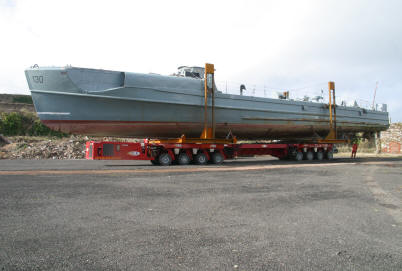
‘On the larger side, we are restoring S130, the last surviving WW2 German schnellboot or E boat, to his (German boats are male) 1943 launch specification inside and out. At 115ft it is still, for the most part, traditional timber boat building, being double-skinned carvel construction on steamed oak timbers. (Click here for a post on this project.)

‘At the smaller end of things we are about to restoring a 14ft mahogany clinker motor boat built at Dartmouth in the early 1950s, and still with her original Stuart Turner engine.

‘Alongside all this I am also working on the design of a fast shoal draft motor boat, capable of 16 to 18 knots with a draft of 6 inches.’

Schnellboot S130 in restoration at Roving Commissions

[ad name=”intheboatshed-post”]

Schnellboot S130 - the last remaining Schnellboot or E-Boat

The last remaining viable example of the feared German Schnellboots, S130 has been in restoration at the Roving Commissions yard at Southdown in Cornwall for some time.

Roving Commissions is run by John Owles, the man who identified the wreck of the historic yacht Scoter as a bawley type. Read more about Scoter.

The 35m torpedo boats had three 2500hp engines a maximum speed of 40knots, and it turns out that S130 was a particularly successful example. Commissioned in the autumn of 1943, she was part of the 9th S-Boot flotilla that in March 1944 found and attacked the American invasion force in Lyme Bay during Operation Tiger, the D-Day preparation training exercise at Slapton Sands that ended in the deaths of more than 740 American forces.