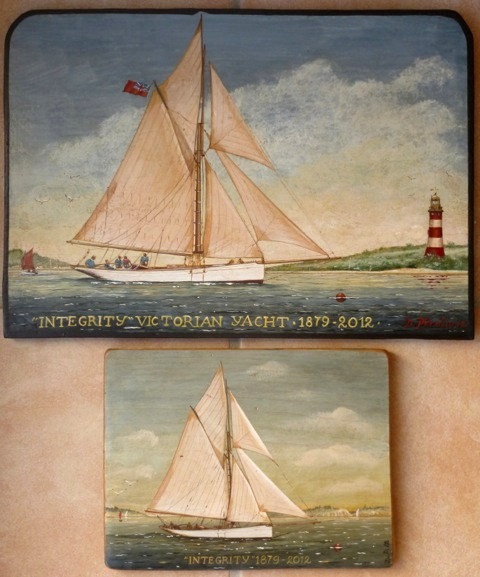
Pierhead painter Dominique Perotin’s portrait of newly built Victorian racing yacht Integrity

Integrity Painting

French pierhead painter Dominique Perotin has produced this portrait of the newly-built Victorian gentleman’s racing yacht Integrity – and it seems to me that she has joined the wonderful yacht’s growing legion of admirers. (Click on the link to see her website.)

Integrity was designed and built by traditional yacht builders and wooden boat repairers Stirling and Son of Tavistock, Devon and is listed for sale via the company website. There are also quite a few posts about her here at intheboatshed.netclick on this link and follow the trail of ‘older posts’ links to find them.

Integrity sailing 6

Integrity in flight

On the subject of Stirlings, boat builders sometimes get some funny commissions. Will Stirling and his colleagues have recently been building a pair of dinghy seats for a pub. I guess if a drinker feels wobbly some time, they can put it down to sitting in a boat, rather than blame the beer and wine…

Stirling & Son dinghy seat

Shipwright John Owles warns against laying timber decks on plywood

Rotten timber from a timber on plywood deck - John Owles shipwright

Rotten stuff from the timber and plywood deck of Antares. Scary, isn’t it?

Cornwall shipwright John Owles has issued a stern warning against timber-on-plywood decks: the commonly-used technique of laying timber decks onto a plywood substrate is doomed to failure.

‘Have one or the other type of deck construction but do not mix the two,’ he says to anyone considering a big repair and restoration job.

John makes his point on a web page reporting on restoration work he did on Antares, a 55ft schooner that was in his yard a little while ago. Her decks consisted of teak planking reclaimed from an old steamer laid onto a plywood substrate and payed with a polysulphide rubber – and the result was widespread rot.

The choice is clear, he argues: if you want a traditional-looking deck then lay a proper traditional deck using fully dried timber. Otherwise lay an epoxy-glass sealed plywood deck and paint it with a two-pack polyurethane sprinkled with glass beads for grip.

With timber on ply decks, it is almost impossible to achieve a good seal, even when the substrate is coated with epoxy.

This is particularly true where fastenings pass through the timber planking and plywood: ‘When a hole is cut in plywood it exposes 360 degrees of end grain, so every layer is at risk of absorbing water.

‘When moisture is trapped in these mid-layers where there is no air circulation, it is impossible for it to dry out… creating an ideal climate for any spores to become active and so the risk of rot is ever present.’

In building a deck, try to avoid anything that allows hidden water to hang around, he adds, and keep your vessel very well ventilated, especially when left unattended.

See John’s website here: www.rovcom.co.uk

A project – and some cheap daysailing fun for someone

It may not look much now, but I’d guess this 20ft Scimitar keelboatlisted on eBay could be destined to provide someone with some splendid daysailing fun.

She’s fibreglass, it’s true, but that’s no reason to be nose-in-the-air about her: she was built at a time when layups were heavy and hull shapes were much like the wood built craft, and she’s currently going for a song.

I’d guess that hull would clean up nicely, and looking at the description my guess is that the biggest problem will be moving her… I suppose there aren’t many of us who have friends from whom we can borrow a crane!

Thanks to traditional boatbuilder Marcus Lewis for pointing her out.