
The SS Robin arises and settles onto her new home – and Dylan Winter films it all

[ad name=”intheboatshed-post”]
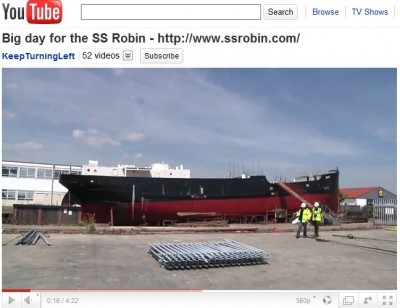
As I write, the last remaining steam-coaster SS Robin should have just been airlifted by two 600-tonne cranes and placed on a pontoon where she will become a floating museum.

Keep Turning Left film-maker Dylan Winter has been filming the event, and I hope his record will be made public at some point. In the meantime, the clip linked above offers a sense of the preparations involved.

I glad I’m not in charge! The cranes involved are two of the heaviest in the UK; their job is to raise the newly-restored 300 tonne vessel off the quayside onto her permanent new home, which is currently at Lowestoft. (PS – I’ve just heard the good news that the SS Robin has landed – see Dylan’s speeded-up video account on Youtube here.)

From Lowestoft she will be taken to London to become new museum and learning centre for young people.

She was brought to Lowestoft in 2008 from London (I used to see her each morning on what was then my daily commute) to undergo essential conservation work and repairs to her historic riveted structure. For earlier posts on the SS Robin, click here and here. Also see the SS Robin project website here.

Built at Bow in 1890, the SS Robin is listed by the National Historic Fleet register and is regarded as one of the most important British-built ships in existence, for there were once thousands of similar steam coasters – they were the heavy goods vehicles of their day, and were immortalised in John Masefield’s poem Cargoes. I don’t know whether kids today study it, but it was certainly taught to my generation. If like me you can’t recall how it goes, here it is:

Cargoes

Quinquireme of Nineveh from distant Ophir,
Rowing home to haven in sunny Palestine,
With a cargo of ivory,
And apes and peacocks,
Sandalwood, cedarwood, and sweet white wine.

Stately Spanish galleon coming from the Isthmus,
Dipping through the Tropics by the palm-green shores,
With a cargo of diamonds,
Emeralds, amythysts,
Topazes, and cinnamon, and gold moidores.

Dirty British coaster with a salt-caked smoke stack,
Butting through the Channel in the mad March days,
With a cargo of Tyne coal,
Road-rails, pig-lead,
Firewood, iron-ware, and cheap tin trays.

John Masefield

As I read this, I’m reminded that I saw the SS Robin’s smokestack in a boatyard not so many weeks ago.

The Semaine du Golfe at Morbihan 2011

[ad name=”intheboatshed-post”]

gulf, morbihan, golfe, morbihan, semaine, boat, festival, maritime gulf, morbihan, golfe, morbihan, semaine, boat, festival, maritime gulf, morbihan, golfe, morbihan, semaine, boat, festival, maritime

gulf, morbihan, golfe, morbihan, semaine, boat, festival, maritime

Semaine du Golfe press photos – the top photo was taken by Quivillac, the following three by Lamour, and the final shot by Boisdron

Another day, another excuse to put up some atmospheric photos! These shots are from the Semaine du Golfe, which takes place every other year in the wonderful Gulf of Morbihan, on the coast of France. Next year it runs from the 30th of May to the 5th of June.

There’s the usual busy programme of sailing, racing and partying, and this year the attendees include a special flotilla from Wales and a delegation from the southern Basque Country.

For more information, see the impressive press pack.

The Life-boat and its Work, a history from 1911 – part II

[ad name=”intheboatshed-post”]

‘It may seem strange that a cause launched with so much enthusiasm, and supported by such influential men, a cause appealing so strongly to the feelings of our countrymen, should have languished and almost died. But the nation was going through a time of deep distress and agitation, and many people thought the State itself was on the verge of shipwreck.’

How little things change! Hopefully, this time we’ll keep the lifeboats in service.

Here’s the second serving of The Life-boat and its Work, the history of the lifeboat of 1911 I started putting up a few days ago.

To see the rest of this series:

The Life-boat and its Work, a history from 1911 – part I

The Life-boat and its Work, a history from 1911 – part II

The Life-boat and its Work, a history from 1911 – part III

lifeboat, lifeboat institution, john cameron lamb, lukin, wouldhave, tyne lifeboat, greathead, history, lifeboat history lifeboat, lifeboat institution, john cameron lamb, lukin, wouldhave, tyne lifeboat, greathead, history, lifeboat history lifeboat, lifeboat institution, john cameron lamb, lukin, wouldhave, tyne lifeboat, greathead, history, lifeboat history

lifeboat, lifeboat institution, john cameron lamb, lukin, wouldhave, tyne lifeboat, greathead, history, lifeboat history lifeboat, lifeboat institution, john cameron lamb, lukin, wouldhave, tyne lifeboat, greathead, history, lifeboat history

lifeboat, lifeboat institution, john cameron lamb, lukin, wouldhave, tyne lifeboat, greathead, history, lifeboat history lifeboat, lifeboat institution, john cameron lamb, lukin, wouldhave, tyne lifeboat, greathead, history, lifeboat history

lifeboat, lifeboat institution, john cameron lamb, lukin, wouldhave, tyne lifeboat, greathead, history, lifeboat history lifeboat, lifeboat institution, john cameron lamb, lukin, wouldhave, tyne lifeboat, greathead, history, lifeboat history

Start receiving the weekly intheboatshed.net newsletter: sign up here