
Boatbuilder Adrian Morgan’s latest projects

Norwegian-derived 15ft boat designed by Adrian Morgan

Norwegian-derived 15ft boat designed by Adrian Morgan

15ft water ballasted small boat designed by Adrian Morgan for Loch Torridon

Stuck last week at home in the ice and snow like many in the UK, writer and Ullapool-based traditional boatbuilder Adrian Morgan got stuck into something he hasn’t done for a while – he sent intheboatshed.net some words and photos.

Naturally, I’m very grateful though I too could do without all that tedious white stuff.

In fact, it all got so bad for Adrian that he decided to start a very interesting weblog: The Trouble with Old Boats.

Here’s what Adrian has to say about the boat above:

‘This was launched in late summer for a client with a cottage on Loch Torridon. It’s built to my design developed from Norwegian original, but beamier and flatter-floored for more stability. She carries water ballast, so is light to tow and launch, but sits deeper for stability. She’s 15ft in length, and built of larch and oak with a standing lug.’

Guillemot rowing boat designed by Iain Oughtred and adapted by Adrian Morgan Guillemot rowing boat designed by Iain Oughtred and adapted by Adrian Morgan Guillemot rowing boat designed by Iain Oughtred and adapted by Adrian Morgan

Guillemot rowing boat designed by Iain Oughtred and adapted by Adrian Morgan Guillemot rowing boat designed by Iain Oughtred and adapted by Adrian Morgan Guillemot rowing boat designed by Iain Oughtred and adapted by Adrian Morgan

Oughtred Guillemot adapted by Adrian Morgan

And here’s what he has to say about this Iain Oughtred-designed Guillemot:

‘Built to replace a 12ft family dinghy that had been well used and loved for 40 years, this Oughtred Guillemot will be rowed on the choppy waters of the Firth of Forth. Stretched to just over 12ft from Iain’s plans for an 11ft 6in dinghy, she has enough length now to allow a rower forward and passenger aft, with another midships, or she can be rowed, swiftly, by one rower sitting centrally.

‘The planking followed Iain’s lines to the letter, once they emerged from below the waterline. Drawn for plywood, there was no way the garboards in larch could match the plywood’s width. I must admit to giving her a little more freeboard forward, as I was concerned she might dip her bow when fully loaded and punching into a head sea. I am not convinced I should not have stuck ruthlessly to Iain’s plans, but where’s the fun in building a one-off boat in solid timber if you can’t tinker a wee bit?

‘With her white-painted bilges, well protected against the rain water that is destined to fill her on her mooring, and varnished topsides, she is a simple, unpretentious little rowing boat of the kind once thrown up in their hundreds and thousands. The finish is smart, but not fussy. You can see your face in the transom, but a little wrinklier than for real. I hope she’ll last looking this good. If she lasts as long as her predecessor, then I will be happy – and in my 90s!’

Many thanks Adrian. I hope you enjoy your weblog as much as I enjoy this one!

If either of these boat tickle your fancy or even meet your needs, contact Adrian via his website: www.viking-boats.com
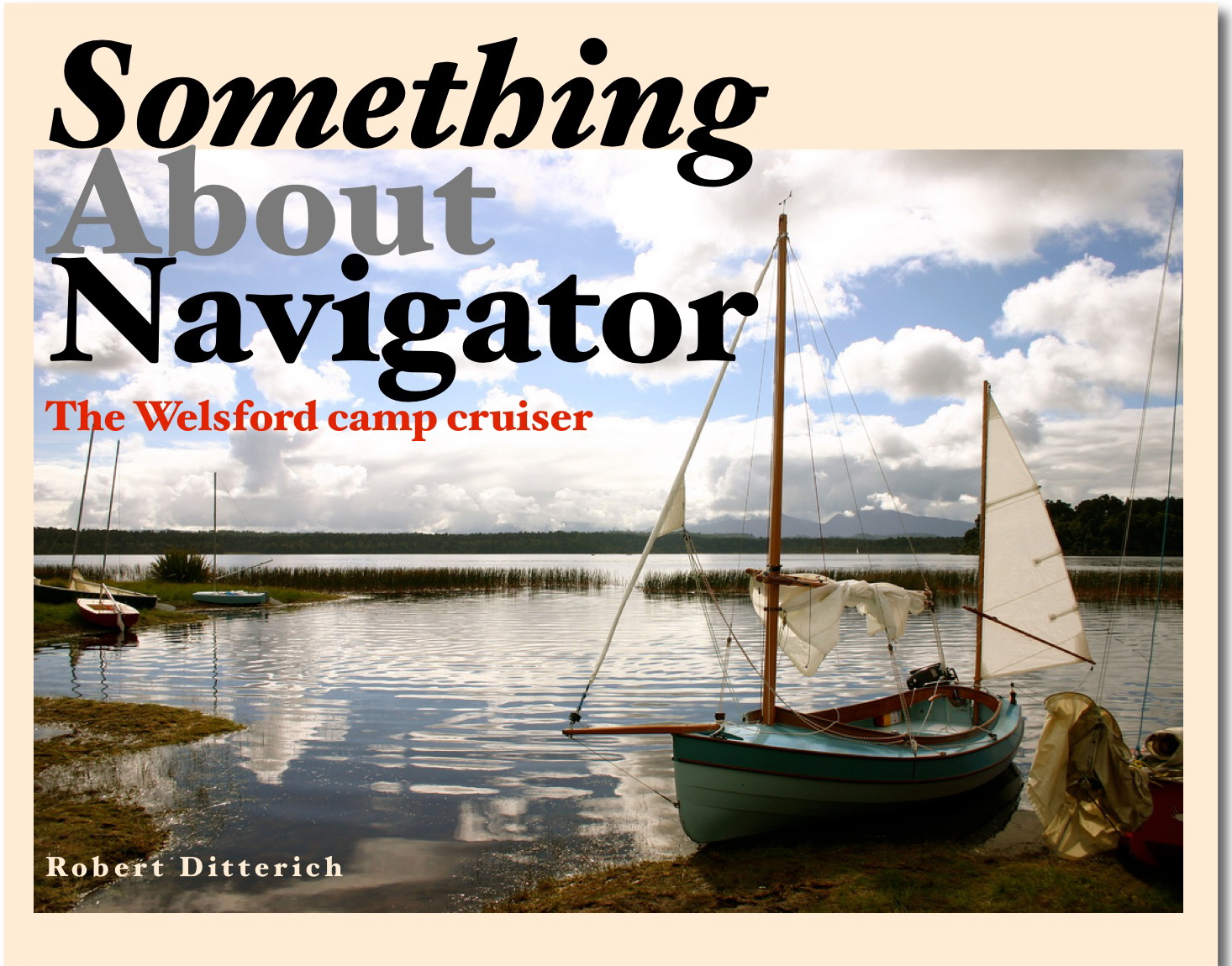
Book celebrates John Welsford’s Navigator

An enthusiast’s self-published book about designer John Welsford’s popular Navigator design is out now.

Robert Ditterich is a violin maker among other things, and clearly both a craftsman and a networker, for in addition to John Welsford himself he’s persuaded some well known names in the Navigator world to donate their experiences. Just some of his contributors are Steve Parke, Owen Sinclair, Richard Schmidt, Chuck Leinweber, Kevin Brennan, Martin Welby, Dave Perillo, Dave Johnstone and Barrett Faneuf.

In Something about a Navigator Robert outlines the development of the design and the aspects of the boat that have made it popular, and a bit of an analysis of the aspects of the boat that have made it such a success, some stories by Navigator owners, sailors and builders. There’s also a chapter about building a hull and another detailing fittings and a list of useful resources.

I haven’t seen the book itself, but if the Navigator is on your boat-dreaming list, I’d say Robert’s book is likely to be both informative and inspirational. Here’s what he says about it:

‘It is my sincere hope that this little book will give some pleasure, not only to Navigator enthusiasts, but to dreamers, builders and sailors who just want something simple, real, and creative in their lives and who find that thinking about little boats is helpful and maybe even inspirational in all that.’

Something about a Navigator is available in two editions, a low cost black and white version priced at $20 and a colour version at $42. Both are available from Robert’s weblog The Middle Thing.

Btw, if anyone has already got a copy, I’d be most grateful for a brief review!

Norfolk Broads half-decker Jamesia II

Jamesia II

Jamesia II Jamesia II Jamesia II

Jamesia II

Joe Farrow in Norfolk has written to tell us about a half-decker that one of his friends is currently working on. It’s been a while since we last had a Norfolk Broads post, so this was a nice surprise!

I’ll let Joe tell the story:

‘Hi Gavin,

‘As promised, I have rooted out a few details for a honey of a half-decker that a friend of mine is lucky enough to own!

‘Jamesia II was built by Martham Ferry Boat Building & Development Company in 1953. Her sister ship “Jamesia” was identical, aside from the cuddy.

‘She was exhibited in 1954 at the British Industries Fair, London Section, which seems like a long way away for a little Norfolk lass!

‘Originally constructed of overall varnished mahogany on oak she is similar to the Twizzy Whiz class designed and built by Ernest Woods – see the pic below of one of these boats, Mandi.

‘My friend Mat Gravener nearly purchased her after just one sail around 15 years ago, after she had been in the hire fleet for many years. I think Mat was attracted by her shape, the configuration of the lifting keel and the capability to camp on-board with ease. From what I understand, he just thought ‘there was something about her’, which included how she looked, her sailing qualities and her history.

‘Time passed. Five or so years ago he spotted her in a shed at Martham, with several planks and timbers cut out of the port quarter. To put in bluntly, she looked sorry and timeworn.

‘A little later she was on eBay and then rumour was that she had been taken to Lincoln for restoration. So no-one was more surprised than Mat when he became aware of her location in a barn, no more than three miles down the road from his house at Stalham!

‘He quickly bought her. Jamesia II is now again in safe hands. With careful chocking to replicate the original sheer and a batten or two, 12 green English oak timbers were left to soak in a boat dyke for a week and then steamed for 15 minutes prior to fitting.

‘Nine lengths of larch planking has been let in having been carefully shaped and hollowed. Fastening was by way of clenching on all but the beam shelf fastenings, which were roved.

‘With a new rudder, and ex Yare and Bure One Design rig lined up to be fitted (again, designed and built by Ernest Woods) Jamesia II looks set to return to exploring the Broads and rivers again in 2011.’

What a fabulous story! Thanks Joe – I’d love to see photos of her, and to see her sailing at some point not too far away. I’d like to add that it’s so often correspondents such as Joe that make intheboatshed.net worth doing – it’s certainly not the peanuts that come from the advertising.

For more Norfolk-related posts, click here.

PS – See the comments for a great story!