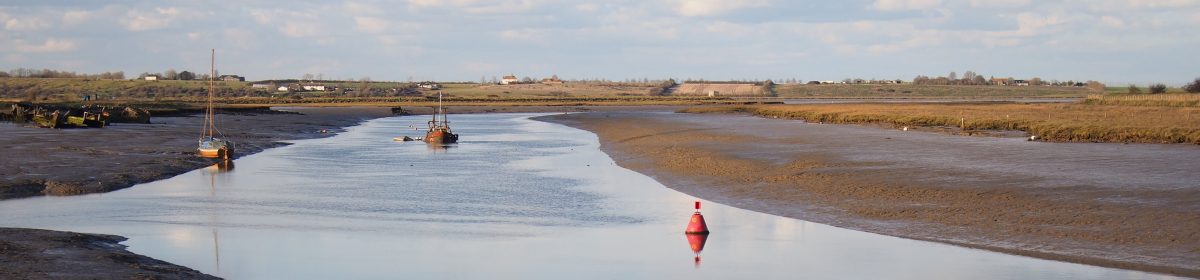
Refurbished Thames barge Edith May at sea and sailing well

[ad name=”intheboatshed-post”]

Thames sailing barge Edith May

Edward Gransden has kindly been in touch with these photos of the Thames sailing barge named Edith May, which has this month been sailing for the first time in ten years or more. Here’s what he says:

‘Please find attached a couple of photos from our first sail. We are intending to charter with individuals and groups up to 12 throughout the summer, operating from Lower Halstow, Chatham and Queenborough.

‘Having spent the past 10 and a half years restoring her, it was a great thrill to be able to take her out sailing for the first time, with her performance proving very pleasing. The Swale Match in August will be the first chance we get to see if she has retained the pace she was once renowned for!’

Thanks Edward! Any time you have photos and stories to share let me know.

It happens that we were over at Lower Halstow this weekend, and found the Edith May in the dock looking very smart. I took some shots with my camera phone – but I’m damned if I can get them out. It’s a better camera than you might think, but the connections and software make me curse!

Here’s an earlier post featuring the Edith May, and here’s a link to the Edith May website.

Alastair Brian Atkin crosses the bar

Alastair Brian Atkin 1930-2010

My father Alastair Brian Atkin – here pictured with his cousin Jean at the fishing village of Chapel St Leonards, Lincolnshire in about 1933-4. The sand hills in the background have long gone

My dear father Alastair Brian Atkin MBE – Brian to many and Alastair to a few – sadly passed away a couple of weeks ago, and I found this photo of him in a fishing boat rigged for sailing at Chapel St Leonards while researching for a speech I was asked to give at a service to give thanks for his life.

Does anyone know anything about this boat please? Is there a story to tell?

Dad knew good times and bad, but in the end I think he had a happy and successful life. He also introduced me to the sea and boating, traditional music and social history – so I have much to thank him for. After the turmoil of the past little while, I went for a long planned couple of days sailing with a friend this past weekend – and I must say that I’m greatly saddened to be unable to tell my father about it.

I should add that Dad was a great fan of Tennyson, a poet closely associated with his home county of Lincolnshire, so it seems appropriate to bring out a poem that’s often quoted at times like these – Crossing the Bar.

Crossing the Bar

SUNSET and evening star,
And one clear call for me!
And may there be no moaning of the bar,
When I put out to sea,
But such a tide as moving seems asleep,
Too full for sound and foam,
When that which drew from out the boundless deep
Turns again home.

Twilight and evening bell,
And after that the dark!
And may there be no sadness or farewell,
When I embark;

For tho’ from out our bourne of Time and Place
The flood may bear me far,
I hope to see my Pilot face to face
When I have crost the bar.

The SS Robin arises and settles onto her new home – and Dylan Winter films it all

[ad name=”intheboatshed-post”]

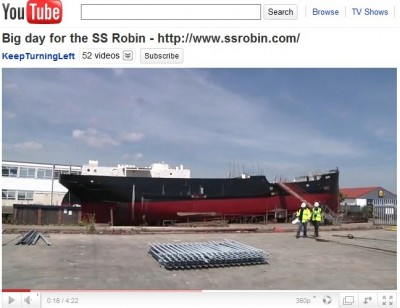
As I write, the last remaining steam-coaster SS Robin should have just been airlifted by two 600-tonne cranes and placed on a pontoon where she will become a floating museum.

Keep Turning Left film-maker Dylan Winter has been filming the event, and I hope his record will be made public at some point. In the meantime, the clip linked above offers a sense of the preparations involved.

I glad I’m not in charge! The cranes involved are two of the heaviest in the UK; their job is to raise the newly-restored 300 tonne vessel off the quayside onto her permanent new home, which is currently at Lowestoft. (PS – I’ve just heard the good news that the SS Robin has landed – see Dylan’s speeded-up video account on Youtube here.)

From Lowestoft she will be taken to London to become new museum and learning centre for young people.

She was brought to Lowestoft in 2008 from London (I used to see her each morning on what was then my daily commute) to undergo essential conservation work and repairs to her historic riveted structure. For earlier posts on the SS Robin, click here and here. Also see the SS Robin project website here.

Built at Bow in 1890, the SS Robin is listed by the National Historic Fleet register and is regarded as one of the most important British-built ships in existence, for there were once thousands of similar steam coasters – they were the heavy goods vehicles of their day, and were immortalised in John Masefield’s poem Cargoes. I don’t know whether kids today study it, but it was certainly taught to my generation. If like me you can’t recall how it goes, here it is:

Cargoes

Quinquireme of Nineveh from distant Ophir,
Rowing home to haven in sunny Palestine,
With a cargo of ivory,
And apes and peacocks,
Sandalwood, cedarwood, and sweet white wine.

Stately Spanish galleon coming from the Isthmus,
Dipping through the Tropics by the palm-green shores,
With a cargo of diamonds,
Emeralds, amythysts,
Topazes, and cinnamon, and gold moidores.

Dirty British coaster with a salt-caked smoke stack,
Butting through the Channel in the mad March days,
With a cargo of Tyne coal,
Road-rails, pig-lead,
Firewood, iron-ware, and cheap tin trays.

John Masefield

As I read this, I’m reminded that I saw the SS Robin’s smokestack in a boatyard not so many weeks ago.