Keith Johnston and friend saved from a dunking by a Selway Fisher-designed tender

Selway Fisher designed Skylark dinghy

Many of us become very attached to craft that serve us well – but tenders aren’t usually the object of our deep affections. However, Keith Johnston tells a story about an experience that taught him the value of his tender in a big way.

‘My friend and I have been sailing Devon Yawls for more than twenty five years simply because they are a modern fibreglass moulding of the Salcombe yawl.

‘Salcombe yawls are now hand built in top quality timbers and are £20,000 16’ dinghies that sail like serious deep sea boats and are a fiercely competed class in Salcombe. More importantly for me, they are based upon a very much tried and tested local inshore fishing boat. The locals know when a boat is good, and the Salcombe yawl is the best, so we’ve been sailing the Devon Yawl is an equivalent boat made in GRP from a mould taken off an a Salcombe yawl. (In fact, I have now graduated from the Devon Yawl to the Devon Dayboat, which is a Devon Yawl with a small cuddy) that provides a little shelter in rough weather or a camping shelter for two. Some of the original Devon Dayboats, like mine have a Stuart Turner 5hp inboard, which makes them reall useful all-round cruising boats.)

‘But back to my story. When we first started sailing yawls we moored the boat at various points on the River Tamar on the border between Cornwall and England. To get to her, we used a Fairey Duckling, which is a superb moulded double diagonal ply built dinghy loosely based on the World War II airborne lifeboats. These were made by Fairey Marine and were dropped from search and rescue planes so that ditched air crew in the North Atlantic and North Sea could rescue themselves. (For more on airborne lifeboats, click here; for more on Fairey Ducklings, click here.)

‘Believe me, the little Ducklings take after their big sister airborne lifeboats and are tough little boats, and we could just about carry the Duckling from the car to the tide line, which was sometimes 150 or 200 yards. As time went by, however, the Duckling seemed to get heavier (or had we got older?) and we realised the Duckling had become a collectors boat and was too valuable to be used as a general beach dinghy any longer. So we decided to try and find a cheap dinghy as a replacement.

‘The first boat I ever built Continue reading “Keith Johnston and friend saved from a dunking by a Selway Fisher-designed tender”

BBA student Francis Clarke builds a Bear Mountain Boats stripper canoe

Derek Thompson LRPS - Frank Clarke Chestnut Canoe - Boat Building Academy

Derek Thompson LRPS - Frank Clarke Chestnut Canoe Derek Thompson LRPS - Frank Clarke - Bob's Special - Chestnut Canoe Company Frank Clarke Bob's Special canoe - bow cramp method

Paul Dyer - Frank Clarke Canoe

Students on the long course at the Boat Building Academy often build a canoe or kayak rather than a boat, and that’s what Frank Clarke from Norfolk did this year, says regular BBA correspondent Emma Brice.

A professionally trained canoeist – but lacking a canoe – Frank chose to build a Bob’s Special – a 15ft open canoe from the Chestnut Canoe Company catalogue.

The canoe was modified for strip planking and drawn by Steve Killing who works with Bear Mountain Boats in the US. More information can be seen on the Bear Mountain Boats website.

Frank’s canoe is strip planked with Western red cedar and has oak rubbing strips, thwarts, decks and fittings.

Usually when building the hull the strips are held to the mould with staples until the glue cures, and then the staples are removed. However, Frank wanted to avoid the marks that the staples leave, and so he invented his own tool, which he named a ‘bow cramp’ for keeping the strips in place as the glue set. It worked a treat: click here to see the photographic diary of the build.

Frank says his project will always be a reminder of his time at Lyme Regis, as well as a demonstration of his craftsmanship.

Before the course Frank worked in various roles, from customer service to sales and taught English in China, gained qualifications in outdoor activities and completed a fine art degree in sculpture. However, he became seriously ill and was paralysed from the waist down for two years: on his recovering Frank joined the course in order to regain his career direction and re-energise his creativity.

Since graduating Frank has decided to become a teacher and hopes to pass on his skills and interest in woodworking and fine art.

The first photo of Frank’s bow cramp method was taken by BBA Administrator Gemma Stunt.

Ben Wales’ clinker launch restoration

Ben Wales working on 18ft clinker launch Mary

Ben Wales working on 18ft clinker launch Mary

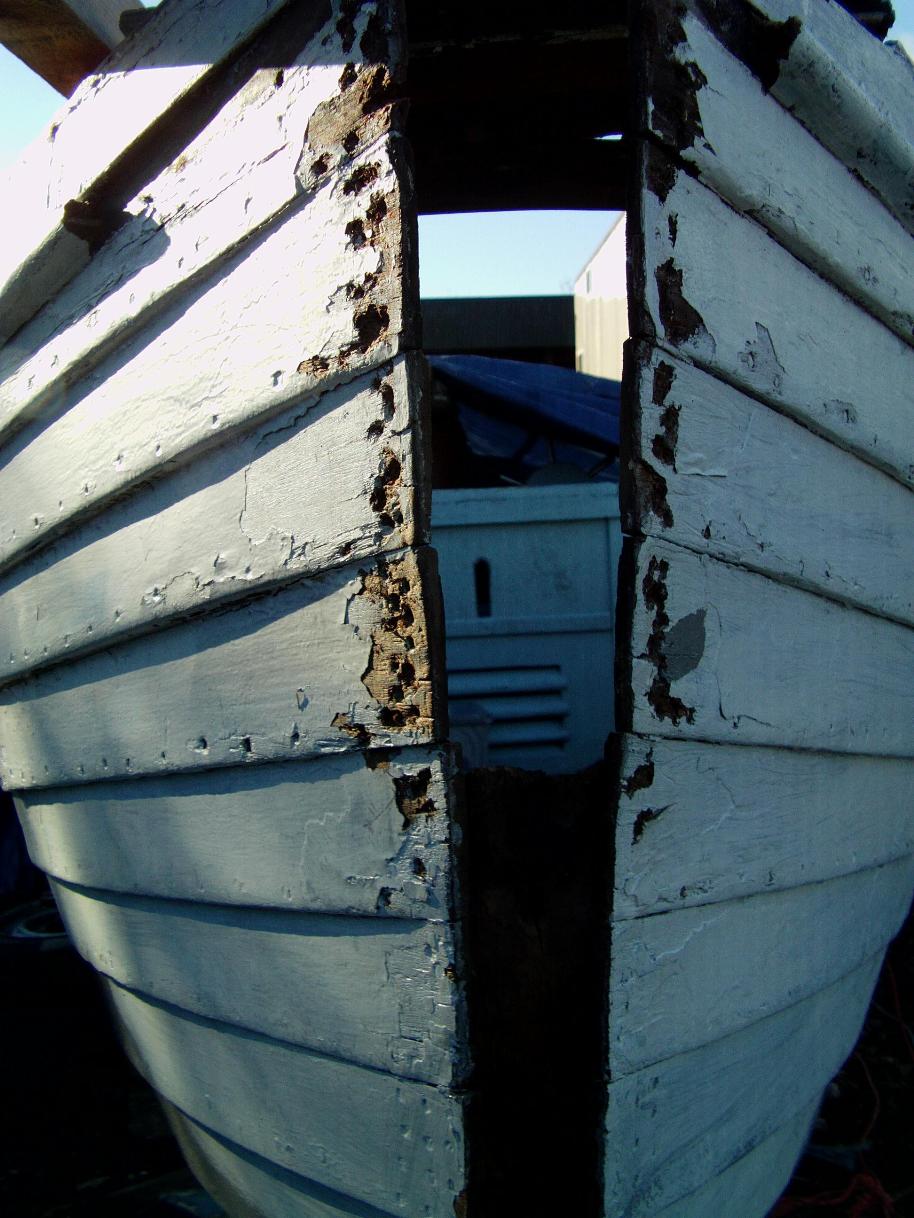
The new stem, and the old stem piece and apron removed

Some time when you’re sitting in the warm, spare a thought for dedicated Ben Wales working when he can in the open air during this winter restoring his 18ft clinker-built motor launch Mary. While you’re at it, wish him luck and good weather.

Here’s what he wrote a few days ago:

‘Here is the latest update on my restoration on Mary. The work has been slow – the weather held us up for over a month as it was just too cold, and before that it was wet whenever we wanted to work on her outside.

‘The stem has now been replaced in English grown oak as the old one was badly worn and soft. Without a doubt this is the most complex and time consuming job we have done on the launch, and all without  power tools or power.

‘First, a template had to be cut out for the bottom and top stem piece and then drawn out on a new in 4in thick oak plank where the two were cut out.

‘The lower part of the stem, which joins with the kee, was first shaped to fit and then holes were drilled out for stainless steel bolts made the job. It had to be scarphed on each end, and a mixture of paint and putty was applied for packing.

‘The top part of the apron was also replaced and that was cut and shaped before the top stem piece was fitted.

‘While the upper part of the stem was fitted we had a quite a task to shape it, as we tried to follow the original patten precisely – but found that had been cut wrong. So after more shaping it fitted far better than the original it replaced.

‘The next task is to fit the gunwales and knees, and to reframe the topsides. When the Weather gets warmer and I have saved up some money, I will purchase the timber to plank her topsides.

‘Ben’

Thanks Ben – I’ll be thinking of you at least!

For an earlier post about this project, click here.