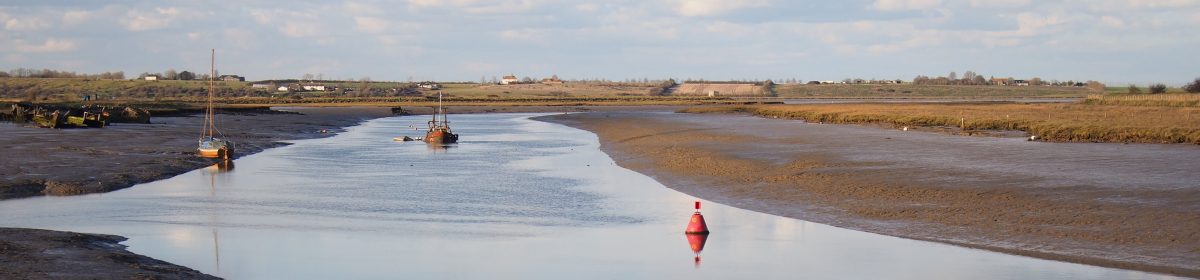
Bill Serjeant visits Oare Creek and Faversham

blogger-image-621749119

I see from Bill’s Log that small boat cruiser and gentleman of the waves Bill Serjeant is spending a little time at Oare Creek and visiting Faversham, where he seems to be enjoying himself. Here’s his description of Oare Creek:

‘I alighted at the head of Oare Creek and ambled along the footpath where late Spring blossoms scented the air. I deeply breathed in and savoured the beauty of the countryside…

‘I was saddened to see so many forsaken yachts no longer cherished by their owners… but in between, snuggled into the mud awaiting the return of the tide there were the most glorious of sailing vessels, Thames barges and classic yachts of all kinds.’

He’s sailing a West Wight Potter these days – for many years he has taken a particular pleasure in changing boats regularly, often building the smaller ones himself. He has travelled over from Burnham and Leigh, hopes to make Ramsgate tomorrow before the wind rises later in the day. Great good luck Bill!

Judging distance at sea by eye – a how-to

Distance judging at sea 5


How far is the mudbank opposite? Half a mile? A mile and a half? On board sailing barge Lady of the Lea in the Swale

Each year I tell myself I will now memorise the ways old fashioned used to judge distances by eye to improve my ability to navigate by eye. Perhaps this will be the year I manage it.

Anyway, it would be a great skill for all of us to have and so when I found this little chapter in The Yachtsman’s Weekend Book  I thought should share it…

Distance judging at sea 1 Distance judging at sea 2 Distance judging at sea 3

Distance judging at sea 4


Some things I mean to try to remember are the following:

  • ‘For the man with his height of eye at 8ft, the sea level horizon will be about 3 1/4 miles.’
  • ‘Anything with its base just touching the horizon line, or a power vessel under way and showing her bow-wave just above the horizon – all these objects would be approximately 3 1/4 miles away.’
  • ‘Had his eye been between 5 and 6 feet above sea level, this distance would be about 2 1/2 miles.’
  • ‘At two miles distance (from the 8-foot observer) a large navigation buoy should be visible, in smooth water, but its shape and colour will as yet be indistinguishable to the naked eye’
  • ‘At a distance of 1 1/2 miles small-sized navigational buoys can be made out in smooth water.
  • ‘At a distance of 1 mile to 1 1/4 miles the shape of the smaller buoy can be made out… as also can the colour and markings of the large type of buoy.’
  • [At a distance 1 to 1 1/4 mile]’A man moving to and fro on board of a ship or on shore shows up… as a black mark but his limbs and features are, of course undistinguishable.’
  • ‘At 600 to 800 yards a moving man… resolves himself into a featurless vertical mark. At 400 to 500 yards distant the movement of a walking man’s legs are noticeable, and the rower’s arms in a dinghy can be seen working… ‘


The Leysdown Tragedy of 100 years ago

The sea off Leysdown, Isle of Sheppey, in quieter times

It was my old friend Nic Lucas who drew my attention to the Leysdown Tragedy, in which nine boys – young Sea Scouts and helpers – drowned when a sudden storm struck their open boat 100 years ago this month.

Writing on his Facebook account, Nic said that as a 14 year old (this would be in the 1960s, I’d guess) he had taken part in Sea Scout flotilla that set out from the RRS Discovery (yes – that Discovery) in London and sailed to France.

The boat my friend was on board was a whaler similar to the ones pictured here, and it was a great adventure for a lad and one that he has remembered all his life.

However, Nic added that this month is the 100th anniversary of the Leysdown Tragedy, in which a group of Sea Scouts and helpers sailing from Waterloo Bridge were capsized by a sudden squall opposite Leysdown on the Isle of Sheppey, just around the corner from the Swale.

They were a young group – the oldest boys were barely teenagers, and on the way, they had slept under their sails at Erith.

The capsize was seen from the island by coastguards (which wouldn’t happen now!) and valiant efforts were made to save the 23 on board the whaler,  though only 14 were rescued alive.

Nic said he thought of those young Sea Scouts as pioneers for his own trip, and for the spirit of adventure that builds fine people including his own son Sam Lucas, who was due to carry the Olympic Torch on the day my pal addressed us all via Facebook.

There’s a BBC news story describing the Leysdown Tragedy on the BBC website, and further sources are here, here and here.

The disaster was one of those that made a big impact on the public, and a striking memorial to the lost youngsters paid for by public subscription was erected at Nunhead Cemetery in South London (see the BBC link for a photo). It stood until 1969 when it was vandalised, and a modern, much simpler memorial now stands in its place.

I’ve been sailing past the site of the Leysdown Tragedy for years without knowing a thing about it. I’ll pause for thought myself, next time I go that way.