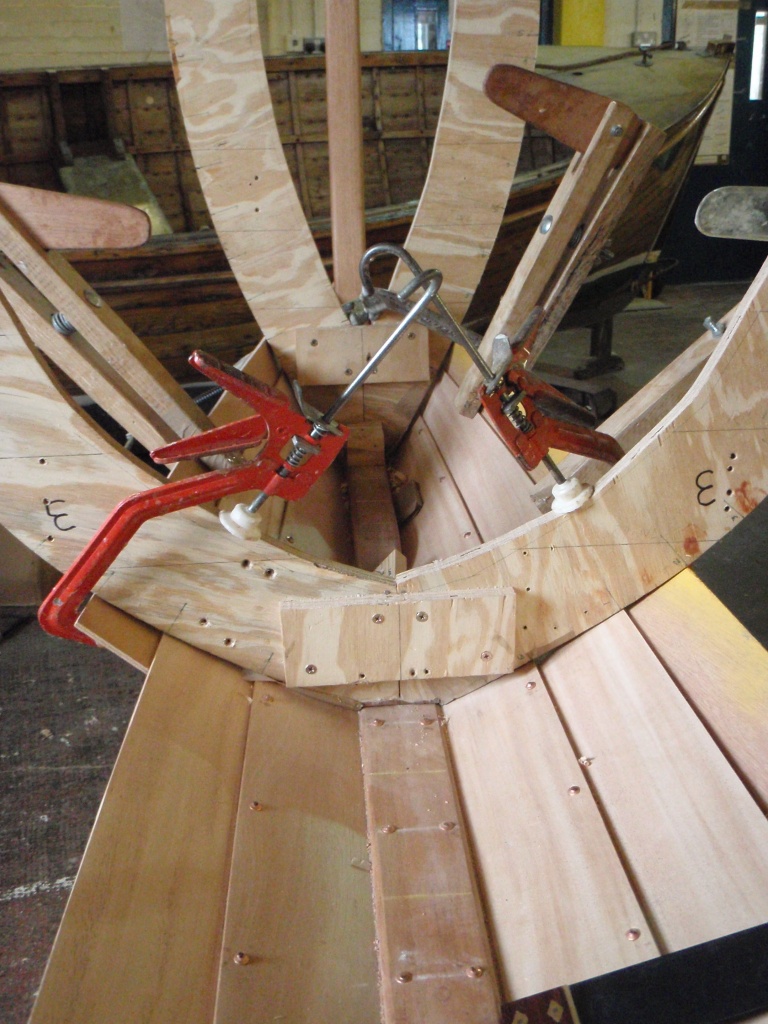
Johnny Tyson builds a 14ft Whitehall at the Boat Building Academy

Johnny's boat leaves the workshop

Johnny’s 14ft Whitehall leaves the workshop on launch day

Johnny workshop 1 Johnny workshop_1 Johnny workshop

And thats all there is to it AK Johnny champagne Johnny Tyson

Boat Building Academy student Johhny Tyson built this John Gardner-designed 14ft Whitehall together with his pal Jerry Reeves, and launched it down at Lyme along with other students’ projects back in June.

The materials Johnny used were West African mahogany on oak with a West African mahogany keel. I gather that following the launch he took it to the Portsoy Scottish Traditional Boat Festival.

There are photos of the build here at Johnny’s website.If you happen to run a boatbuilding business, need staff and like what you see, I gather he’s looking for a suitable job…

I should point out that John Gardner’s books are a tremendous body of work if you’re interested in American boat types, and some of them have been available at very keen prices in recent years it’s well worth checking Amazon – I’d suggest in particular that Building Classic Small Craft including 47 sets of boat building plans is a bargain at less than £15.

My thanks to Academy principal Yvonne Green for the photos.

For more on student launches at the Boat Building Academy, click here.

Dr Strangelove goes gunning – H C Folkard’s scary wildfowling boats

[ad name=”intheboatshed-post”]

Folkard01

Folkard’s remarkable shooting boat with a gun on its bows – click on the thumbnail for a bigger image

A few days ago a correspondent named Graeme reminded me that H C Folkard’s 19th century book The Sailing Boat includes a fair number of pages about boats used for shooting wildfowl, and commented that some of them seemed a little extreme.

So I looked out my copy, and sure enough I found the illustration above – a sailing punt of what must be 40ft fitted with a gun on a swivelling mount. The sharp eyed will note a group of ducks wisely flying out of range, that the helmsman has brailed up a section of sail to allow him to spot the quarry, and, of all things, what seems to be a lateen-rigged gunning punt in the background. (Is that really a lateen?)

Folkard makes some memorable points.

The advantages of two-handed punts are, that they carry a larger gun than others; sometimes a full-sized stanchion gun that throws from one and a half to two pounds of shot at a charge, making fearful destruction among large numbers of wild-fowl, and, when loaded with mould-shot they sweep the water from sixty to one hundred and twenty yards, spreading terrible slaughter among the feathered tribe.

It sounds more like a kind of madness than a sport, at least to me. Sailing the small gunning punts does sound like fun, however, but Folkard issues a clear warning about what they can and cannot do safely.

‘But the inexperienced are warned of the peril of carrying sail on a punt in any but smooth water. The effect of venturing into rough water with such a long low craft, whilst pressing her ahead under sail would be to drive her bows under water; and the weight of the gun at the head of the punt must tend to increase the danger. If the punter moves forward to lower the sail, his extra weight thrown suddenly forward would, in such a case, inevitably send  the punt under water head first; and independently of such a glaring indiscretion, it is impossible to prevent the water flying over the gunwales in a heavy sea. Therefore, the wild-fowler is cautioned not to venture into rough water with the sailing punt, for a sportsman’s life is supposed to be of more value than a duck.’

I have a feeling that this is the voice of experience, and that Folkard may have had had to swim for it on at least one occasion in the past…

For an intheboatshed.net post about gun punts in the East of England including a splendid quotation from Victorian scholar and man of the cloth Sabine Baring-Gould, click here.

For a little on a gun punt in Ireland, click here.

 

Griff Rhys-Jones falls out of a coracle and explains the disappearing salmon

[ad name=”intheboatshed-post”]

461Griff_rivers

Rivers: irritating at times, but often interesting and always beautifully photographed

I’ve always said coracles are cheeky little chappies that are just a little too fly to be trusted… Anyway I was greatly amused last night to see Griff Rhys Jones fall out of one into the River Wye on the latest episode of his beautifully-shot BBC series Rivers.

For a few moments I thought GRJ had the thing licked, but I can’t say I’m surprised he ended up in the water – the one time I tried to paddle one I found it nearly impossible.

This was the best episode of the three so far, and by far the best part was the section on two forms of salmon fishing that seem to be about to disappear, netting with lathe nets (like giant butterfly nets, but used in the water) and trapping with wicker baskets called putchers.

Both techniques are practiced only by older gentlemen, but a large part of the problem seems to be that the natural upstream spawning habitats used by salmon have been disrupted, as have the peat bogs that used to help moderate the river’s flow. GRJ’s key message in this series seems to be that councils and others are allowing commercial interests to wreck the longstanding natural functions of rivers while 96 per cent of the river network is closed, even to canoeists. I’d say the wrong activity (and the wrong people) are being banned.

If you’re in the UK, catch it on the iPlayer before it gets replaced by next Sunday’s episode.