Light Trow Onawind Blue gets her new wings

[ad name=”intheboatshed-post”]

Light Trow Onawind Blue gets new lugsails

Light Trow Onawind Blue has a new set of standing lugsails

Ben Crawshaw has given his Light Trow some new standing lugsails made especially for her. They’re obviously not the spritsails I originally drew, but he seems very happy with the result and the boat looks just right – and charmingly picturesque too. I’m very happy with the change.

Read all about it at Ben’s excellent weblog The Invisible Workshop, which describes the story of how he originally built the beach cruiser from my free plans, and how he’s been adapting her to his needs for cruising on the Spanish coast.

There’s no doubt Ben’s going to enjoy her new turn of speed combined with the ability to reef well down – as the picture shows, he’s got two good-sized reefs in each sail.

For more links related to the Light Trow design and to trows in general, follow this link.

Don’t miss out – to receive weekly newsletters from intheboatshed.net, sign up using the link below.

Jack Holt’s first Heron on show at the National Maritime Museum Cornwall

[ad name=”intheboatshed-post”]

Flook - the first example of Jack Holt\'s Heron design

Flook – the first Heron, designed by Jack Holt

Not long ago, it would have been difficult to imagine popular small dinghies appearing at the National Maritime Museum – but that’s one of the important things that the NMM has been able to do at its Falmouth site in Cornwall.

The boat shown here on show at the NMMC is Flook, the very first Heron dinghy.

Designed in 1950 by the world renowned and highly respected Jack Holt, this 58-year old remains a popular do-it-yourself project and starter boat.

In the years following World War II, people began taking to the water in greater numbers than ever before in boats they built for themselves using waterproof glues and plywood developed during the war. The new materials meant that designers such as Holt could provide a new range of affordable boats.

The popular Heron can be rowed, sailed or even driven by a small outboard motor, and can be carried on the roof of a family car, and more than 10,000 Herons have been built around the world.

In addition to the Heron, other well known Jack Holt-designed boats include the Mirror dinghy (Mirror No 1 is also on display at the museum), International Enterprise, Solo, Hornet, Flying Ten, Lazy E, Merlin, GP14 and Streaker.

See the NMMC website.

There’s a section discussing waterproof glues and plywoods in my book Ultrasimple Boatbuilding.

John Welsford’s micro cruiser Fafnir sparks the imagination

[ad name=”intheboatshed-post”]

John Welsford micro-cruiser Fafnir

John Welsford micro-cruiser Fafnir

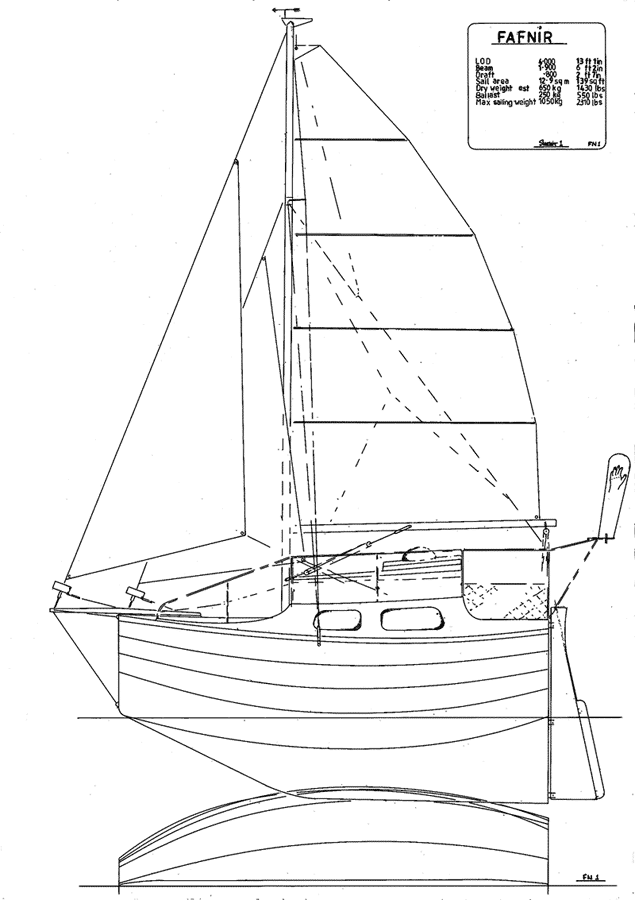
John Welsford’s interesting Fafnir design. Click on the images for larger drawings

John Welsford tells me that the level of interest in his new Fafnir pocket cruiser design is exceeding all expectations.

It’s certainly an interesting boat – a blue-water cruiser capable of being build in a typical garage, and there’s a good case for saying that it’s the best choice available for someone who wants to sail alone in a small, easily handled boat.

Its crucial dimensions are:
•Length on deck 13ft 1in (4.00m),
•Beam 6ft 2in (1.90m)
•Draft 2ft 7in (0.800m)
•Sail area 139sqft (14.9sqm)
•Dry weight estimated 1430lbs (650kg)
•Ballast 550lbs (250kg)
•Maximum sailing weight 2420lbs (1100kg)

John describes Fafnir as a tough little cruiser for one or two, and tells a story about how the design came about at his website.
It seems a customer wanted to build a 10ft boat in which to circumnavigate, so John worked out a route, the amount of current assist that was possible, the weather windows and the climatic and stores consumption issues – and decided the voyage wasn’t practical.

But he went on to draw the minimum boat he considered workable – and Fafnir is the result.

Go to John Welsford’s site to learn more!