Summer on Lake Rotoiti

Summer on Lake Rotoiti - photos from Paul Mullings - pedal powered catamaran

Summer on Lake Rotoiti - photos from Paul Mullings - pedal powered catamaran Summer on Lake Rotoiti - photos from Paul Mullings - pedal powered catamaran Summer on Lake Rotoiti - photos from Paul Mullings - pedal powered catamaran

Summer on Lake Rotoiti - photos from Paul Mullings - homebuilt Summer on Lake Rotoiti - photos from Paul Mullings - homebuilt Summer on Lake Rotoiti - photos from Paul Mullings - homebuilt

Summer on Lake Rotoiti - photos from Paul Mullings - homebuilt

I reckon Paul Mullings is out to make us winter-bound Northern Europeans envious with these shots taken in high summer down in New Zealand – which he sent in an email in which he signs off  ‘Keep warm – Paul’.

The shots of a pedal powered catamaran and an interesting home-built cruising dinghy were taken on the shores of Lake Rotoiti in the Nelson Lakes National Park at the top of the South Island and show a couple of boats that caught his interest recently. The cat looks fun, but can anyone identify the dinghy and perhaps explain how that tiller works?

We’ve had some of the most bitterly cold weather I’ve seen lately, and the only way to keep consistently warm round here is to never leave the stove. I’m tempted to do just that each morning, though other people I know are busily leaving the country…

Glued clinker John Gardner Whitehall skiff launched by BBA students

Derek Thompson LRPS - Mark Cotterill Whitehall skiff on parade

Derek Thompson LRPS - Mark Cotterill Whitehall skiff on the water Tracey Marler - Mark Cotterill Whitehall skiff Tracey Marler - Mark Cotterill Whitehall skiff waiting for launch

Chelsea Davine - Whitehall skiff with Matt Cotterill and Yvette Smith newly engaged

Photos by Derek Thompson LRPS (first two); Tracy Marler (third and fourth); and Chelsea Davine (fifth)

Boat Building Academy students Matt Cotterill and Nuh dan Per built this glued clinker epoxy ply 14ft Whitehall skiff ready for the student launch in December, reports BBA staffer Emma Brice.

Originally from the Yorkshire Pennines, Matt worked in package design and 3D branding before throwing it all in and taking up the chisel in March 2010.

Matt chose the John Gardner-designed skiff because of its general similarity to the traditional boats of the Thames – he lives in the Thames Valley.

The boat, named Nicky Nacky Noo, was made using Gaboon marine plywood, with West African mahogany plywood for the sheer strake. Matt, who I gather showed clear evidence of his designer’s eye, and great attention to detail and craftsmanship, incorporated steamed timbers and various bronze fittings.

When it came to launch day Matt certainly added a dimension of his own to the schedule: surprised onlookers cheered as he rowed out on his maiden voyage, got down on one knee and proposed to his girlfriend Yvette. She said yes, and accepted the wooden ring Matt had made himself.

A local newspaper article about the newly engaged couple appeared under the headline ‘Bride and Boom’.

I should add that Chris Partridge of Rowing for Pleasure beat me with this story weeks ago, but it’s still a very cute tale.

With the course is over, Matt is setting up his own workshop to develop wooden products, inspired by the shapes and forms of boat building and using boat building construction methods.

Nuh, Matt’s main helper on the build, is of Turkish descent but was born and grew up in Germany and is one of a number of German students who have studied at the BBA. Nuh was an IT project manager for a car manufacturer before attending the course at Lyme. He is now pursuing boat building opportunities in warmer climates and hopes to move to Greece.

PS – Photographer Derek Thompson has signed up for the next BBA 38-week course due to start in March and attended the December launch day to see what he was in for. I guess he found out…

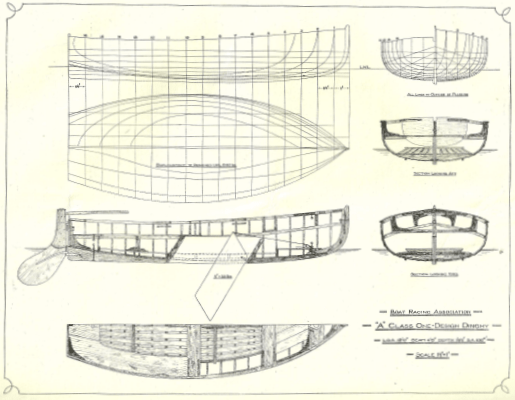
Boat Racing Association A-Class One Design Dinghy specifications and drawings

A-Class one design dinghy specification

A-Class one design dinghy specification

Brian Smith has sent in interesting scans of the specification for the delightful Boat Racing Association A-Class One Design Dinghy, which I gather is a very close relative to the International 12. I’ll let him tell the story:

‘Hi Gav,

‘I attach drawings and specifications of the BRA 12ft dinghy as published in the Yachtsman of 12 June 1913, which could be of interest to your readers as I believe they were little changed for the International 12ft dinghy class.

‘George Cockshott [the designer of the International 12] was a frequent and sometimes successful entrant in design competitions in the Yachtsman and Yachting Monthly, although it is not certain that any of those designs were ever built. The 12ft dinghy design was the result of a competition run by the BRA. Cockshott may have been inspired by the 12ft restricted class sailed at Hoylake, West Kirby and Rhyl. The design does seem to have been influenced by the class.

‘The largest yacht designed by Cockshott appears to have been the 19 tons TM Nautilus II built by R Lathom at Crossens, near Southport in 1902.

‘Hope this is of interest,

‘Brian’

Thanks Brian – it certainly is. I love all that old-fashioned specification stuff: ‘The whole of each boat, inside and out, to be varnished four coats best yacht varnish. (Or, if desired by the owner, the bottom to be painted three coats and finished with anitfouling composition or enamel externally, and to be painted three coats internally). The name or number to be written in gold leaf and shaded, on the transom or as may be required.‘

For a post on George Cockshott’s International 12 dinghy, click here.