Lyme Regis boat builder Gail McGarva receives Royal award

Here’s something you don’t see every day: a boat builder recognised by Royalty!

Lyme Regis boat builder Gail McGarva went to Buckingham Palace this week to collect an award from Princess Anne, The Princess Royal, on Tuesday this week.

Gail received a ‘highly commended’ certificate for the Prince Philip Medal, an international award honouring those who have ‘travelled the City & Guilds path’ and achieved outstanding accomplishments in their chosen field.

Following a successful career as a sign language interpreter, Gail enrolled on the Boat Building Academy’s 38-week course in 2004 wanting to change career. Funded by a City & Guilds bursary, she achieved City & Guilds levels 2 and 3 in boat building, maintenance and support, and began a long relationship with the Academy and Lyme Regis.

After working as an instructor at the BBA she moved on to become an independent boat builder, but has not moved too far – as she now works in a workshop on the academy’s site at Lyme Regis.

Gail is currently building a third racing gig for Lyme Regis Gig Club.

Stirling and Son deliver two very different 12ft rowing dinghies, and repair a hogged Tideway


Lead On (first photo) is a new pilot’s punt built for for Kindly Light, a Bristol Channel pilot cutter, was completed by Stirling and Son and delivered to her owner during March.

She was built to the owners specification’s following his extensive research into the pilot cutters‘ boats.

Here’s what Will has to say about her:

‘She is built to both tow well in a seaway and also to scull well, and has very flat floors midships to provide stability, a little hollow in the bow under the waterline so that she cleaves the water with full sections above the waterline to give her good reserve buoyancy forward. Aft, she has a shapely transom above the waterline to reduce drag to a minimum.

‘In an initial tests in Carrick Roads, when a 12-stone man stood on her gunwale only 6in of freeboard showed above the water.’

That stable shape is very clear in the photo.

The second shot above shows another new 12ft rowing dinghy that left the yard at the end of March. Destined for a lake in Sussex, this is a much finer boat for rowing on lakes and rivers, and is varnished with gold leaf scrollwork and cove line. Will remarks that it’s interesting that two 12ft rowing dinghies of similar beam can be so different.

A third 12ft dinghy – a Tideway general purpose sailing dinghy – came into the Stirlings yard for repairs recently. New sidedecks and foredeck were fitted, underwater repairs were carried out and the boat was completely refinished.

Will’s remarks about this boat include a useful little warning for owners of timber-built dinghies:

‘This Tideway had generally stood the test of time well but, like another dinghy we repaired earlier in the year, most of the damage requiring attention had been done by the trailer where she had sagged aft of the last trailer roller.

‘A good piece of money-saving advice for traditional dinghy owners who keep their boats on a trailer for long periods is to put some supporting blocks under the transom – it is better to risk causing a little extra rocker than have the boat hog.’

Thanks Will! Stirling and Son offers traditional yacht building and wooden boat repair, and is based at Tavistock, in Devon.

 

Percy Mitchell boat Tudor Owen launch photo – and the crazy story of how they used to launch boats at Portmellon

Reader Roly Deighton sent us this photo from Melbourne, Australia, thinking that it showed the Tudor Owen built by well known boat builder Percy Mitchell being launched through a gap in the sea wall at Portmellon.

Naturally I contacted current local boat builder Marcus Lewis to ask if he could add anything – and he could. Yes, he confirmed, the boat is indeed Mitchell’s Tudor Owen, and added that the boat was bound for a customer at Brixham, the date would be in the early 1950s and the boat was on a temporary slipway down to the sea.

But if you think that was elaborate, consider what Marcus had to say next.

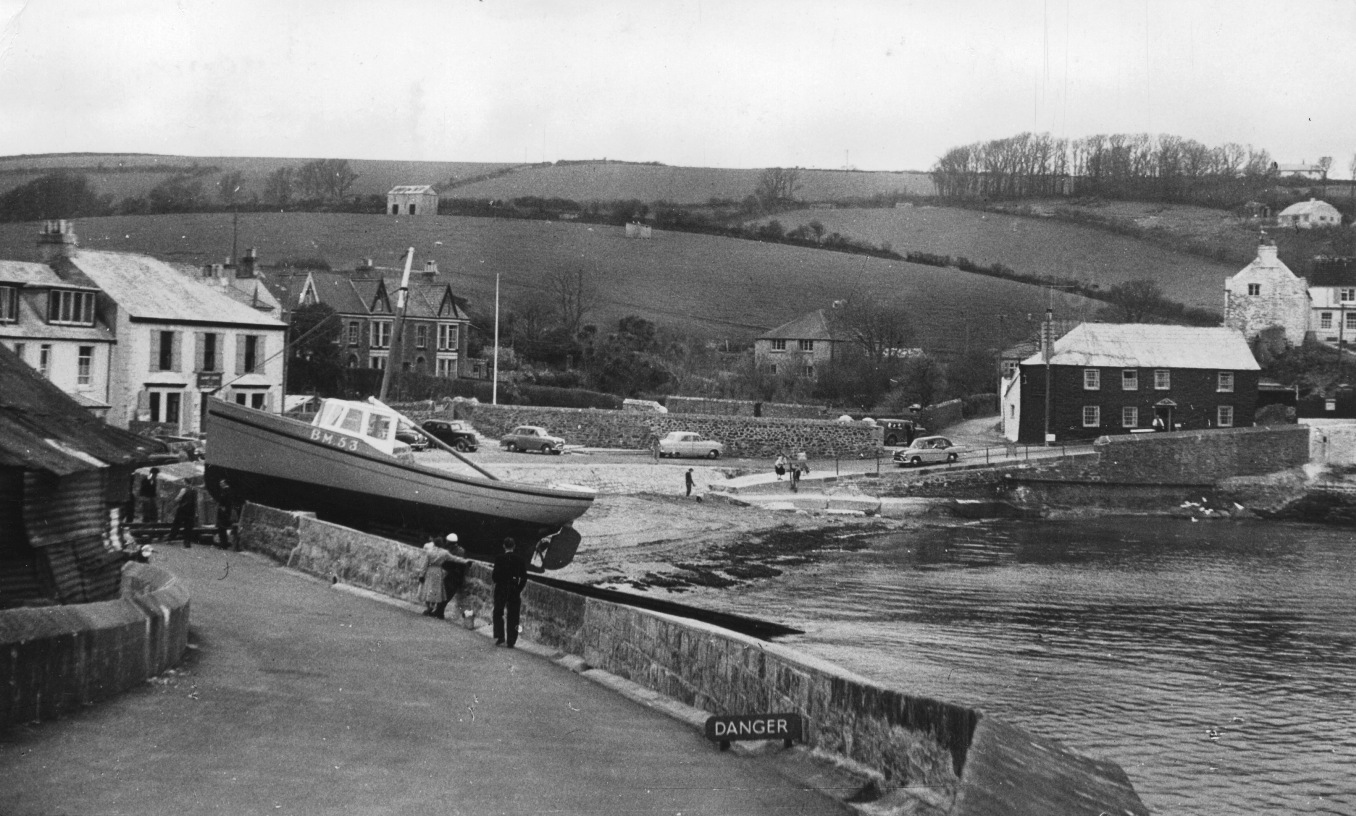
‘Prior to this, the boats had to be taken over the sea wall. This was a pretty precarious operation, during which the coast road would be completely blocked. The attached photo [see below] is a picture of the Torbay Belle balanced on top of the wall, waiting to descend the temporary slipway onto the beach.

‘Because of a problem with the lower ramp, the Belle sat like this for a day and a half while the lower ramp was levelled-up – and the road was blocked for three days. Then, at high tide her chocks were knocked out and she slid into the water without a problem.’

Could you could get insurance for something like that these days, he asks?

My thanks to both Roly and Marcus for this information.

Marcus is well known for building the local Troy class of racing keelboats, and the Fowey River class sailing dinghies. For more intheboatshed.net posts relating to Marcus and his work, click here.

PS – Roly later sent me this photo showing storm damage at Portmellon, in which the sea wall is almost all gone. There’s a quote on the village’s Wikipedia entry that leaves no doubt: ‘The true nature of this delightful little east facing cove is betrayed by the fact that all the houses along the sea front have stout wooden shutters which can be closed over their windows for those times when storms drive the waves over the sea wall.’