Gavin Atkin's weblog for the sort of people who like looking inside boat sheds. It's about old boats, traditional boats, boat building, restoration, the sea and the North Kent Coast
Category: Boatbuilders and restorers
Professional and amateur boat builders and restorers
The Fife Regatta 2013 (28th June-5th July) and the Bosham Classic Revival (6-7 July) are at different ends of the boating spectrum – but they both look great fun.
And of course the Fife Regatta has the best poster we’re likely to see this year! I gather it will shortly be on sale from the website.
The Fife Regatta is an invitation-only in which beautifully restored and maintained William Fife-designed and built sailing yachts return to their birthplace on the River Clyde to take part in a regatta. It will be a stunning sight.
Over at Bosham in Hampshire, the aim is to see as many classic dinghies and keelboats as possible racing around Chichester Harbour. It sounds damned fine to me…
Boat Building Academy students Kyle Paternoster and Rob Hounslow made a traditionally-built clinker pram dinghy to plans by Iain Oughtred and sailed it for the first time on their course’s student launch day.
The 7ft 9in dinghy made to Oughtred’s Humble Bee design is planked in sweet chestnut with a Dorset-grown oak centreline and fore and aft transoms, and green oak ribs.
Her name, Rubee, is a play on words based on Kyle’s grandmother’s name, Ruby, and Humble Bee. The red sails were made by students on a weekend sail-making workshop at the academy run by Jeremy White, managing director of Elvstrom Sails.
Kyle started work as an engineer on one of the biggest yachts in the world the week after leaving the Academy – the role is based on three-month rotations, and will allow Kyle to work as a boat builder in the months he is at home, building and selling his own boats.
He’s a qualified dinghy instructor and in his spare time plans to teach members of his family to sail in Rubee.
Rob, who worked with Kyle on the build, grew up around water on his father’s fish farm on the River Kennet. Rob had done almost every job there is around a fish farm, including making jetties and bridges and working with green oak, but he wanted to master a craft and so decided to join the Academy to learn boat building.
Rob will be using his newly acquired skills at Cockwells Modern and Classic Building at Falmouth, where he will be working alongside fellow BBA graduate Jack Livesey, who graduated in June 2012.
The BBA website has a photographic diary of Rubee’s construction.
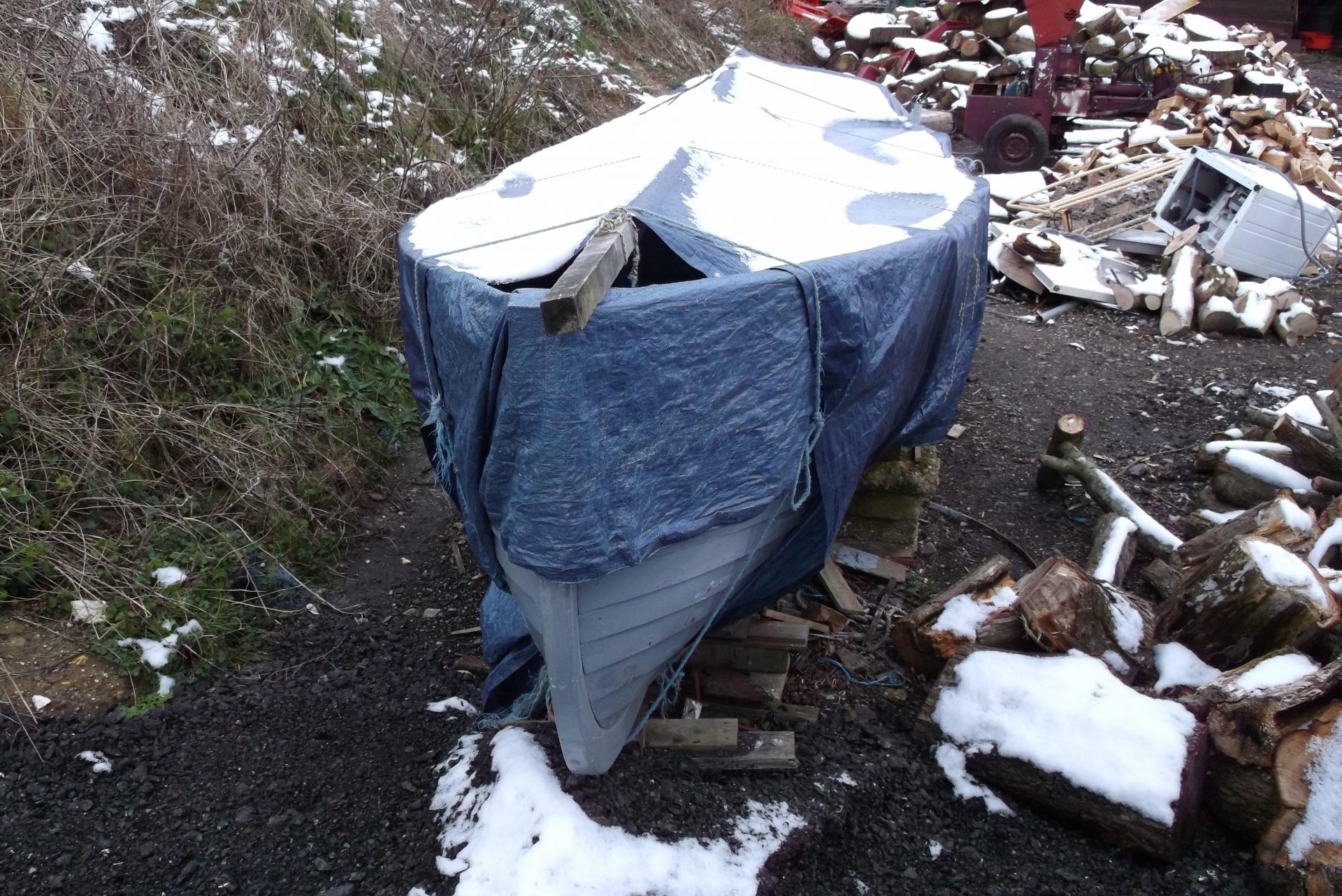
The winter’s been going on for ages now – or so it seems – and Ben Wales has been making only slow progress restoring the motor launch Mary due to the weather and his friend’s short illness.
However, he’s now back working on the boat and recently fitted a new forward gunwale. The recent photos above show the new wale in place.
Ben has posted the first of a series of YouTube videos about the restoration work on Mary.
Ben has also written a short history of his boat:
The motor launchMary
Open clinker-built motor launches had been popular since the early 1900s and were popular up to the 1950s, when they were replaced by new boat building techniques and materials.
One example was the 18ft launch Mary, believed to be built in the early 1900s. She was originally lightly constructed in mahogany on oak timbers with small forward and aft decks and may well had been designed to serve as a tender. She is believed believed to have been steam powered when constructed.
Little is known about who had the launch built and where it was first used, however it is now believed to arrived on Lymington River some time in the early 1930s when purchased by Tom Clease, a Lymington engineer. It was commandeered by the Admiralty in 1939 and is believed to be used in the area throughout World War II.
In 1947 the launch was sold to Harry Goodhart of Lymington. Harry renamed her Mary, after his wife.
The Goodharts moored and used Mary on the river for many years and were active members of the Royal Lymington Yacht Club, where Harry was appointed rear assistance commodore at the club in the 1950s.
Around the late 1940s a new Stuart Turner 8hp engine was fitted, together with new decking.
During the 1950s and 1960s the launch was used by the RLYC as a standby, and for ferrying boat crews across the Solent to Yarmouth.
The Goodhart family sold the Mary in the late 1960s to another Lymington owner, Joe Sanders of Sanders Sails and she was then moored further up the river. In the 1970s she came into the hands of Reg Toms, who used her for fishing and potting in the Western Solent area. Around this timem the Stuart Turner engine was rebuilt and she was given new steering gear.
By the late 1970s she was sold to John Bird, who moved her to Oxey Lake to the west of Lymington River, and around 1982 it was sold to Norman Rickman, who had a new propeller shaft fitted and re-planked the hull in Honduras mahogany planking, and fitted a new 6hp Petter diesel engine.
Around 1987, the Mary sank while on her winter berth, and after some repairs the owner moved her to dry storage at a farm at Pennington for the winter. As time went by, no further work had been done and the Mary was left to deteriate.
After some searching I tracked down her location and the owner in 2007 – by this time the owner had no further interest in the boat and I acquired Mary – and a major restoration project had begun!
After some planning and waiting for the ideal weather conditions to move the boat, a road trailer was hired and on 29th May 2010 the launch moved to Marchwood Slipways (formerly Husband’s Shipyard) for a few months and the work started.
The first task was the cleaning down the old pealing paint on the topsides and hull and bilges, followed by removing the top and middle stem pieces and making a template for a new oak stem.
The transom on the stern end, the top part was found rotten and was removed and a new mahogany upper transom was fitted.
September 2010, the launch was moved back to Pennington at Solent View Farm, were the major work would began. During September and October a new oak stem was made and fitted and a new apron was made.
Over the winter months for 2010/2011 some minor work was carried out on the launch while we waited for improved weather conditions. In May 2011, the first batch of cut khaya mahogany timber (for the topside plankin) was purchased from Robbins Timber.
Through out the summer and autumn of 2011, each plank had to carefully removed and used as a template for each new plank we cut out and fitted.
The year 2012 saw slow progress, mainly due to the poor weather conditions as we are still working outdoors, however all 40 timbers were replaced with New Forest oak and in 2013 we have started work fitting new gunwales and rubbing strakes.
It is hoped that the launch will be ready to be floated by the late spring 2013, and that after almost 30 years ashore she will once again be seen on the Solent.