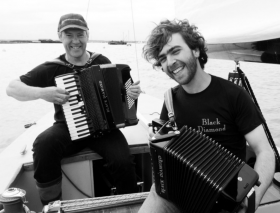


Greg Dunn and his crew are to celebrate the 50th year of their Jack Holt-designed plywood racer Black Diamond by entering her in the Round the Island Race, raising sponsorship money for the RNLI as they go round (see their Just Giving page), and playing accordions at every possible opportunity.
Black Diamond is a Yachting World Diamond class racing yacht designed by Jack Holt in response to a brief from Yachting World to draw a 30ft keelboat, capable of being home-built.
Like the earlier Mirror dinghy also designed by Holt (with TV handyman Barry Bucknell), the stitch and glue YW Diamond was a deliberate attempt to open up the elitist world of yacht racing to the working man. The YW Diamond was also unusual for its time in that it is a planing keelboat – in that way it was in line with Uffa Fox’s Flying series of designs, including the Flying 15, Flying 30 and Flying 50.
But what about the accordions? Last year, Greg and partner Juliet Doyle founded a company marketing Chinese-made accordions and melodeons fitted with distinctive-sounding Italian reeds – and named it Black Diamond Accordions after Greg’s boat.
So we’re told to expect lots of accordion action before, after and possibly during the race from Greg himself and also from crew member James Delarre, a member of the popular folk-scene band Mawkin.
Greg says Black Diamond has survived until 2012 owing to a restoration that encapsulated the hull in epoxy resin, and will hopefully remain viable for the next 50 years.
Here’s what Greg has to say about Black Diamond:
‘In some ways, she is a Volkswagen, in that her design brief was a deliberate attempt to reduce the elitist image of keelboat racing in what was still the post-war epoch, although I’m sure the ‘you’ve never had it so good’ economy was starting to kick in.
‘Put simply, Yachting World recognised Holt’s use of stitch-and-glue plywood in the Mirror as having potential for a keelboats, and he was engaged to draw a lightweight keelboat capable of being home-built, that would give exciting performance on a modest budget.
‘What he created was the mother of all sportsboats. It does take the best part of a gale to make the hull plane, though, and never wanting to push my old Diamond that hard, I generally suffer by carrying the class yardstick, which definitely assumes planing conditions!
‘The keelboat Holt drew was basically a very large Mirror, but with the sheer line brought up to a bow rather than the pram we see in the dinghy. He also carried the lines including the hard chine that helps in planing well aft, also.
‘He also used the Nordic device of bringing the forestay down well aft of the bow, giving the boat a distinctive skerries-cruiser look.
‘The boats were originally called the YW Keelboat, but changed to the YW Diamond in 1967 to the Diamond. Boat number 1 was Zest, which I have recently seen in a shed in southern Holland, totally original and stripped back to the ply for repainting.
‘Black Diamond was professionally built (rather than home-built built) in 1962 and this is possibly the reason she’s still afloat, and was restored by a chap called Bob Rule in Portsmouth during the 90s. He encapsulated her in epoxy, and did a good job – I have only had to do a small section of repair under the port chainplates, after a hard winter in the open.
‘There is more of the story at the Bursledon Blogger weblog, more information about YW Diamonds in Australia here, and a very lively video of an Aussie Diamond sailing in 30-plus knots of wind here.
‘I have seen several adapted Diamonds, but the one that takes the biscuit is Saltash II in Brisbane, still a plywood hull, but sheathed, cabined and fenced, with a deep spade rudder, two foot aft of the rudder shown in the plans, a deep bulb keel and faired underwater section, a sugarscoop transom, narrow rigging and 6 feet extra on the mast. She holds the record for the Brisbane Hamilton race, 309 nautical miles in 31 hours!
‘There are many hybrids, as most Diamonds have been fiddled with at some time or other, including mine. The design had great qualities, but back in 1960, underwater dynamics were not then a fully explored science, and the keel and rudder are, quite frankly, disaster areas! I am planning to take the back edge down to a point next winter.
‘I did pay a small fortune to have a carbon fibre rudder designed and moved three foot aft, and this turned her into the last boat in the fleet to drop her spinny – the control we now have is utterly amazing! I’m not claiming to have had the idea: I went to Australia to research the Diamond, where they still race them as a class, with two guys on trapezes, and that was where I discovered Saltash II.’
In fact, the story of Black Diamond, Greg and the accordion business is one for the ‘small world’ file. I remember reading about the boat from Max the Bursledon Blogger’s website some years ago, and I knew Greg from his stand at music festivals and events such as Melodeons & More (some readers may spot someone familiar here). What I didn’t know was that there was a connection. How could I have guessed?



